A few years ago, I was running a small online store selling handmade candles. I had good traffic, but sales were barely trickling in. People would visit, browse my lavender-scented soy candles, add them to their carts, and then… nothing. They just vanished.
I felt frustrated. I knew these people were interested—they had spent time on my site, clicked around, and even filled their carts. But they left without buying. I didn’t know how to bring them back.
Then I heard about remarketing and retargeting. Honestly, I thought they were the same thing. I used the words interchangeably. But when I finally understood the real difference, everything changed. I started bringing people back, and my sales slowly climbed.
If you have ever felt that same confusion—wondering why visitors leave and how to get them back—you are not alone. Many people mix up these two terms. Some marketers even use them as synonyms. But they are not the same. And choosing the wrong one can waste your time and money.
This guide explains everything in simple English with practical examples so you can clearly understand the real difference.
What Is Retargeting?
Retargeting is a paid advertising strategy. It shows ads to people who have already visited your website or app but did not take action—like making a purchase, signing up, or filling a form.
Think of it like this: someone walks into your store, looks around, picks up a product, and then leaves without buying. Retargeting is like following them outside and showing them a billboard of that exact product as they walk down the street.
How Retargeting Works
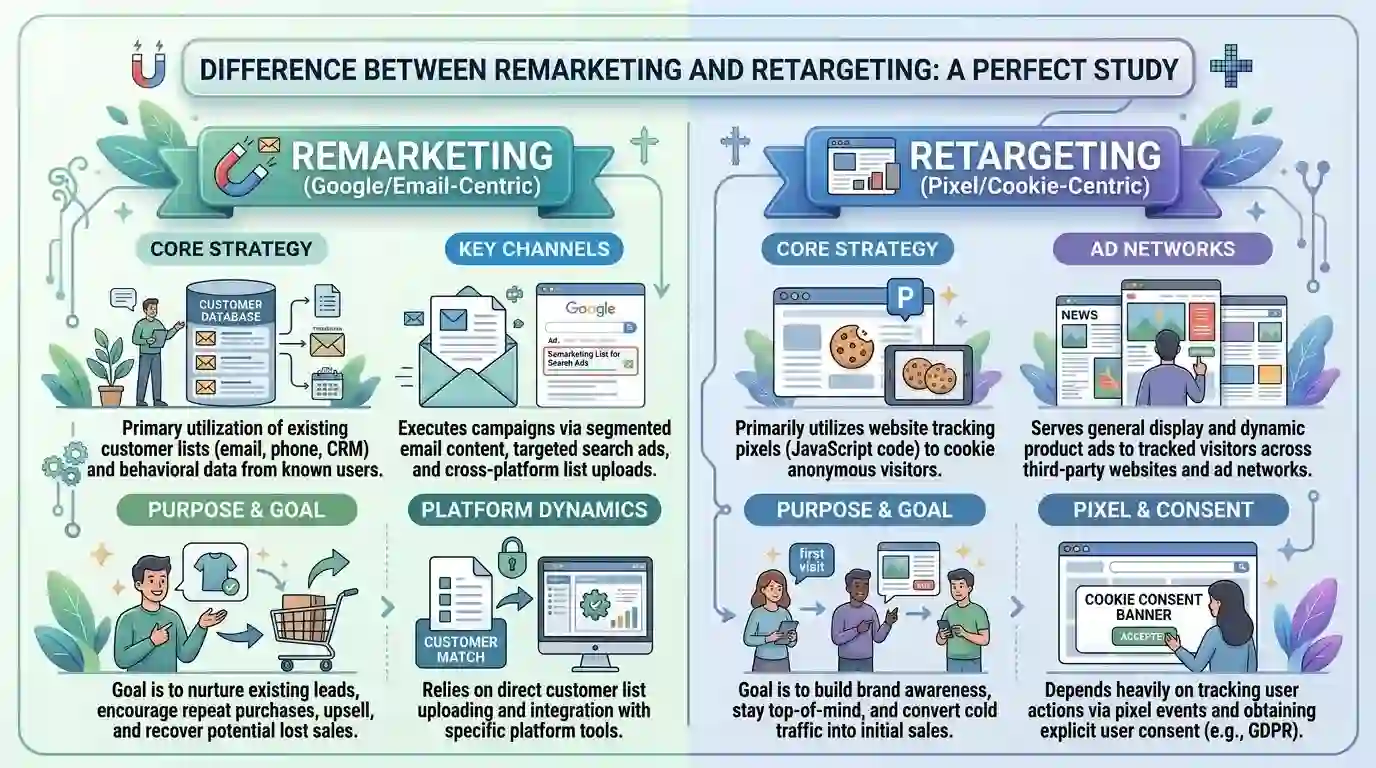
Retargeting uses small pieces of code called pixels or cookies. When someone visits your site, a cookie drops into their browser. As they browse other websites or scroll through social media, that cookie tells ad platforms to show them your ads.
You do not need the person’s email address or any personal information. Retargeting works with anonymous visitors.
Common Retargeting Channels
Display ads – banner ads shown on websites across the Google Display Network
Social media ads – ads on Facebook, Instagram, LinkedIn, or TikTok
Video ads – pre-roll ads on YouTube
Search retargeting – paid search ads with adjusted bids for past visitors
Real-World Retargeting Example
Imagine you are shopping for a new pair of running shoes. You visit a sports store website, look at a few models, and leave without buying. Later that day, while scrolling through Instagram, you see an ad for the exact same shoes you were looking at. That is retargeting in action.
Retargeting is effective because it reaches people who already know your brand. They are warmer leads than cold traffic, so they are more likely to convert. In fact, retargeting campaigns can be up to 10 times more effective than standard advertising.
What Is Remarketing?
Remarketing is a strategy that re-engages people who have already given you their contact information—like email subscribers, past customers, or leads in your database.
Unlike retargeting, remarketing does not rely on ads. It uses direct communication channels like email, SMS, push notifications, or even messenger apps.
Think of remarketing as sending a friendly reminder to someone who already knows you. They have shopped with you before, signed up for your newsletter, or downloaded your free guide. You are not chasing strangers. You are reconnecting with people who have already shown trust in your brand.
How Remarketing Works
Remarketing uses data you already own—your email list, customer relationship management (CRM) system, or past purchase history. You send personalized messages based on what you know about that person.
For example, if someone bought a coffee maker from you six months ago, you might send them an email suggesting coffee beans or a descaling kit. You are not guessing what they like. You already know.
Common Remarketing Channels
Email remarketing – abandoned cart emails, welcome sequences, win-back campaigns
SMS remarketing – text messages with reminders or special offers
Push notifications – browser or app notifications like “Your cart is still waiting”
Messenger remarketing – using WhatsApp, Telegram, or Facebook Messenger to follow up
CRM-based remarketing – using your existing contact lists to deliver personalized ads or messages
Real-World Remarketing Example
You sign up for a meal delivery service and order a few times. Then you stop. A few weeks later, you receive an email saying, “We miss you! Here is 20% off your next order.” That is remarketing.
Remarketing is cost-effective because you are using channels you already own. You do not have to pay for ad space every time you reach out. Studies show that 45% of abandoned cart emails are opened, and remarketing can bring 26% of users back to a website.
Quick Comparison Table
| Feature | Retargeting | Remarketing |
|---|---|---|
| Meaning | Showing ads to past website visitors | Sending messages to known contacts |
| Audience | Anonymous visitors who did not convert | Existing customers, subscribers, or leads |
| Channel | Paid ads (display, social, video) | Email, SMS, push notifications |
| Data Used | Cookies and pixels | Email lists, CRM data, purchase history |
| Cost | Pay-per-click or per-impression | Mostly free or low-cost (owned channels) |
| Personalization | Based on pages viewed or products browsed | Based on past purchases, preferences, or profile |
| Goal | Bring back lost visitors and convert them | Build loyalty, encourage repeat purchases, and reactivate inactive users |
| Best For | Recovering abandoned carts and brand awareness | Nurturing existing relationships, upselling, and win-back campaigns |
| Example | An ad for a product you viewed appears on another site | An email offers a discount on your recent purchase |
Biggest Difference
The core practical difference is simple:
Retargeting reaches anonymous visitors through paid ads. Remarketing reaches known contacts through direct messages.
Retargeting is about casting a wider net to catch people who showed interest but slipped away. Remarketing is about deepening relationships with people who already know you.
This matters more than many beginners realize. If you spend all your budget on retargeting ads but ignore remarketing, you might keep chasing new visitors while neglecting your existing customers—who are often your most valuable audience. On the other hand, if you only do remarketing, you might miss out on bringing back people who never gave you their email in the first place.
The smartest approach? Use both. They work better together than apart.
Key Differences Explained
- Audience Type
Retargeting targets people who visited your site but did not convert. These are anonymous visitors. You do not know their names, emails, or anything personal about them.
Remarketing targets people who have already shared their contact information with you. These are known contacts—past customers, email subscribers, or leads in your database.
Why this matters: Anonymous visitors are colder leads. They need more convincing. Known contacts already trust you. They are easier to convert again.
- Channel Used
Retargeting uses paid advertising channels. Your ads appear on other websites, social media platforms, or search results. You pay every time someone sees or clicks your ad.
Remarketing uses owned channels like email, SMS, or push notifications. You do not pay per message. You already have the person’s permission to contact them.
Why this matters: Retargeting costs money every time. Remarketing is nearly free once you have built your list. Over the long term, remarketing can be much more cost-effective.
- Data Source
Retargeting relies on cookies and tracking pixels placed in a visitor’s browser. These cookies follow the user across the web and trigger ads based on their behavior.
Remarketing relies on first-party data—information you already own. This includes email addresses, phone numbers, purchase history, and browsing behavior tied to a known profile.
Why this matters: Retargeting depends on cookies, which are becoming less reliable as browsers phase them out. Remarketing uses data you control, making it more future-proof.
- Personalization Level
Retargeting personalizes ads based on what pages a user viewed or what products they added to their cart. For example, if someone looked at red sneakers, they see ads for red sneakers.
Remarketing personalizes messages based on the user’s full profile—past purchases, preferences, subscription status, and more. You can send highly tailored recommendations.
Why this matters: Remarketing allows deeper personalization because you know more about the person. A personalized email can feel like a conversation, not just an ad.
- Cost Structure
Retargeting is a paid strategy. You pay for ad impressions, clicks, or conversions. Costs can add up quickly, especially in competitive industries.
Remarketing is mostly free or low-cost. Sending an email costs almost nothing. You only pay for your email marketing platform or SMS service.
Why this matters: If you have a tight budget, remarketing gives you more bang for your buck. You can reach people without spending on ads every time.
- Goal and Intent
Retargeting aims to convert first-time visitors into customers. The primary goal is acquisition—getting someone to buy for the first time.
Remarketing aims to retain and nurture existing customers. The goal is loyalty, repeat purchases, and reactivation.
Why this matters: Your goal determines which strategy to use. If you want new customers, focus on retargeting. If you want repeat business, focus on remarketing.
- Frequency and Aggressiveness
Retargeting ads are often shown multiple times a day. The goal is to stay top-of-mind and push the user to return quickly.
Remarketing messages are typically less aggressive. You send emails at a reasonable frequency—maybe once a week or after specific triggers like cart abandonment.
Why this matters: Too many retargeting ads can annoy people. Too few remarketing emails can make you forgettable. Finding the right balance is key.
- Permission and Privacy
Retargeting does not require explicit permission. Cookies track users automatically unless they have blocked them.
Remarketing requires permission. People must opt in to your email list or share their contact information with you.
Why this matters: Privacy regulations like GDPR and CCPA are making retargeting harder. Remarketing operates with consent, making it more compliant and trustworthy.
- Measurement Metrics
Retargeting measures clicks, impressions, click-through rates (CTR), and conversions.
Remarketing measures email open rates, click-throughs, replies, and conversion rates from email campaigns.
Why this matters: Different metrics tell different stories. Retargeting shows how many people saw your ad. Remarketing shows how many people engaged with your message.
- Long-Term Value
Retargeting provides short-term wins. It brings back visitors who were about to buy but got distracted. It does not build lasting relationships.
Remarketing builds long-term customer value. It keeps your brand top-of-mind, encourages repeat purchases, and turns one-time buyers into loyal fans.
Why this matters: Over the long term, remarketing often delivers more sustainable growth. A loyal customer buys again and again. A retargeted visitor might buy once and never return.
- When Each Strategy Shines
Retargeting works best for:
Recovering abandoned carts
Building brand awareness with new visitors
Promoting time-sensitive offers
Reaching people who never gave you their email
Remarketing works best for:
Nurturing existing customer relationships
Upselling and cross-selling
Reactivating lapsed customers
Building loyalty and trust over time
Similarities Between Remarketing and Retargeting
Despite their differences, remarketing and retargeting share some important similarities:
Both aim to bring people back. Whether through ads or emails, both strategies exist to re-engage people who have already shown interest in your brand.
Both target warm audiences. Neither strategy reaches cold traffic. Both focus on people who already know your business in some way.
Both improve conversion rates. People who have visited your site before are more likely to convert than complete strangers. Both strategies capitalize on that.
Both can be used together. Many businesses combine retargeting and remarketing into a single strategy. For example, you might send a remarketing email and follow up with a retargeting ad for extra reinforcement.
Both rely on data. Retargeting uses behavioral data from cookies. Remarketing uses profile data from your CRM. Both depend on understanding what your audience has done.
Pros and Cons
Pros of Retargeting
High conversion potential – Targets people who already showed interest
Wide reach – Can reach millions of people across the web and social media
Quick results – Ads can start showing within hours of a site visit
No email list needed – Works with anonymous visitors
Highly targeted – Ads can be tailored to specific pages or products viewed
Cons of Retargeting
Can be expensive – You pay for every impression or click
Privacy concerns – Relies on cookies, which are being phased out
Ad fatigue – Seeing the same ad too often can annoy users
Requires ongoing budget – Ads stop when you stop paying
Less personal – Ads feel generic compared to personalized emails
Pros of Remarketing
Low cost – Email and SMS are cheap or free to send
Highly personalized – Messages can be tailored to each person’s history
Builds loyalty – Nurtures long-term relationships
Owned data – You control your email list and customer data
Higher engagement – People who opted in are more likely to open and click
Cons of Remarketing
Requires permission – You need people to opt in first
Slower to build – It takes time to grow an email list
Lower reach – Only reaches people who have shared their contact info
Can feel intrusive – Too many emails can lead to unsubscribes
Less immediate – Email campaigns take time to plan and execute
Which Is Better for Different Situations?
For Beginners
Start with retargeting. It is easier to set up. You can run a simple retargeting campaign on Google or Facebook within an hour. You do not need an email list or any existing contacts. Just install a pixel and start showing ads.
For Small Budgets
Lean toward remarketing. Sending emails costs almost nothing. You can reach hundreds of people for the price of a few ad clicks. If money is tight, remarketing gives you more value for your spend.
For E-Commerce Stores
Use both. Retargeting recovers abandoned carts. Remarketing sends follow-up emails to people who left items behind. Together, they can dramatically increase your conversion rate.
For Service-Based Businesses
Focus on remarketing. Service businesses often rely on trust and relationships. Email nurturing works better than ads for building long-term client relationships.
For Brand Awareness
Prioritize retargeting. Showing ads across the web keeps your brand in front of potential customers. It builds recognition and trust over time.
For Customer Retention
Invest in remarketing. Keeping existing customers is cheaper than finding new ones. Remarketing emails keep your brand top-of-mind and encourage repeat business.
For Time-Sensitive Offers
Use retargeting. If you have a flash sale or limited-time discount, retargeting ads can drive immediate traffic and urgency.
For Long-Term Growth
Build a remarketing strategy. Over time, your email list becomes one of your most valuable assets. Remarketing nurtures relationships that pay off for years.
Common Mistakes People Make
- Using the Terms Interchangeably
Many people assume remarketing and retargeting mean the same thing. They do not. Using them interchangeably leads to confusion and poor strategy choices.
- Ignoring Existing Customers
Some businesses pour all their budget into retargeting ads while neglecting their email list. Existing customers are often easier to convert than new visitors. Do not forget them.
- Over-Retargeting
Showing the same ad too many times can annoy potential customers. People get tired of seeing the same product over and over. Set frequency caps to avoid ad fatigue.
- Sending Too Many Emails
Remarketing emails can also become annoying if you send too many. People unsubscribe when they feel overwhelmed. Space out your messages and only send relevant content.
- Not Personalizing Enough
Generic messages do not work well. Both retargeting ads and remarketing emails perform better when they are personalized. Show people what they actually looked at or bought.
- Ignoring Privacy Regulations
Retargeting relies on cookies, which are becoming restricted. Remarketing requires consent. Make sure your strategies comply with privacy laws like GDPR and CCPA.
- Not Testing and Optimizing
Many people set up a campaign and forget it. Both retargeting and remarketing need ongoing testing. Try different ads, subject lines, offers, and timing to see what works best.
Expert Recommendation
Choose Retargeting If:
You have a website with decent traffic
You want to recover abandoned carts
You are running a time-sensitive promotion
You do not have an email list yet
You want to build brand awareness quickly
Choose Remarketing If:
You already have an email list or customer database
You want to nurture long-term relationships
You have a limited budget
You sell products or services that require repeat purchases
You want to upsell or cross-sell to existing customers
Avoid Retargeting If:
You have a very small budget
Your website traffic is low
You sell products with a long purchase cycle
Privacy concerns are a major issue for your audience
Avoid Remarketing If:
You do not have permission to contact your audience
You do not have an email list or CRM
Your business relies on one-time purchases
You lack the time or resources to create email campaigns
Final Verdict
The real difference between remarketing and retargeting comes down to one thing: how you reach people and who you are reaching.
Retargeting is about casting a wide net with paid ads to catch anonymous visitors who slipped away. It is fast, effective, and great for short-term wins. But it costs money every time, and it depends on cookies that are becoming less reliable.
Remarketing is about nurturing relationships with people who already know you. It uses email, SMS, and other direct channels to build loyalty and encourage repeat business. It costs less over time and builds lasting value. But it takes longer to set up and requires permission.
Here is the honest truth: most businesses need both.
If you only retarget, you might keep chasing new visitors while neglecting your best customers. If you only remarket, you might miss out on bringing back people who never gave you their email.
The smartest approach is to use retargeting to bring people in and remarketing to keep them coming back. Together, they create a full-funnel strategy that turns curious visitors into loyal customers.
After using both for some time, I can tell you this: remarketing saved me money and built real relationships. Retargeting brought in quick sales when I needed them. Together, they transformed my small candle business.
Start with whichever one fits your current situation. But do not stop there. Build both over time, and you will see the difference.
FAQ
- Which is better, remarketing or retargeting?
Neither is universally better. Retargeting works well for bringing back anonymous visitors through paid ads. Remarketing excels at nurturing existing customers through email and SMS. The best approach depends on your goals, budget, and audience. Many businesses use both for maximum impact.
- Is remarketing the same as retargeting?
No, they are different. Retargeting uses paid ads to reach anonymous website visitors who did not convert. Remarketing uses direct messages like email or SMS to re-engage known contacts such as past customers or subscribers.
- Which is cheaper, remarketing or retargeting?
Remarketing is generally cheaper. Sending emails or SMS messages costs very little compared to paying for ad impressions or clicks. Retargeting ads require ongoing ad spend, which can add up quickly, especially in competitive industries.
- Which is easier for beginners?
Retargeting is usually easier to set up initially. You can install a pixel on your website and start running ads on Google or Facebook within hours. Remarketing requires building an email list or having customer data, which takes more time.
- Can I use remarketing and retargeting together?
Absolutely. In fact, using them together is often the most effective strategy. You can retarget visitors with ads and also send them remarketing emails. This multi-channel approach reinforces your brand and increases the chances of conversion.
- Which one converts better?
Both can convert well, but they serve different purposes. Retargeting often converts first-time visitors into customers. Remarketing tends to convert existing customers into repeat buyers. Studies show retargeting can be up to 10 times more effective than standard ads, while remarketing can increase conversion rates by up to 161%.
- What mistakes should beginners avoid?
Common mistakes include using the terms interchangeably, ignoring existing customers, showing too many ads or sending too many emails, not personalizing messages, and failing to test and optimize campaigns. Also, be aware of privacy regulations that affect both strategies.
- Are they interchangeable in Google Ads?
Google Ads uses the term “remarketing” as a catch-all for both strategies, which adds to the confusion. In practice, Google’s remarketing includes both ad-based retargeting and email-based remarketing. Understanding the difference helps you use each tool more effectively.
Conclusion
Remarketing and retargeting are two powerful ways to bring people back to your business. Retargeting uses paid ads to reach anonymous visitors who left your site without buying. Remarketing uses email, SMS, and other direct messages to reconnect with people who already know you. Both have their strengths. Retargeting works fast and reaches a wide audience. Remarketing builds lasting relationships and costs less over time. The best strategy is not choosing one over the other—it is using both together. Start with whatever fits your current situation. If you have traffic but no email list, begin with retargeting. If you already have customers, invest in remarketing. Over time, build both into your marketing plan. This way, you will not only bring new people in but also keep them coming back again and again.

Hi! I am Arshad Ullah presently working as linguist in Punjab Education Department. I have done MA in English Literature while M.Phil in Applied Linguistics. I have taught creative writing to the post graduation classes for 15 years. Presently I am working as content writer, and offering classes for blog writing. On this site, I research each topic from authoritative sources and edit every comparison for accuracy and clear, simple language.