A few years ago, I found myself standing outside two different churches on the same Sunday morning. One was a Lutheran church. The other was a Methodist church. I had no idea which one to walk into.
I knew both were Christian. I knew both were Protestant. But beyond that, I was lost. Did they believe the same things? Did they worship the same way? Would I feel out of place in one versus the other?
Many people face this same confusion. Maybe you’re looking for a new church home. Maybe you’re just curious about what your friends or neighbors believe. Or maybe you’re exploring Christianity for the first time and trying to understand all the different names.
The truth is, Lutherans and Methodists share a lot in common. They both trust Jesus. They both read the Bible. They both sing hymns and pray. But beneath the surface, there are real differences that affect everything from how they understand salvation to what happens during Sunday worship.
Choosing between them isn’t about which one is “right.” It’s about which one fits your understanding of faith, your personality, and what you’re looking for in a spiritual community.
This guide explains everything in simple English with practical examples so you can clearly understand the real difference.
What Is a Lutheran?
Lutherans are followers of the teachings of Martin Luther, a German monk who lived in the 1500s. Luther was deeply troubled by some practices he saw in the Roman Catholic Church. He believed the church had moved away from the Bible’s core message.
In 1517, Luther wrote something called the 95 Theses. Think of it like a list of complaints pinned to a church door. He wanted to start a conversation about reform. Instead, it started a movement that became the Protestant Reformation.
Lutherans are considered the first Protestants. Their tradition is older than Methodism by about 200 years.
At the heart of Lutheran belief is a simple but powerful idea: we are saved by grace alone, through faith alone, because of Christ alone. This means nothing you do earns your salvation. It’s a free gift from God. You simply receive it by trusting Jesus.
Lutherans also believe the Bible is the sole source for Christian teaching. They don’t rely on tradition, personal feelings, or human reasoning to determine what’s true. Scripture stands on its own.
Today, Lutherans are found all over the world. There are different Lutheran groups, like the Evangelical Lutheran Church in America (ELCA) and the Lutheran Church-Missouri Synod (LCMS). They share the same basic beliefs but differ on some details.
What Is a Methodist?
Methodists trace their roots to the 1700s in England. Two brothers, John and Charles Wesley, started a movement within the Church of England. They were called “Methodists” because they were so methodical about their faith. They prayed regularly, studied the Bible, and held each other accountable.
The Wesley brothers wanted to breathe new life into the church. They emphasized something called “Scriptural holiness” — living a life that reflects God’s love in practical, everyday ways.
Methodism eventually became its own denomination. Today, the United Methodist Church is one of the largest Protestant groups in the United States.
Methodists believe in grace, just like Lutherans. But they describe grace in three stages:
- Prevenient grace — God’s love that works in your life before you even know God.
- Justifying grace — God’s forgiveness that makes you right with him.
- Sanctifying grace — God’s work in you that helps you grow more loving and holy over time.
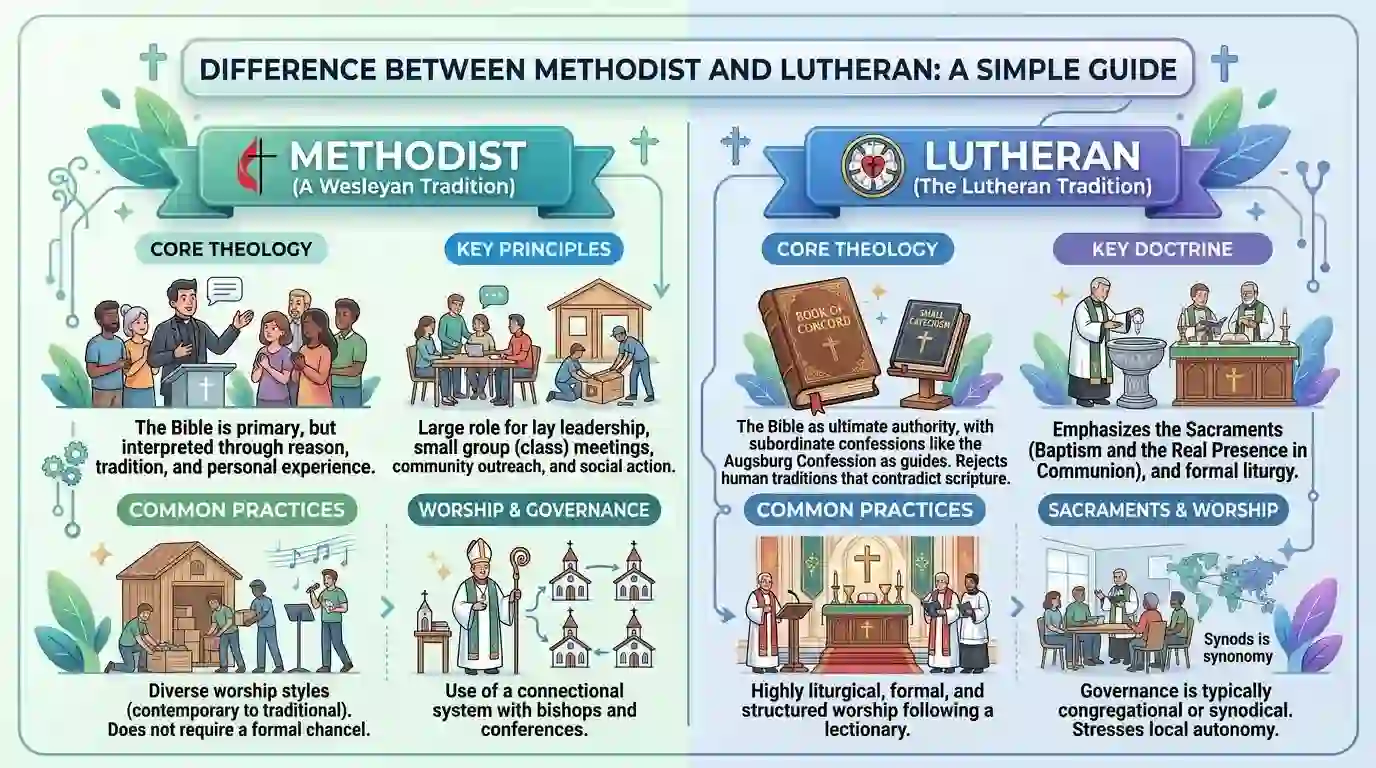
Methodists see the Bible as the primary source for Christian teaching, but they also value tradition, reason, and personal experience. They believe these things help us understand Scripture better.
Methodists are known for their emphasis on social justice. They run hospitals, schools, and charities around the world. For Methodists, faith isn’t just something you believe — it’s something you do.
Quick Comparison Table
| Aspect | Lutheran | Methodist |
| Origin | Germany, 1500s (Martin Luther) | England, 1700s (John & Charles Wesley) |
| Bible Authority | Sole source of doctrine (sola scriptura) | Primary source, plus tradition, reason, experience |
| Salvation Focus | Justification — what God did for us | Sanctification — what God does in us |
| Free Will | Humans are spiritually dead; God does everything | Humans can respond to God’s grace |
| Christian Perfection | Impossible in this life; we remain sinner and saint | Possible through God’s grace |
| Baptism | Act of God; infants receive grace | Act of God; infants receive grace |
| Communion (Lord’s Supper) | Christ is truly present (sacramental union) | Christ is spiritually present |
| Church Governance | Varies (episcopal, congregational, synodical) | Connectional with bishops |
| Worship Style | More liturgical, formal, like Catholic Mass | Generally simpler, more flexible |
| Alcohol | Wine used in communion | Traditionally grape juice (no alcohol) |
| Social Action | Important but secondary to gospel | Central to faith expression |
Biggest Difference
The biggest difference between Lutherans and Methodists comes down to one question: What is salvation all about?
For Lutherans, salvation is about what God has done for us. Jesus died on the cross. He paid for our sins. He gives us forgiveness and eternal life as a free gift. Our job is simply to trust him. That’s it.
For Methodists, salvation is about what God does in us. Yes, Jesus saves us. But that’s just the beginning. God then works in our lives to make us more loving, more holy, more like Jesus. And we cooperate with that process.
This might sound like a small difference. But it affects everything.
Imagine you’re drowning in the ocean. Someone throws you a life preserver. You grab it. You’re saved.
The Lutheran says: “I didn’t do anything to save myself. I just grabbed the rope. All the credit goes to the rescuer.”
The Methodist says: “Yes, the rescuer saved me. But now I need to learn how to swim. I need to grow stronger. I need to become the kind of person who can help others too.”
Both are grateful for the rescue. But they think about what comes next very differently.
Key Differences Explained
1. How They Understand Salvation
Lutherans put their primary focus on justification. This is the moment God declares you “not guilty” because of Jesus. It’s a legal decision. God looks at you and sees Christ’s righteousness instead of your sin.
Lutherans believe this happens outside of you. It’s God’s action. You don’t contribute anything. You just receive it by faith.
Methodists focus on sanctification. This is the lifelong process of becoming more like Christ. Justification is the starting line. Sanctification is the race.
Methodists believe you play a role in this. You cooperate with God’s grace. You make choices. You grow. You can even reach a state of “Christian perfection” — not sinless perfection, but a heart fully devoted to God.
Real-world impact: A Lutheran might say, “I’m a sinner saved by grace.” A Methodist might say, “I’m being saved by grace, and I’m growing every day.”
2. Free Will and Human Nature
Lutherans teach that human beings are spiritually dead before God saves them. They can’t choose God on their own. They don’t even want to choose God. Salvation is entirely God’s work. Humans play no part in their own conversion.
Methodists teach that God gives prevenient grace to everyone. This grace awakens your desire for God. It gives you the ability to respond. You can say yes or no to God’s offer. Your choice matters.
Real-world impact: A Lutheran might say, “God chose me.” A Methodist might say, “I chose to follow God, and God helped me make that choice.”
3. Authority: Bible Alone vs. Bible Plus
Lutherans believe the Bible is the sole source for Christian teaching. Tradition is helpful. Reason is useful. Experience is meaningful. But none of these can add to Scripture or correct Scripture. The Bible stands alone and self-authenticating.
Methodists believe the Bible is the primary source, but tradition, reason, and experience also matter. John Wesley called this the “Wesleyan Quadrilateral.” Scripture is the foundation, but these other tools help us interpret it correctly.
Real-world impact: When faced with a tough question, a Lutheran asks, “What does the Bible say?” A Methodist asks, “What does the Bible say, what has the church always taught, what does reason tell me, and what does my experience reveal?”
4. Christian Perfection
Lutherans teach that every Christian is both sinner and saint at the same time. You’re forgiven, but you’re still imperfect. You’ll struggle with sin your whole life. Perfection only comes in heaven.
Methodists teach that you can experience entire sanctification in this life. This doesn’t mean you never sin. It means your heart is completely devoted to God. You love God with your whole being. This is possible through God’s grace.
Real-world impact: A Lutheran might feel humble and realistic about their flaws. A Methodist might feel hopeful and motivated to keep growing.
5. Baptism
Both Lutherans and Methodists baptize infants. Both see baptism as a means of grace — something God uses to bless us.
Lutherans view baptism as “essentially an act of God”. It’s not something we do for God. It’s something God does for us. Even infants receive God’s grace in baptism.
Methodists also baptize infants and see baptism as God’s action. But they place more emphasis on the faith community’s role in raising the child.
Real-world impact: In practice, baptism looks similar in both traditions. But Lutherans might emphasize what God gives in baptism, while Methodists might emphasize the community’s responsibility.
6. Communion (The Lord’s Supper)
Lutherans believe Christ is truly present in the bread and wine of communion. This is called the “sacramental union.” It’s not just a symbol. Christ is really there, giving you his body and blood for the forgiveness of sins.
Methodists believe Christ is spiritually present in communion. The bread and wine are symbols, but they’re powerful symbols. Christ meets you in a real way through this sacrament.
Real-world impact: A Lutheran might approach communion with a sense of awe and mystery. A Methodist might approach it with gratitude and remembrance.
7. Church Leadership and Governance
Lutherans have different forms of church government depending on the denomination. Some have bishops (like the ELCA). Others are more congregational (like the LCMS). There’s no single Lutheran structure.
Methodists have a “connectional” system with bishops. Bishops appoint pastors to churches. Pastors move around every few years. This keeps the church connected and prevents any single congregation from becoming too isolated.
Real-world impact: In a Methodist church, you might get a new pastor every few years. In a Lutheran church, the pastor might stay much longer. Both have advantages and challenges.
8. Worship Style
Lutheran worship tends to be more formal and liturgical. Think robes, organs, responsive readings, and a set order of service. It looks a lot like Catholic Mass. There’s a sense of reverence and tradition.
Methodist worship is generally simpler and more flexible. You might see a praise band instead of an organ. The service might feel more casual. There’s often more time for greeting and connecting with others before the service starts.
Real-world impact: If you like structure and tradition, you might prefer Lutheran worship. If you like flexibility and a warm community feel, you might prefer Methodist worship.
9. Alcohol and Communion
Lutherans typically use real wine during communion. This follows the biblical example and the practice of the early church.
Methodists traditionally use grape juice instead of wine. This came from the temperance movement in the 1800s. Methodists wanted to avoid any association with drunkenness.
Real-world impact: This is a small difference, but it matters to some people. If you have strong feelings about alcohol, this might influence your preference.
10. Social Action and Charity
Lutherans care about social issues. They run charities and help the poor. But they see this as a response to the gospel — something you do because you’re already saved.
Methodists see social action as central to faith. John Wesley said, “There is no holiness but social holiness.” Faith and action are connected. You can’t truly love God without loving your neighbor.
Real-world impact: A Methodist church might be heavily involved in community projects, food banks, and advocacy. A Lutheran church might do these things too, but they might emphasize preaching and teaching as their primary mission.
11. History and Age
Lutherans have been around since the 1500s. They’re the oldest Protestant denomination. Their history is tied to the Reformation in Germany.
Methodists started in the 1700s. They emerged from the Church of England. They’re about 200 years younger than Lutherans.
Real-world impact: Lutherans have a longer history and tradition. Methodists grew out of a revival movement and have always emphasized personal transformation and social action.
Similarities Between Them
Despite all these differences, Lutherans and Methodists share a lot in common.
Both are Protestant. They both broke away from the Roman Catholic Church. They both affirm the core Reformation principles: salvation by grace through faith.
Both trust Jesus. They believe Jesus is the Son of God who died for our sins and rose from the dead. They both look to him for salvation.
Both read the Bible. They both believe the Bible is God’s word and the guide for Christian living.
Both affirm the historic creeds. Lutherans and Methodists both confess the Apostles’ Creed and the Nicene Creed.
Both practice baptism and communion. They both see these as important sacraments given by Christ.
Both care about grace. They both believe salvation is God’s gift. They just understand the details of that gift differently.
Both have different denominations within them. Not all Lutherans are the same. Not all Methodists are the same. There’s diversity in both traditions.
This is why people confuse them. They look similar from the outside. You have to look closely to see the differences.
Pros and Cons
Pros of Lutherans
Strong theological clarity. Lutherans know what they believe and why. The theology is clear and consistent.
Emphasis on grace. You never have to wonder if you’ve done enough. Salvation is a gift. This brings deep peace.
Rich liturgical tradition. Worship is beautiful, meaningful, and connects you to centuries of Christian history.
Biblical authority. The Bible is central. You can trust that what you’re taught comes from Scripture.
Cons of Lutherans
Can feel rigid. The formality and structure might feel stiff or unapproachable to some people.
Less emphasis on personal growth. The focus on grace can sometimes lead to a “I’m saved, so it doesn’t matter how I live” attitude (though this is a distortion of Lutheran teaching).
Complex theology. Lutheran theology can be difficult to understand. It takes time and study.
Pros of Methodists
Emphasis on personal growth. You’re encouraged to grow in holiness and love. Faith is a journey, not a one-time event.
Warm community. Methodist churches are often known for being welcoming and friendly.
Social action. Faith makes a difference in the world. You can see your faith in action through service.
Flexible worship. Services can adapt to different styles and preferences.
Cons of Methodists
Can feel too focused on works. Some people worry that Methodism teaches you have to earn your salvation (though Methodists would say this is a misunderstanding).
Less theological precision. The flexibility can sometimes lead to fuzzy thinking about core beliefs.
Pastoral turnover. Methodist pastors move every few years. This can make it hard to build long-term relationships with your pastor.
Which Is Better for Different Situations?
For Beginners
Methodist churches are often more approachable. The worship is simpler. The community tends to be warm and welcoming. You can ease into faith without feeling overwhelmed.
For People Who Love Tradition
Lutheran churches offer rich liturgy, beautiful music, and a deep sense of history. If you appreciate ritual and structure, you’ll feel at home.
For People Who Want Clear Answers
Lutherans have clear, defined theology. If you want to know exactly what the church believes, you’ll find straightforward answers.
For People Who Want to Grow and Change
Methodists emphasize personal transformation. If you want to become a better person and see real change in your life, Methodism offers a clear path.
For People Who Want to Make a Difference
Methodists prioritize social action. If you want your faith to translate into feeding the hungry, helping the poor, and changing the world, Methodism will give you lots of opportunities.
For People Who Need Reassurance
Lutherans offer deep assurance. Your salvation doesn’t depend on your performance. It’s a gift. If you struggle with guilt or fear, this can be incredibly freeing.
For Families with Children
Both traditions offer strong children’s programs and youth groups. Methodists might have more emphasis on family activities and community events. Lutherans might offer more structured religious education.
For People Who Like Flexibility
Methodists win here. Worship styles vary. Beliefs are interpreted more broadly. You have room to ask questions and explore.
Common Mistakes People Make
Thinking they’re basically the same. They’re not. The differences matter. They affect how you understand God, yourself, and your faith.
Choosing based on the building or the music. These things matter, but they shouldn’t be the only factor. Look at the beliefs and the community.
Assuming one is “more Christian” than the other. Both are authentic Christian traditions. Both have strengths and weaknesses.
Overlooking the importance of church governance. How a church is run affects everything from the pastor’s tenure to how decisions are made.
Ignoring the theology. Worship style is important. Community is important. But theology shapes everything else. Take time to understand what each tradition actually believes.
Not visiting both. The best way to understand the difference is to experience it. Visit a Lutheran church one Sunday and a Methodist church the next. See which one feels right.
Assuming all Lutherans or all Methodists are the same. There’s diversity within each tradition. Don’t judge an entire denomination based on one church.
Expert Recommendation
Choose Lutheranism if:
- You want clear, precise theology
- You need deep assurance of salvation
- You love traditional, liturgical worship
- You believe the Bible stands alone as the source of truth
- You want a church with a long history and rich tradition
- You struggle with guilt and need to hear “it’s a gift”
- You prefer structure and order in worship
Choose Methodism if:
- You want to grow and change as a person
- You value social action and making a difference
- You prefer flexible, welcoming worship
- You believe experience and reason help you understand faith
- You want a warm, connected community
- You’re looking for a church that emphasizes practical Christianity
- You want room to ask questions and explore
Avoid Lutheranism if:
- You find formal worship stuffy or uncomfortable
- You want a church that emphasizes personal transformation
- You prefer a more casual atmosphere
- You believe tradition and experience are important for understanding faith
Avoid Methodism if:
- You want crystal-clear theological answers
- You worry about “works-based” salvation
- You prefer a more structured, traditional worship style
- You want a church with a strong, centralized authority
Final Verdict
After all this, you might still be wondering: which one is better?
The honest answer is: it depends on you.
Both Lutherans and Methodists are genuine Christian traditions. Both point people to Jesus. Both offer community, worship, and spiritual growth. Both have produced saints and scholars, missionaries and martyrs.
The difference isn’t about which one is “right.” It’s about which one fits you.
If you need to hear that salvation is a free gift — that you don’t have to earn it or deserve it — you might find deep peace in Lutheranism.
If you want to be challenged to grow, to change, to make a difference in the world — you might find inspiration in Methodism.
The best approach? Visit both. Talk to people. Ask questions. Read about their beliefs. Pray about it.
And remember: the God they both worship is the same God. The Jesus they both trust is the same Jesus. The Holy Spirit who works in both traditions is the same Spirit.
Choose the tradition that helps you love God more, love others better, and become the person you’re meant to be.
FAQ
Which is better, Lutheran or Methodist?
Neither is “better.” They’re different traditions with different emphases. Lutherans emphasize God’s grace and justification. Methodists emphasize sanctification and personal growth. The best choice depends on your personality, needs, and spiritual journey.
Is Lutheran or Methodist more conservative?
It depends on the specific denomination. Some Lutheran groups (like the LCMS) are very conservative. Others (like the ELCA) are more progressive. Similarly, some Methodist churches are conservative, while others are more liberal. There’s diversity in both traditions.
Do Lutherans and Methodists get along?
Yes. In fact, some Lutheran and Methodist denominations have entered into “full communion” agreements. This means they recognize each other’s baptisms, share communion, and even exchange pastors. They see each other as brothers and sisters in Christ.
Can a Lutheran take communion in a Methodist church?
In many cases, yes. Both traditions typically have “open communion,” meaning anyone who trusts Jesus is welcome to receive communion. However, some Lutheran groups (like the LCMS) have more restrictions. It’s best to ask.
Can a Methodist take communion in a Lutheran church?
Same answer. Many Lutheran churches welcome all believers to communion. But some require membership or catechetical instruction. Always check with the pastor or church.
Which church is older, Lutheran or Methodist?
Lutheran is older. Lutherans trace their roots to the 1500s and the Protestant Reformation. Methodists started in the 1700s, about 200 years later.
Do Lutherans and Methodists both baptize infants?
Yes. Both traditions practice infant baptism. Both see baptism as a means of grace and a sign of God’s covenant with believers and their children.
What is the main difference between Lutheran and Methodist?
The main difference is their focus in salvation. Lutherans emphasize justification — what God has done for us. Methodists emphasize sanctification — what God does in us and what we do in response.
Conclusion
Lutherans and Methodists share the same foundation: faith in Jesus Christ, trust in the Bible, and a commitment to following God. But they emphasize different parts of the Christian life. Lutherans focus on God’s grace and the free gift of salvation. Methodists focus on growing in holiness and making a difference in the world. Both are valid. Both are beautiful. Both have helped millions of people find faith and meaning.
If you’re trying to decide between them, don’t stress. Visit both. Ask questions. Pay attention to how you feel. Notice which community draws you in. Notice which sermons speak to your heart. Over time, you’ll know where you belong.
And remember: the God who loves you isn’t worried about which label you choose. He just wants you to know him, trust him, and love him. Everything else is details.

Hi! I am Arshad Ullah presently working as linguist in Punjab Education Department. I have done MA in English Literature while M.Phil in Applied Linguistics. I have taught creative writing to the post graduation classes for 15 years. Presently I am working as content writer, and offering classes for blog writing. On this site, I research each topic from authoritative sources and edit every comparison for accuracy and clear, simple language.