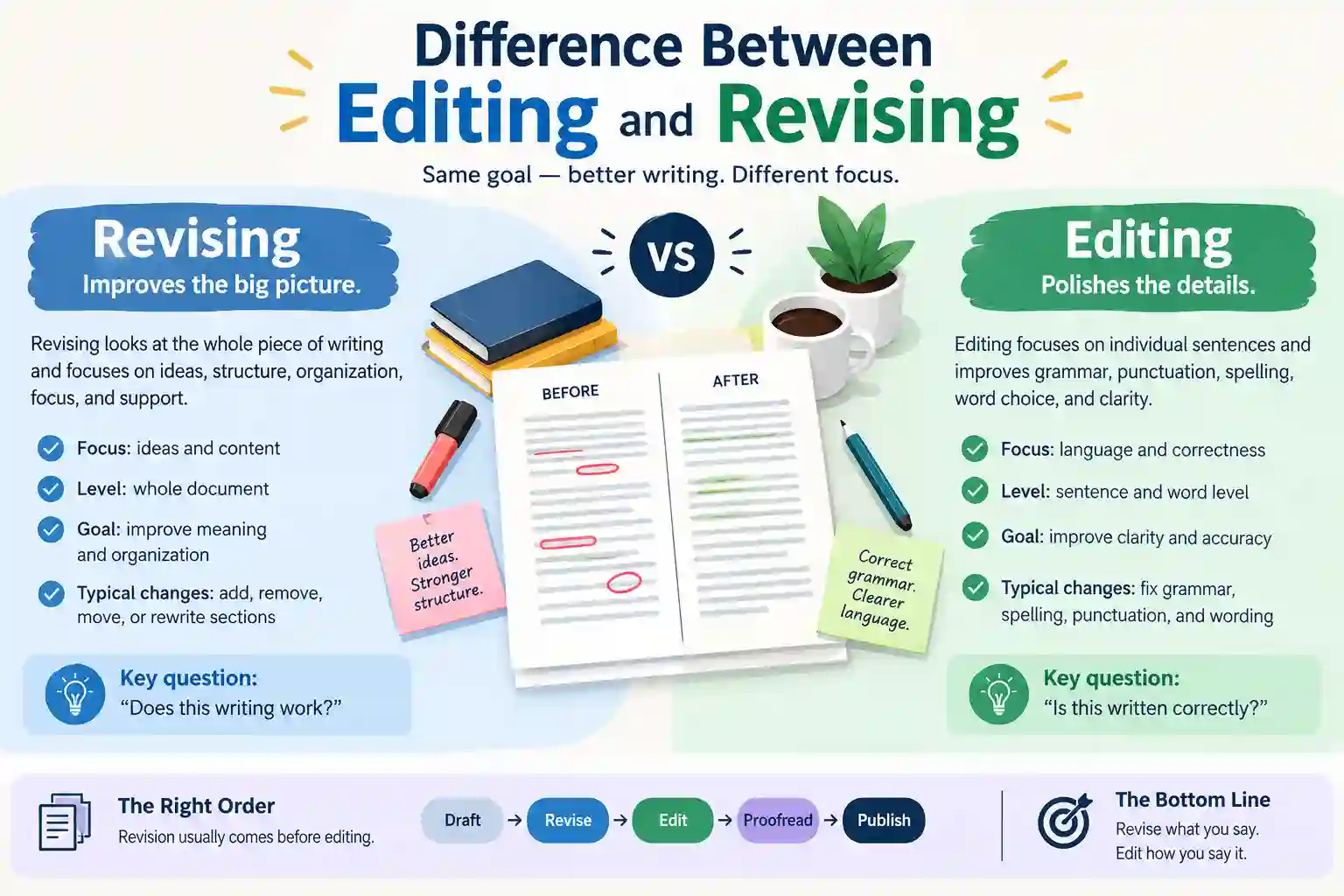
The difference between editing and revising is mainly the level of change. Revising looks at the whole piece of writing and improves its ideas, structure, organization, focus, and support. Editing works mainly at the sentence level and improves grammar, punctuation, spelling, word choice, and clarity. In most writing processes, revising comes before editing.
Quick Comparison Table
| Attribute | Revising | Editing |
| Main focus | Ideas and overall writing | Sentences and language |
| Level | Whole document | Sentence and word level |
| Main goal | Improve meaning and organization | Improve correctness and clarity |
| Typical changes | Add, remove, move, or rewrite sections | Fix grammar, spelling, punctuation, and wording |
| Main question | “Does this writing work?” | “Is this written correctly?” |
| When it usually happens | Before editing | After major revision |
| Example | Move a paragraph to improve the flow | Change “their” to “there” |
| Size of changes | Often large | Usually smaller |
Introduction
Editing and revising are two important steps in the writing process. People often use the words as if they mean the same thing, but they have different purposes.
Revising means looking at your writing again and improving the bigger parts of the text. You may change the main idea, add information, remove a weak section, or move paragraphs.
Editing comes later. It focuses more closely on sentences, words, grammar, spelling, punctuation, and clarity. Purdue OWL describes revision as a stage that generally comes before editing.
A simple way to remember the difference is:
Revise the ideas. Edit the language.
What Is Revising?
Revising means looking at your writing again with the goal of making the whole piece stronger.
The word revise is related to the idea of “re-seeing.” During revision, you step back from individual sentences and look at the writing as a whole. You consider whether the ideas are clear, useful, well developed, and in the right order.
What Do You Do When You Revise?
You may:
- Add important information.
- Remove unnecessary information.
- Change the main idea or focus.
- Move paragraphs or sections.
- Improve the order of ideas.
- Develop weak explanations.
- Add better examples.
- Strengthen evidence or support.
- Rewrite unclear sections.
- Change the introduction or conclusion.
- Make the writing better suited to its audience.
For example:
Before revision:
Exercise is good. It helps people. There are many types of exercise. Walking is one type.
The writer may decide that the paragraph is too general. During revision, the writer could add a clear main point, useful details, and a better order of ideas.
Revision may therefore change much more than a few words.
What Is Editing?
Editing means checking and improving the language and correctness of a piece of writing.
After the main ideas and structure are working well, the writer can examine individual sentences. Editing often focuses on grammar, punctuation, spelling, word choice, sentence structure, and clarity.
What Do You Do When You Edit?
You may:
- Correct grammar mistakes.
- Correct spelling mistakes.
- Fix punctuation.
- Replace weak or inaccurate words.
- Remove unnecessary words.
- Improve sentence structure.
- Fix awkward wording.
- Improve sentence clarity.
- Check capitalization.
- Check consistency in language and style.
For example:
Before editing:
The students was very happy because they win the competition.
After editing:
The students were very happy because they won the competition.
The main idea has not changed. The sentences have simply been corrected.
Core Differences Between Editing and Revising
1. Difference in Focus
The biggest difference is what you look at.
When you revise, you look at the whole piece.
When you edit, you look more closely at individual sentences and words.
Revision asks:
Does this article communicate its main idea clearly?
Editing asks:
Is this sentence grammatically correct and clear?
Revision deals with the larger picture, while editing deals more with the smaller details.
2. Difference in the Size of Changes
Revision can lead to major changes.
You might:
- Delete an entire paragraph.
- Add a new section.
- Move several paragraphs.
- Change your main argument.
- Rewrite the introduction.
- Change the conclusion.
Editing usually involves smaller changes.
You might:
- Change one word.
- Add a comma.
- Correct a verb.
- Remove repetition.
- Fix a spelling mistake.
- Improve a sentence.
This does not mean editing is unimportant. Small language problems can affect the reader’s understanding of a well-developed piece of writing.
3. Difference in Purpose
The purpose of revision is to make the content and structure stronger.
The purpose of editing is to make the language clearer and more correct.
For example, suppose an article has excellent grammar but its ideas are in the wrong order.
It needs revision.
Now suppose the ideas are well organized, but the article contains spelling and punctuation errors.
It needs editing.
4. Difference in Questions
A useful way to separate the two processes is to ask different questions.
Revision Questions
- Is my main point clear?
- Does the introduction prepare the reader?
- Are my ideas in a logical order?
- Do I provide enough information?
- Is anything unnecessary?
- Do my examples support my point?
- Does the conclusion fit the article?
- Is the writing suitable for my audience?
Editing Questions
- Is the grammar correct?
- Is the spelling correct?
- Is the punctuation correct?
- Are the sentences clear?
- Is the word choice accurate?
- Have I used unnecessary words?
- Are there repeated words or phrases?
- Are capitalization and formatting consistent?
These questions show why revision and editing should not be treated as exactly the same task.
Revising vs. Editing: An Example
Consider this short paragraph:
Social media is useful for students. Students can use social media for learning. Social media also have many problems. It can waste time and students should be careful when they use it.
This paragraph has both content problems and language problems.
First: Revision
The writer may decide that the ideas need a clearer structure.
A revised version might be:
Social media can help students learn by giving them access to educational content and discussions. However, it can also distract students and waste their time. Students should therefore use social media carefully and choose useful educational resources.
The writer has changed the organization and developed the ideas.
Second: Editing
The writer can now check individual language problems:
- “social media have” → “social media has” or rewrite the sentence
- Improve word choice.
- Check punctuation.
- Remove unnecessary wording.
- Make the sentences smoother.
The important point is that revision improved the ideas and structure, while editing improved the language.
Why Revising Usually Comes Before Editing
It is usually better to revise before you edit.
Imagine that you spend 20 minutes correcting the grammar of a paragraph. Later, during revision, you decide that the entire paragraph is unnecessary and delete it.
Your earlier editing work is now wasted.
Purdue OWL explains this idea by comparing revision to major changes in a house and editing to smaller finishing changes. It also notes that editing before revision can be inefficient because a later revision may remove or completely change the edited material.
A useful order is:
Draft → Revise → Edit → Proofread → Publish or Submit
This order is not an absolute rule for every type of writing, but it is a useful general process.
What Revising Looks Like
Imagine you have written a 1,000-word article.
During revision, you notice:
- The introduction is too long.
- The main point is unclear.
- Two paragraphs repeat the same idea.
- An important example is missing.
- The conclusion does not match the main argument.
You might:
- Shorten the introduction.
- Rewrite the main argument.
- Combine two repeated paragraphs.
- Add the missing example.
- Rewrite the conclusion.
These are revision changes because they affect the content and structure of the article.
What Editing Looks Like
After revision, you read the new article carefully.
You notice:
- A verb does not agree with its subject.
- A comma is missing.
- One word is repeated too often.
- A sentence is too long.
- One word is spelled incorrectly.
You correct these problems.
These are editing changes because they mainly affect sentence-level correctness and clarity.
Similarities Between Editing and Revising
Although editing and revising are different, they have several things in common.
Both:
- Improve the quality of writing.
- Require careful reading.
- Help readers understand the text.
- Can involve rewriting.
- Can improve clarity.
- Are important before publication.
- May require more than one pass.
Good writing normally needs both processes.
A piece of writing may have excellent ideas but poor grammar. It may also have perfect grammar but weak ideas and poor organization. Strong writing needs both sound content and clear language.
Can Editing and Revising Overlap?
Yes.
The distinction between editing and revising is useful, but the two activities can sometimes overlap.
For example, changing a sentence may improve both its grammar and its meaning. A writer may also discover a problem with the organization while editing a paragraph.
Some writing professionals use editing as a broader term that can include different kinds of changes. However, writing centers and academic writing guides commonly distinguish revision as the bigger-picture stage from editing as the sentence-level stage.
So the distinction is best understood as a practical writing tool rather than a rigid rule.
Revising vs. Editing vs. Proofreading
Editing is also different from proofreading.
Revising
Focuses on:
- Ideas
- Content
- Organization
- Structure
- Focus
- Development
Editing
Focuses on:
- Grammar
- Sentence structure
- Word choice
- Clarity
- Punctuation
- Spelling
Proofreading
Focuses on the final surface errors that remain before publication or submission.
A simple model is:
Revision = Improve the whole piece
Editing = Improve the sentences
Proofreading = Find the final mistakes
These stages can overlap, but separating them helps writers work more efficiently.
When Should You Revise?
Revise when the message itself needs improvement.
You probably need revision if:
- Your main point is unclear.
- Your ideas are not in a logical order.
- You need more evidence.
- Your article has unnecessary sections.
- Your paragraphs do not connect well.
- Your introduction does not match the content.
- Your conclusion feels weak.
- Your writing does not meet the needs of the audience.
In these cases, correcting grammar alone will not solve the problem.
When Should You Edit?
Edit when the ideas are already in good shape but the language needs work.
You probably need editing if:
- Your grammar has errors.
- Your punctuation needs correction.
- Your spelling needs checking.
- Your sentences are awkward.
- Your word choices are weak.
- Your writing contains unnecessary words.
- Your sentences need better clarity.
Editing should polish a strong draft rather than hide problems with weak content.
A Simple Way to Remember the Difference
Think about building a house.
Revising is changing the structure.
You may move a wall, remove a room, or add a new room.
Editing is improving the finished structure.
You may repair small problems, improve the surfaces, or make the details cleaner.
The same idea works for writing:
Revision changes what the writing says and how it is organized. Editing improves how the writing says it.
FAQs
Is revising the same as editing?
No. Revising and editing are related but different. Revising focuses mainly on the whole piece of writing, including its ideas, structure, organization, focus, and support. Editing focuses more on sentences and language, including grammar, punctuation, spelling, word choice, and clarity.
Which comes first, revising or editing?
Revision usually comes first. It is better to fix major problems with ideas and organization before spending time correcting individual sentences. Otherwise, you may carefully edit material that you later remove or rewrite.
Is changing a paragraph revision or editing?
It depends on the type of change. If you move, remove, add, or completely rewrite a paragraph to improve the content or organization, that is revision. If you only correct grammar, punctuation, or wording inside the paragraph, that is editing.
Does revising include grammar?
Grammar can sometimes be noticed during revision, but grammar correction is normally associated with editing. Revision focuses more on whether the ideas, structure, purpose, and organization work well for the reader.
Can you revise and edit at the same time?
You can, and writers often notice both types of problems during the same reading. However, separating the tasks can make the process more effective. First look at the big picture and revise the content. Then edit sentences and correct language problems.
Why is revision important?
Revision helps you see whether your writing actually communicates what you want to say. It can reveal weak ideas, missing information, poor organization, repetition, and unclear arguments. A grammatically correct text can still need major revision if its ideas are weak or poorly organized.
Why is editing important?
Editing makes your revised writing clearer and more accurate. It helps remove grammar, spelling, punctuation, word-choice, and sentence-level problems that may distract readers or make the meaning difficult to understand.
What is the easiest way to remember editing and revising?
Remember this simple rule:
Revise the message. Edit the language.
If you are changing ideas, structure, or organization, you are revising. If you are correcting grammar, spelling, punctuation, or wording, you are editing.
Conclusion
Editing and revising are both important, but they do different jobs. Revising looks at the big picture: ideas, organization, structure, focus, and support. Editing looks at the smaller details: grammar, punctuation, spelling, word choice, and sentence clarity. In most writing processes, revision should come before editing because major changes can affect individual sentences. The easiest way to remember the difference is simple: revise what you say and how your ideas are organized; edit how you say it. Using both steps helps turn a rough draft into clear, effective writing.

Hi! I am Arshad Ullah presently working as linguist in Punjab Education Department. I have done MA in English Literature while M.Phil in Applied Linguistics. I have taught creative writing to the post graduation classes for 15 years. Presently I am working as content writer, and offering classes for blog writing. On this site, I research each topic from authoritative sources and edit every comparison for accuracy and clear, simple language.