I still remember a time when a friend volunteered to speak in front of hundreds of people even though he was visibly nervous. Someone called him brave, while another person called him courageous. That simple moment made me wonder: are bravery and courage really the same thing?
Many people use these words interchangeably. In everyday conversations, books, movies, and motivational speeches, bravery and courage often appear side by side. Because of this, people rarely stop to think about their actual meanings.
Understanding the difference between bravery and courage matters more than many people realize. These qualities influence how we face fear, make decisions, overcome challenges, and grow as individuals. When people misunderstand them, they may misjudge their own strengths or the actions of others.
This guide explains everything in simple English with practical examples so you can clearly understand the real difference.
What Is Bravery?
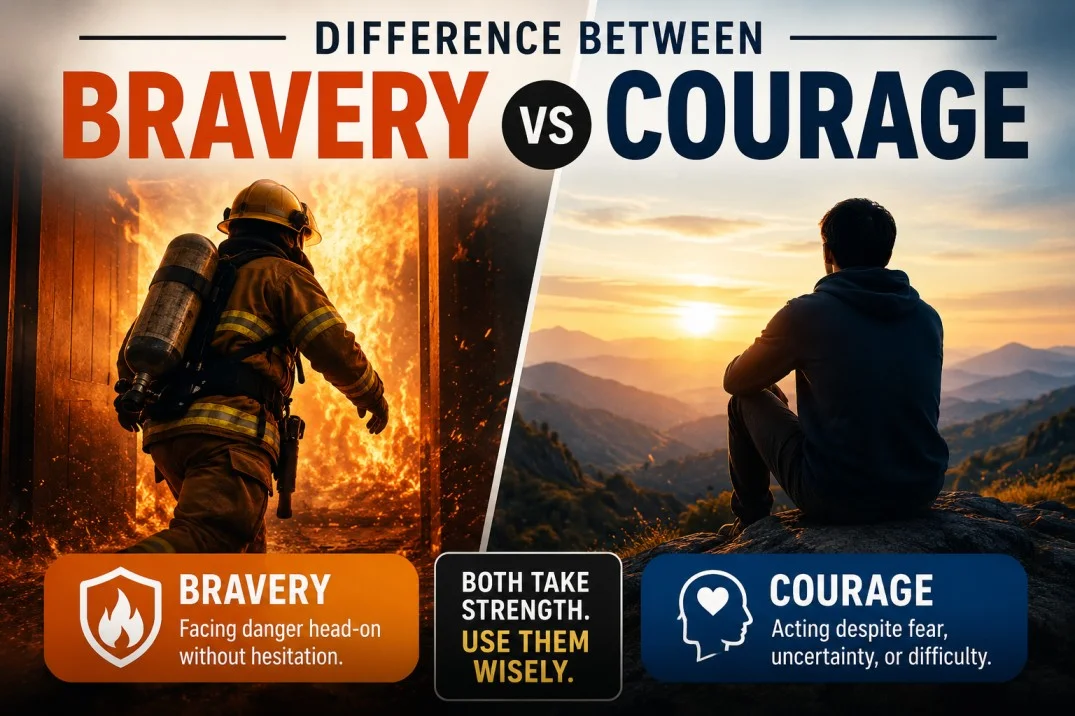
Bravery is the willingness to face danger, pain, difficulty, or risk without showing fear.
A brave person acts boldly when confronted with a challenging situation. Bravery is often associated with physical actions, such as rescuing someone from danger, defending another person, or entering a risky situation.
The word “bravery” comes from the idea of being bold, strong, and fearless.
Key Characteristics of Bravery
- Often involves visible action
- Usually linked to danger or risk
- May appear fearless from the outside
- Can happen in a sudden moment
- Frequently associated with heroes and warriors
Real-Life Examples of Bravery
- A firefighter entering a burning building
- A soldier protecting others during conflict
- A person rescuing someone from a river
- A child standing up to a bully
For many people, bravery is what they can easily see because it often involves action in dangerous situations.
What Is Courage?
Courage is the ability to act despite feeling fear.
Unlike bravery, courage does not require a dangerous situation. It can appear in everyday life when people do difficult things even though they feel scared, uncertain, or vulnerable.
Courage is often emotional, mental, or moral rather than physical.
Key Characteristics of Courage
- Fear is usually present
- Involves inner strength
- Can be emotional or moral
- Often requires persistence
- May not be visible to others
Real-Life Examples of Courage
- Admitting a mistake
- Starting a new business
- Speaking the truth when it is unpopular
- Leaving a toxic relationship
- Asking for help during difficult times
In real-world use, courage often happens quietly and receives less attention than bravery.
Quick Comparison Table
| Feature | Bravery | Courage |
| Meaning | Facing danger boldly | Acting despite fear |
| Main Focus | External action | Internal strength |
| Fear Present | May or may not be visible | Usually present |
| Type | Often physical | Often emotional or moral |
| Risk Level | Frequently high | Can be high or low |
| Visibility | Easy to notice | Often hidden |
| Duration | Can be momentary | Often long-term |
| Effort Required | Immediate action | Ongoing mental effort |
| Common Example | Saving someone from danger | Speaking the truth |
| Popularity in Stories | Very common | Less obvious but common |
| Best Use Case | Emergency situations | Personal growth situations |
| Main Advantage | Fast action | Deep resilience |
| Main Limitation | Can seem impulsive | May not be recognized |
Biggest Difference Between Bravery and Courage
The biggest difference is that bravery focuses on facing danger, while courage focuses on acting despite fear.
A brave person may rush into a risky situation to help others. A courageous person may spend months overcoming fear to make a difficult but necessary decision.
Many people first assume bravery means courage and courage means bravery. In reality, courage is often the deeper inner force that allows bravery to happen.
This difference matters because some of life’s hardest challenges are not physical. They are emotional, mental, and moral.
Key Differences Explained
1. Fear
Bravery
- Fear may not be obvious.
- The person appears fearless.
Courage
- Fear is often clearly present.
- Action happens despite fear.
Example: A student giving a speech while nervous shows courage.
2. Physical vs Emotional Challenges
Bravery
- Commonly linked to physical danger.
Courage
- Commonly linked to emotional struggles.
Example: Undergoing medical treatment requires courage.
3. Visibility
Bravery
- Easy for others to notice.
Courage
- Often happens privately.
Example: Recovering from personal loss requires hidden courage.
4. Duration
Bravery
- Can occur in a single moment.
Courage
- Often lasts for weeks, months, or years.
Example: Caring for a sick family member requires long-term courage.
5. Decision-Making
Bravery
- Often involves quick action.
Courage
- Usually involves thoughtful decisions.
Example: Reporting workplace wrongdoing takes courage.
6. Motivation
Bravery
- Driven by immediate circumstances.
Courage
- Driven by values and principles.
Example: Defending honesty despite consequences shows courage.
7. Risk Type
Bravery
- Physical risk is common.
Courage
- Emotional, social, or professional risk is common.
Example: Changing careers requires courage.
8. Recognition
Bravery
- Often receives praise and attention.
Courage
- May go unnoticed.
Example: Overcoming anxiety quietly is courageous.
9. Emotional Strength
Bravery
- Focuses on bold action.
Courage
- Focuses on emotional endurance.
Example: Facing grief requires courage.
10. Everyday Use
Bravery
- Less common in daily life.
Courage
- Appears regularly.
Example: Having difficult conversations requires courage.
11. Long-Term Impact
Bravery
- Solves immediate problems.
Courage
- Often transforms lives.
Example: Pursuing dreams despite fear demonstrates courage.
Similarities Between Them
Despite their differences, bravery and courage share many qualities.
Both Involve
- Strength
- Determination
- Risk-taking
- Personal growth
- Overcoming obstacles
Why People Confuse Them
- Both involve difficult situations.
- Both require action.
- Both are admired traits.
- Both help people overcome challenges.
In many situations, bravery and courage work together.
Pros and Cons
Pros of Bravery
- Helps in emergencies
- Encourages quick action
- Protects others
- Inspires people
Cons of Bravery
- Can become reckless
- May ignore risks
- Sometimes driven by impulse
Pros of Courage
- Builds resilience
- Supports personal growth
- Improves decision-making
- Strengthens character
Cons of Courage
- Progress may be slow
- Can be emotionally exhausting
- Often goes unnoticed
Which Is Better for Different Situations?
For Emergencies
Bravery is often better.
For Personal Growth
Courage is usually more valuable.
For Students
Courage helps with learning, speaking, and overcoming failure.
For Professionals
Courage supports leadership and ethical decisions.
For Families
Courage helps during illness, financial struggles, and difficult conversations.
For Long-Term Success
Courage usually creates more lasting change.
For High-Risk Situations
Bravery may be necessary.
Common Mistakes People Make
Thinking Bravery Means No Fear
Fear can exist even when someone acts bravely.
Believing Courage Requires Danger
Many courageous actions involve no physical risk.
Ignoring Emotional Challenges
Emotional struggles often require tremendous courage.
Confusing Confidence With Courage
Confidence is feeling capable. Courage is acting despite uncertainty.
Praising Visible Actions Only
Some of the most courageous acts happen privately.
Expert Recommendation
Choose Bravery If:
- You must act quickly
- Physical danger is present
- Others need immediate help
- A crisis requires decisive action
Choose Courage If:
- You face emotional challenges
- You must make difficult decisions
- Long-term growth matters
- You want to overcome fear
Avoid Depending Only on Bravery If:
- You act without thinking
- Risks are not understood
- Emotions are ignored
Avoid Depending Only on Courage If:
- Immediate action is required
- Delay could cause harm
- Quick decisions are necessary
Final Verdict
Bravery and courage are closely related, but they are not identical. Bravery is often the bold action people see. Courage is the inner strength that helps people act even when fear exists.
In everyday life, courage appears more often than many people realize. It shows up when people speak honestly, face uncertainty, admit mistakes, or continue moving forward during difficult times. Bravery usually stands out during moments of danger or crisis.
After observing both over time, one small difference most people overlook is that courage often lasts longer. It helps people grow, heal, and persevere through challenges that cannot be solved in a single moment.
The best approach is not choosing one over the other. Instead, develop both. Bravery helps you face the world, while courage helps you face yourself. Together, they create the strength needed for a meaningful and successful life.
Frequently Asked Questions
Which is better, bravery or courage?
Neither is universally better. Bravery is valuable during dangerous situations, while courage is often more useful in daily life because it helps people act despite fear and uncertainty.
Is courage the same as bravery?
No. Bravery usually involves bold action in risky situations, while courage involves acting even when fear is present. Courage often focuses on emotional and moral strength.
Which lasts longer, bravery or courage?
Courage usually lasts longer. Bravery may occur in a single moment, while courage can help someone overcome challenges over months or years.
Which is easier to develop?
Most people find bravery easier in short situations. Developing courage often requires ongoing personal growth, self-awareness, and emotional resilience.
Can a person be courageous but not brave?
Yes. Someone may face emotional struggles, tell the truth, or overcome fear without ever encountering physical danger.
Are bravery and courage interchangeable?
In casual conversation they often are, but their meanings differ. Courage focuses on inner strength, while bravery focuses more on bold action.
What do most people prefer?
Many people admire bravery because it is visible. However, courage is often valued more deeply because it supports long-term growth and character development.
What mistakes should beginners avoid?
The biggest mistake is believing courage means having no fear. True courage often means feeling fear and moving forward anyway.
Conclusion
The difference between bravery and courage is subtle but important. Bravery is often seen in bold actions taken during dangerous or difficult situations. Courage, on the other hand, is the inner strength that allows a person to move forward despite fear, doubt, or uncertainty. While bravery usually appears in moments of action, courage often works quietly behind the scenes and can last much longer.
Many people use these words as if they mean the same thing, but understanding the distinction helps us better appreciate human behavior and personal growth. In daily life, courage may be more common because people constantly face emotional, social, and moral challenges. Bravery becomes important when quick action is needed.
The strongest individuals often possess both qualities. Bravery helps them face external challenges, while courage helps them overcome internal struggles. Together, they build resilience, confidence, and lasting character.

Hi! I am Arshad Ullah presently working as linguist in Punjab Education Department. I have done MA in English Literature while M.Phil in Applied Linguistics. I have taught creative writing to the post graduation classes for 15 years. Presently I am working as content writer, and offering classes for blog writing. On this site, I research each topic from authoritative sources and edit every comparison for accuracy and clear, simple language.