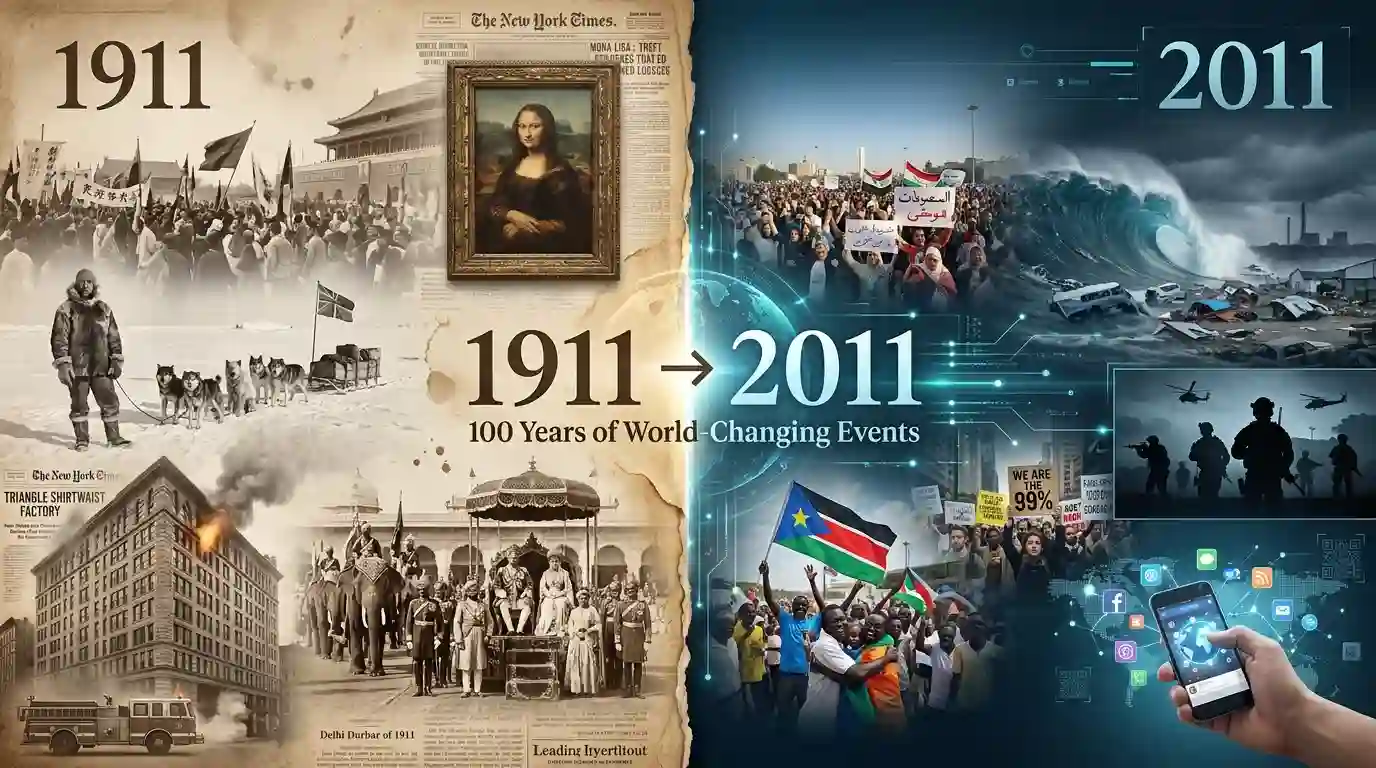
The years 1911 and 2011 were separated by exactly 100 years, but both were marked by major political change, social unrest, disasters, and events that attracted worldwide attention. In 1911, the Chinese Revolution challenged the Qing dynasty, Roald Amundsen reached the South Pole, and the theft of the Mona Lisa became one of history’s most famous art crimes. In 2011, the Arab Spring spread across the Middle East and North Africa, South Sudan became an independent country, and a devastating earthquake and tsunami struck Japan.
The two years also show how dramatically the world changed in a century. In 1911, news traveled mainly through newspapers, telegraphs, and early photography. By 2011, television, smartphones, websites, and social media could spread news around the world within seconds.
1911 vs. 2011: Quick Comparison
| Category | 1911 | 2011 |
| Major political change | Chinese Revolution | Arab Spring |
| Major disaster | Triangle Shirtwaist Factory fire | Japan earthquake and tsunami |
| Exploration | Amundsen reached the South Pole | Major advances in space technology |
| New country | Political changes in China began the end of Qing rule | South Sudan became independent |
| Famous crime | Mona Lisa was stolen | Osama bin Laden was killed |
| Protest movements | Labor and social reform movements | Arab Spring and Occupy Wall Street |
| Technology | Telegraph, telephone, early automobiles | Internet, smartphones, social media |
| Communication | Newspapers and telegraph | Internet and social networks |
| Global connection | Growing but relatively slow | Highly connected and immediate |
What Happened in 1911?
1911 was a major year in the early 20th century. Several events changed politics, science, labor rights, and popular culture.
1. The Chinese Revolution Began
One of the most important political events of 1911 was the Chinese Revolution, also known as the Xinhai Revolution.
The Wuchang Uprising began on October 10, 1911. It triggered a wider revolution against the Qing dynasty, China’s ruling imperial dynasty.
The revolution did not complete the creation of the Republic of China during 1911 itself. The Qing emperor abdicated in February 1912, and the Republic of China was formally established in 1912.
However, the events of 1911 started the political process that ended more than two thousand years of imperial rule in China.
This makes 1911 an important turning point in modern Chinese history.
2. Roald Amundsen Reached the South Pole
1911 was also an important year for exploration.
Norwegian explorer Roald Amundsen and his expedition reached the South Pole in December 1911. He and his team became the first people to reach the geographic South Pole.
The achievement was part of a famous race between Amundsen and British explorer Robert Falcon Scott.
Amundsen’s success became one of the great exploration achievements of the early 20th century.
3. The Mona Lisa Was Stolen
One of the strangest events of 1911 happened at the Louvre in Paris.
Leonardo da Vinci’s Mona Lisa was stolen from the museum on August 21, 1911. The thief was Vincenzo Peruggia, an Italian who had previously worked at the Louvre.
The painting was not yet the worldwide celebrity it would later become. The theft dramatically increased public interest in the painting.
The disappearance was discovered after the painting had been removed from the museum. The Mona Lisa was eventually recovered in Italy in 1913.
4. The Triangle Shirtwaist Factory Fire
On March 25, 1911, a terrible factory fire occurred at the Triangle Waist Company in New York City.
The fire killed 146 people, many of them young immigrant women. Workers became trapped in the upper floors of the building, and the disaster exposed serious weaknesses in workplace and fire safety. Cornell University’s historical archive records that 146 people died in the fire.
The tragedy helped strengthen public pressure for better workplace safety regulations.
The event became an important part of American labor history and demonstrated the human cost of inadequate safety protections.
5. The Delhi Durbar
Another important event took place in British India.
In December 1911, King George V and Queen Mary attended the Delhi Durbar. George V had already become king in 1910, so it is more accurate to say that he participated in the 1911 Delhi Durbar rather than that he became king in 1911.
The Delhi Durbar was held to mark the coronation of George V as Emperor of India. During the event, the British government announced the transfer of India’s imperial capital from Calcutta to Delhi.
The event demonstrated the political importance of India within the British Empire at that time.
What Happened in 2011?
A century later, 2011 became another remarkable year in world history.
Political uprisings, natural disasters, terrorism, economic protests, and technological change made the year particularly eventful.
1. The Arab Spring
The Arab Spring was one of the defining developments of 2011.
Protests that began in Tunisia spread to other countries across the Middle East and North Africa. Demonstrators called for political reform, greater freedom, better economic opportunities, and an end to authoritarian rule.
The movement contributed to major political changes in countries including Tunisia and Egypt. In Libya, the uprising developed into a civil war that eventually led to the fall and death of Muammar Gaddafi.
The events of 2011 changed the political landscape of the region and influenced international politics for years afterward.
2. The Japan Earthquake, Tsunami, and Fukushima Disaster
On March 11, 2011, Japan experienced one of the most devastating natural disasters of the modern era.
A massive earthquake struck off Japan’s northeastern coast. The earthquake generated a powerful tsunami that devastated coastal communities.
The tsunami also severely damaged the Fukushima Daiichi Nuclear Power Station, creating a major nuclear accident.
The disaster became known as the 2011 Tōhoku earthquake and tsunami and had consequences far beyond Japan. It affected energy policy, nuclear safety discussions, disaster planning, and the Japanese economy.
3. Osama bin Laden Was Killed
Another major event of 2011 was the death of Osama bin Laden, the founder and leader of al-Qaeda.
U.S. forces killed bin Laden during an operation in Abbottabad, Pakistan, on May 2, 2011.
The operation became one of the most widely reported international security events of the year.
His death was especially significant because bin Laden had been one of the world’s most wanted terrorism suspects following the September 11, 2001 attacks.
4. South Sudan Became Independent
On July 9, 2011, South Sudan became an independent country after decades of conflict and a referendum on self-determination.
The United Nations describes South Sudan as having formally separated from Sudan on July 9, 2011, following an internationally monitored referendum held earlier that year. It was admitted to the United Nations on July 14 as the organization’s 193rd member state.
Its independence was one of the most important changes to the world’s political map in 2011.
The new country faced major challenges, including poverty, weak infrastructure, and political insecurity.
5. The Libyan Civil War and the Death of Gaddafi
The Arab Spring also reached Libya in 2011.
Opposition forces challenged the government of Muammar Gaddafi, leading to a civil war and international military intervention.
Gaddafi’s rule eventually ended, and he was killed in October 2011.
His death marked the end of more than four decades of rule in Libya.
6. Occupy Wall Street
Another important protest movement began in the United States in 2011.
Occupy Wall Street began in New York City on September 17. The movement focused attention on economic inequality, corporate influence, and the distribution of wealth.
Its slogan, “We are the 99%,” became widely recognized.
The movement spread beyond New York and inspired demonstrations in other cities and countries.
7. Steve Jobs Died
2011 was also the year that Steve Jobs, co-founder of Apple, died.
Jobs had played a major role in the development and popularization of personal computers, smartphones, and digital media products.
His death on October 5, 2011, attracted worldwide attention and became one of the major cultural and technology stories of the year.
1911 vs. 2011: The Biggest Differences
Although both years were full of important events, the nature of those events was very different.
1. Political Change
In 1911, political change was strongly connected to empires, monarchies, and colonial rule.
The Chinese Revolution challenged one of the world’s oldest imperial systems.
In 2011, political change was more closely connected to democracy, authoritarian governments, civil rights, economic inequality, and popular protest.
The Arab Spring demonstrated how ordinary citizens could challenge established governments on a massive scale.
2. Technology
The technological gap between 1911 and 2011 was enormous.
In 1911, people relied heavily on:
- Newspapers
- Telegraphs
- Telephones
- Printed photographs
- Steam-powered transportation
- Early automobiles
- Early aircraft
By 2011, people commonly used:
- Smartphones
- Personal computers
- Search engines
- Social media
- Video websites
- GPS
- Digital cameras
- Broadband internet
This difference changed how historical events were experienced.
A major event in 1911 could take days or weeks to become widely known. In 2011, photographs and videos could reach millions of people almost immediately.
3. Communication
Communication was much slower in 1911.
Newspapers were among the most important ways people learned about major events. Telegraph networks could transmit information over long distances, but communication was not instant for ordinary people.
By 2011, the internet had transformed global communication.
A protest in one city could be watched by people on the other side of the world. Social media also allowed protesters to communicate and organize rapidly.
4. Transportation
Transportation had also changed dramatically.
In 1911, automobiles and airplanes were still relatively new technologies. Long-distance travel could take considerable time.
By 2011, commercial aviation connected major cities around the world. High-speed transportation, modern highways, container shipping, and international airlines had created a much more connected planet.
5. The Role of Ordinary People
Ordinary people played an important role in both years.
In 1911, workers, revolutionaries, reformers, and activists participated in movements for political and social change.
In 2011, ordinary citizens again became major participants in history through protests and social movements.
The major difference was the technology available to them.
A protester in 1911 might communicate through newspapers, leaflets, meetings, or word of mouth.
A protester in 2011 could use Facebook, Twitter, smartphones, websites, text messages, and online video.
Similarities Between 1911 and 2011
Despite the huge technological and social differences, the two years had several surprising similarities.
Both were years of political change
The Chinese Revolution transformed China’s political future in 1911.
The Arab Spring changed governments and political movements across parts of the Arab world in 2011.
Both witnessed major protests and social movements
Labor reform and political movements were important in 1911.
Popular protests became one of the defining features of 2011.
Both experienced major disasters
The Triangle Shirtwaist Factory fire shocked the United States in 1911.
The Japan earthquake, tsunami, and Fukushima nuclear accident shocked the world in 2011.
Both produced events that changed public awareness
The Triangle fire increased attention to workplace safety.
The Fukushima disaster increased international attention to nuclear safety.
Both became important historical reference points
People studying modern history still examine the events of 1911.
Likewise, 2011 is already an important reference point for understanding the political and technological history of the 21st century.
1911 vs. 2011: How the World Changed in 100 Years
The biggest difference between 1911 and 2011 was not simply the events themselves. It was the environment in which those events happened.
In 1911, the world was dominated by large empires and colonial powers. The British Empire was enormous, European powers controlled territories across Asia and Africa, and monarchies still played major political roles.
By 2011, most colonies had become independent states. International organizations such as the United Nations played major roles in diplomacy, and national governments operated within a highly interconnected global economy.
Technology also changed the meaning of distance.
In 1911, information moved through physical networks such as newspapers, telegraph wires, ships, and railways.
In 2011, information could move through the internet almost instantly.
That difference is particularly important when comparing political movements.
The revolutionaries of 1911 depended heavily on physical communication and organized networks. Protesters in 2011 could communicate with large numbers of people through digital platforms.
From Newspapers to Social Media
Perhaps the clearest way to understand the difference is to compare how people received news.
In 1911:
- A major event happened.
- Reporters gathered information.
- Newspapers prepared stories.
- Newspapers were printed.
- People read the news later.
In 2011:
- A major event happened.
- Someone could record it on a phone.
- The video could be uploaded online.
- News organizations could report it almost immediately.
- Millions of people could see it around the world.
This transformation changed journalism, politics, protests, business, and everyday life.
Which Year Was More Historically Important?
It is difficult to say that one year was simply more important than the other.
1911 was extremely important because it marked the beginning of political changes that helped end China’s imperial system. It also included major events in exploration, labor history, British India, and popular culture.
2011 was important because it produced major political uprisings, the birth of South Sudan, a major natural and nuclear disaster in Japan, the death of Osama bin Laden, and the rise of global protest movements.
The two years were important for different reasons.
1911 was a turning point in the early modern industrial world.
2011 was a turning point in the highly connected digital world.
Frequently Asked Questions
What was the biggest event of 1911?
The Chinese Revolution was one of the most important events of 1911 because it began the process that ended Qing imperial rule in China. The revolution’s political transition was completed in 1912.
What was the biggest event of 2011?
There is no single universally accepted answer. The Arab Spring, Japan’s earthquake and tsunami, South Sudan’s independence, and the killing of Osama bin Laden were among the year’s most significant international events.
Was George V crowned king in 1911?
No. George V became King of the United Kingdom in 1910. In 1911, he attended the Delhi Durbar in India, where he was formally proclaimed Emperor of India.
What happened to the Mona Lisa in 1911?
The Mona Lisa was stolen from the Louvre in Paris on August 21, 1911. The painting was recovered in Italy in 1913. The theft helped make the painting even more famous.
What major disaster happened in 1911?
The Triangle Shirtwaist Factory fire in New York City was one of the year’s major disasters. It killed 146 people and became an important event in the history of workplace safety.
What major natural disaster happened in 2011?
Japan suffered a massive earthquake and tsunami on March 11, 2011. The disaster also caused a major nuclear accident at the Fukushima Daiichi nuclear power plant.
Did a new country appear in 2011?
Yes. South Sudan became independent from Sudan on July 9, 2011, and joined the United Nations later that month as its 193rd member state.
How were 1911 and 2011 similar?
Both years experienced major political movements, social unrest, disasters, and events that changed history. The biggest difference was the technology available to people and the speed at which information could travel.
Conclusion
The comparison between 1911 and 2011 shows how dramatically the world changed over a century. In 1911, the Chinese Revolution challenged imperial rule, Amundsen reached the South Pole, the Mona Lisa was stolen, and the Triangle Shirtwaist Factory fire exposed serious problems in workplace safety. In 2011, the Arab Spring reshaped politics in the Middle East and North Africa, South Sudan became independent, Japan suffered a devastating earthquake and tsunami, and digital technology transformed the way people experienced global events.
The two years were separated by 100 years, but both remind us that history can change quickly. The difference is that in 2011, technology allowed those changes to be witnessed and discussed around the world almost instantly.

Hi! I am Arshad Ullah presently working as linguist in Punjab Education Department. I have done MA in English Literature while M.Phil in Applied Linguistics. I have taught creative writing to the post graduation classes for 15 years. Presently I am working as content writer, and offering classes for blog writing. On this site, I research each topic from authoritative sources and edit every comparison for accuracy and clear, simple language.