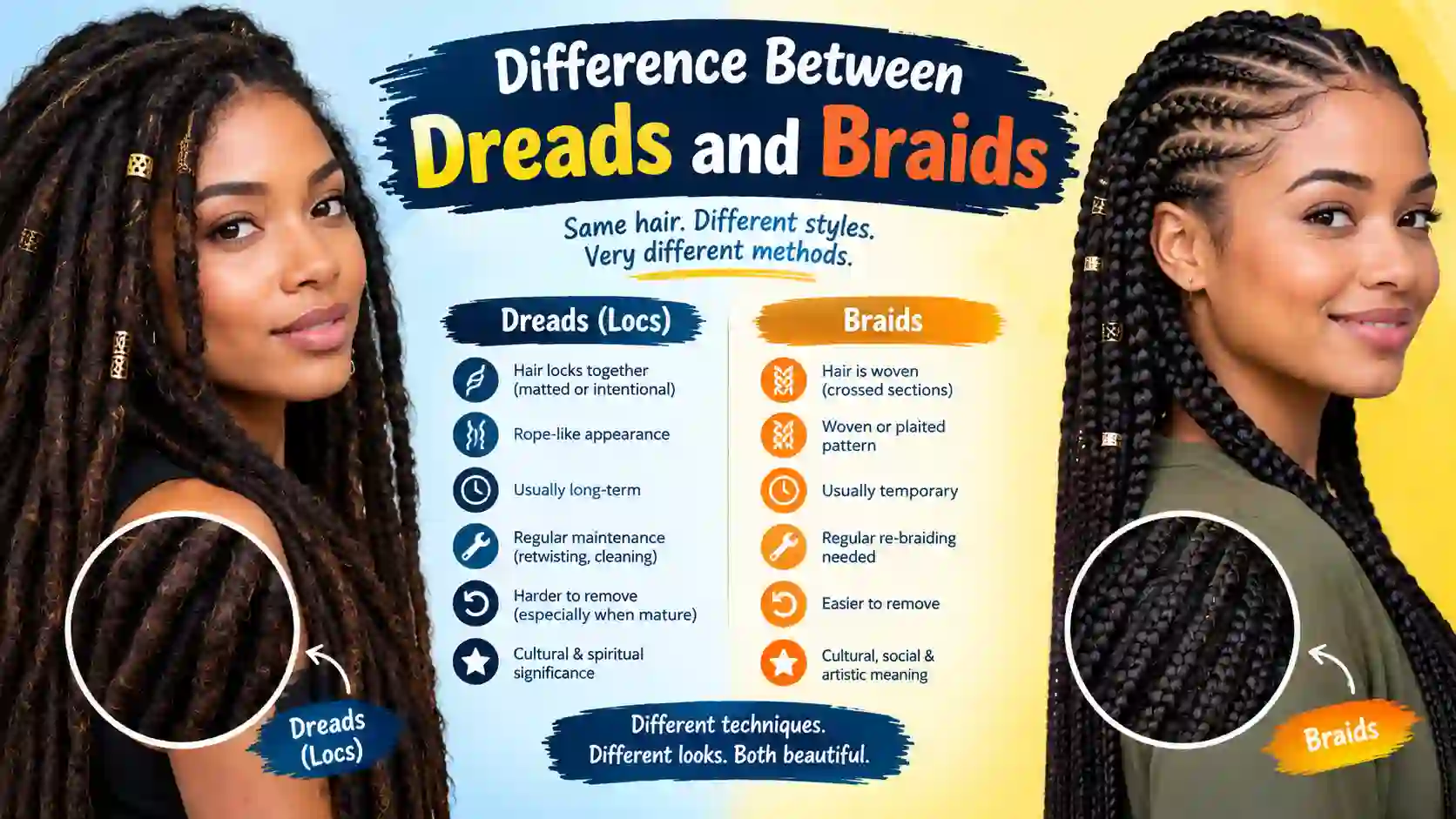
Dreads and braids are two different ways of styling hair. Braids are made by crossing three or more sections of hair over and under each other to form a woven pattern. Dreads, also called locs, are formed when sections of hair become matted or intentionally locked together into rope-like strands. Braids are usually easier to undo, while mature locs are more permanent.
Quick Comparison Table
| Feature | Dreads (Locs) | Braids |
| Basic method | Hair is locked or matted together | Hair sections are woven together |
| Appearance | Rope-like, solid strands | Woven or plaited strands |
| Main structure | Hair strands become joined | Separate strands cross each other |
| Can they be undone? | Often difficult, especially when mature | Usually easier to undo |
| Maintenance | Regular retwisting or loc maintenance may be used | Usually needs regular re-braiding |
| Duration | Can be worn for a long time | Usually a temporary style |
| Extensions | Can be added in some loc styles | Commonly added |
| Cultural meaning | Has cultural and spiritual meanings in different communities | Has cultural, social, and artistic meanings in many cultures |
Introduction
Dreads and braids can look similar from a distance, but they are made in very different ways.
The main difference between dreads and braids is how the hair is formed. Braiding keeps hair sections arranged in a woven pattern. Locs allow hair to lock together into a more solid strand.
Both styles have a long history and can have cultural meaning. For example, the Smithsonian notes that braids in some African societies were used to express things such as age, marital status, wealth, religion, and social class.
What Are Dreads?
Dreads, more commonly called locs or dreadlocks, are rope-like sections of hair created when hair becomes intentionally or naturally locked together.
Instead of crossing separate sections to make a braid, the hair in a loc gradually forms a more unified strand.
Main Characteristics of Dreads
- Hair sections become locked together.
- They usually look like solid ropes or cords.
- They can be thin, medium, or thick.
- They can be short or very long.
- Some people maintain them by separating new growth and retwisting the roots.
- Mature locs can be difficult to undo without cutting or extensive detangling.
The style has important cultural and personal meanings in different communities. The Smithsonian’s National Museum of African American History and Culture lists dreadlocks among the natural hairstyles embraced by African Americans.
What Are Braids?
Braids are hairstyles made by dividing hair into sections and crossing those sections over one another in a repeated pattern.
A simple three-strand braid is the basic example.
Main Characteristics of Braids
- Hair is divided into separate sections.
- The sections are crossed over one another.
- The hair keeps a visible woven pattern.
- Braids can be loose or tight.
- They can be made with natural hair or extensions.
- Many types exist, including cornrows, box braids, and French braids.
Braiding is an ancient practice. A Library of Congress resource notes that braiding dates back thousands of years and has been practiced across different cultures, including Indigenous American, European, and Egyptian cultures.
Core Difference Between Dreads and Braids
1. How They Are Made
This is the biggest difference.
Dreads:
Hair sections are encouraged or worked into a locked form.
Braids:
Hair sections are crossed over one another to create a woven structure.
Think of it this way:
Dreads = hair locks together.
Braids = hair is woven together.
2. Appearance
Dreads usually look like individual ropes or cords.
Braids usually show a clear woven or crossing pattern.
For example:
- A loc may look like a thick rope.
- A three-strand braid looks like a repeated crossing pattern.
- Cornrows form neat braided rows close to the scalp.
- Box braids hang as separate braided strands.
3. How Easy They Are to Remove
Braids are normally easier to remove.
You can usually undo a braid by working backward through the crossed sections.
Locs are different. As hair becomes more mature and tightly locked, separating the hair can become very difficult and time-consuming.
So:
Braids → usually temporary and easy to remove
Locs → usually longer-term and harder to reverse
4. Maintenance
Both styles require care, but the routine is different.
Loc maintenance may include:
- Separating locs
- Cleaning the scalp
- Maintaining new growth
- Retwisting or interlocking, depending on the method
Braid maintenance may include:
- Keeping the scalp clean
- Protecting the braids while sleeping
- Managing new growth
- Removing and redoing the braids when needed
Hair care should also be gentle. Very tight braids and twists can put stress on hair and may contribute to breakage or hair loss.
Similarities Between Dreads and Braids
Although they are different styles, they have several things in common.
- Both can be used as protective hairstyles.
- Both can be made in many sizes and shapes.
- Both can be worn with accessories.
- Both can express personal style.
- Both have cultural importance in different communities.
- Both can be created using natural hair or, in some styles, added hair.
Hair styling also has a strong cultural role. The Smithsonian describes African hair traditions as connected with identity, culture, family, and history.
Dreads vs. Braids: A Simple Example
Imagine two pieces of rope.
Braiding is like taking several separate strings and weaving them together.
Locing is more like allowing the hairs within a section to become joined into one continuous strand.
That is why a braid has a visible pattern, while a mature loc usually has a more solid, rope-like appearance.
Can Dreads Be Braided?
Yes. Locs can sometimes be styled into braids.
This does not mean that locs and braids are the same thing. It simply means that an existing loc can be arranged into a braided hairstyle.
Likewise, braided hair can eventually become tangled or matted if it is not properly maintained, but this does not automatically make it a mature loc.
Common Misconceptions
Are dreads just very tight braids?
No. Braids and locs use different structures. A braid is made by crossing separate sections of hair. A loc is a locked section of hair.
Are all locs natural?
Not necessarily. Locs can form naturally over time, but people can also intentionally create and maintain them using different techniques.
Are braids always permanent?
No. Most braids are temporary hairstyles and can be removed. Their wearing time depends on the type of braid, hair, and maintenance.
Are dreads and locs the same thing?
In everyday use, dreads and dreadlocks are commonly used to refer to locs. Some people prefer the term locs because of personal or cultural preferences.
FAQs
Are dreads better than braids?
Neither is automatically better. They serve different purposes. Locs are a long-term hairstyle based on locked hair, while braids provide a woven hairstyle that can usually be removed more easily. The better choice depends on the person’s preferred appearance, maintenance routine, hair type, and desired length of time for the style.
Which lasts longer, dreads or braids?
Locs can be maintained for many years because they are designed to be a long-term hairstyle. Braids are generally temporary and are eventually removed and redone. How long either style lasts depends on the hairstyle, hair condition, maintenance, and how much tension is placed on the hair.
Can you turn braids into dreads?
Braids can contribute to tangling and locking if they are left in place for a long time, but simply wearing braids does not automatically create mature locs. Purposefully creating locs involves techniques that allow sections of hair to become and remain locked.
Are locs and braids protective hairstyles?
Both can be used as protective styles, but the result depends on how they are installed and maintained. A style that is too tight can place stress on the hair and scalp. Dermatologists advise avoiding excessive tension because tight hairstyles can contribute to breakage and some types of hair loss.
Do braids and dreads have cultural meaning?
Yes. Hair styling has cultural importance in many societies. The Smithsonian documents how braiding in several African societies could communicate social information such as age, marital status, wealth, religion, and social class.
Conclusion
The main difference between dreads and braids is how the hair is formed. Braids are woven hairstyles made by crossing separate sections of hair, while dreads or locs are sections of hair that become locked together. Braids usually have a clear woven pattern and can normally be removed more easily. Locs have a rope-like appearance and are generally designed as a long-term style. Both can be beautiful, practical, and culturally meaningful. The best choice depends on the look, maintenance routine, and level of commitment a person wants.

Hi! I am Arshad Ullah presently working as linguist in Punjab Education Department. I have done MA in English Literature while M.Phil in Applied Linguistics. I have taught creative writing to the post graduation classes for 15 years. Presently I am working as content writer, and offering classes for blog writing. On this site, I research each topic from authoritative sources and edit every comparison for accuracy and clear, simple language.