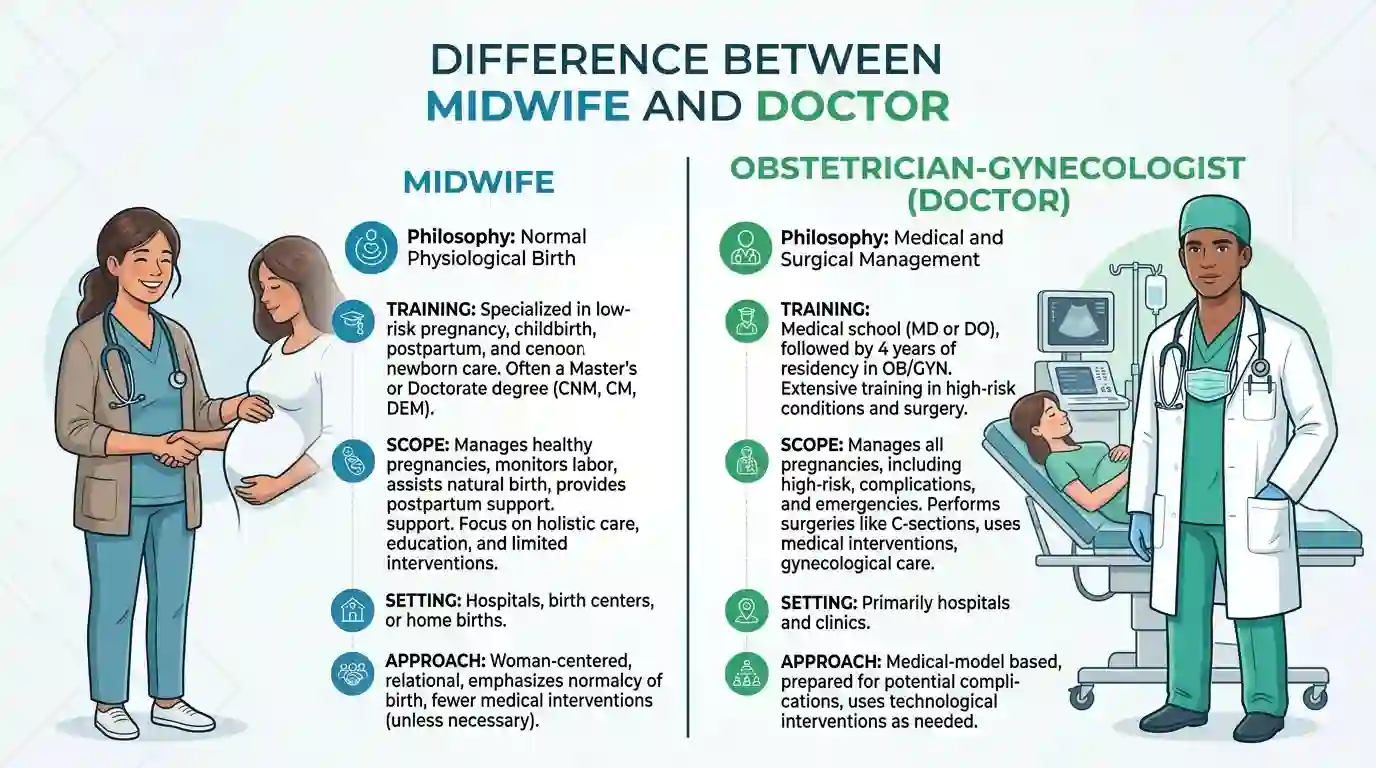
A midwife is a trained health professional who mainly cares for women during pregnancy, normal labor, birth, and the period after birth. A doctor is a medical professional trained to diagnose and treat a wide range of diseases and medical problems. In pregnancy, a doctor—especially an obstetrician—can manage medical and pregnancy complications and perform procedures or surgery when needed.
Quick Comparison Table
| Feature | Midwife | Doctor |
| Main focus | Pregnancy, labor, birth, and newborn care | General health and disease |
| Training | Specialized midwifery education | Medical school and medical training |
| Normal pregnancy | Provides routine care | May provide care when needed |
| Normal birth | Can provide care and assist with birth | Can manage birth, especially when medical issues arise |
| Complications | Identifies and refers or manages within their scope | Diagnoses and treats medical complications |
| Surgery | Generally outside normal midwifery practice | Some doctors, such as obstetricians, can perform surgery |
| Newborn care | Provides immediate newborn and breastfeeding support | Can treat medical problems in the newborn |
| Main role | Pregnancy and childbirth care | Diagnosis and treatment of illness and medical conditions |
What Is a Midwife?
A midwife is a trained and licensed professional who specializes in pregnancy, childbirth, and care after birth. Midwives can monitor pregnancy, support women during labor, assist with normal births, care for newborns, and provide breastfeeding support.
A midwife may:
- Check the mother’s health during pregnancy.
- Monitor the baby’s development.
- Check blood pressure and other routine health measures.
- Support the mother during labor.
- Assist with normal childbirth.
- Provide care after birth.
- Help with breastfeeding.
- Identify possible complications.
- Refer the mother to a doctor or specialist when more advanced medical care is needed.
What Is a Doctor?
A doctor is a medical professional trained to diagnose and treat diseases, injuries, and other health problems. Doctors can work in many fields, such as family medicine, surgery, internal medicine, pediatrics, and obstetrics and gynecology.
For pregnancy, an obstetrician is a doctor who has specialized training in pregnancy, childbirth, and related medical problems.
An obstetrician may:
- Manage high-risk pregnancies.
- Diagnose pregnancy complications.
- Treat medical problems during pregnancy.
- Perform certain medical procedures.
- Perform cesarean sections when required.
- Manage serious complications during labor and birth.
Core Differences Between a Midwife and a Doctor
1. Main Area of Care
The biggest difference is their main area of training and practice.
A midwife focuses on pregnancy, childbirth, postpartum care, and newborn care. A doctor has broader medical training and can diagnose and treat many types of illnesses and injuries.
2. Normal Pregnancy vs. Medical Problems
Midwives can provide care throughout a normal, uncomplicated pregnancy. If a complication develops, they can identify it and arrange medical assessment or referral.
Doctors, particularly obstetricians, are trained to manage medical and obstetric complications. WHO describes midwives and specialist doctors as working together when a woman or newborn needs care beyond the midwife’s scope.
3. Childbirth
A trained midwife can provide care during normal labor and birth. Doctors can also care for women during childbirth, particularly when medical problems require their expertise.
WHO recognizes appropriately trained midwives and doctors among skilled health professionals who can provide care during childbirth.
4. Surgery
A major practical difference is surgery.
Midwifery is primarily focused on normal pregnancy and birth and does not generally include major surgery. An obstetrician is a medical doctor who can perform surgical procedures, including a cesarean section when medically necessary.
5. Working Together
A midwife and doctor are not simply competing alternatives. They can work as a team.
For example, a woman may receive routine pregnancy care from a midwife. If a complication develops, the midwife can involve an obstetrician or another specialist. If the situation later becomes uncomplicated again, the midwife may resume the main care role, depending on the local healthcare system.
When Is a Midwife Usually Involved?
A midwife is commonly involved when pregnancy and birth are progressing normally.
For example:
- Routine pregnancy checkups
- Education about pregnancy and birth
- Support during labor
- Normal vaginal birth
- Post-birth care
- Breastfeeding support
- Basic newborn care
The exact duties of a midwife vary by country, because licensing and scope of practice are set by local rules.
When Is a Doctor Usually Needed?
A doctor may become especially important when there is a medical condition or pregnancy complication.
Examples include:
- High blood pressure or pre-eclampsia
- Certain problems with the placenta
- Serious bleeding
- Some fetal complications
- Conditions requiring surgery
- A pregnancy classified as high risk
- Complications that require specialist treatment
For high-risk pregnancies or certain medical conditions, hospital care may be recommended because specialist services are available there.
Common Misconception: Is a Midwife a Doctor?
No. A midwife and a doctor are different health professions with different education, training, and scopes of practice.
However, a qualified midwife is a trained healthcare professional, not simply someone who helps during delivery. Midwives have specialized knowledge and skills for pregnancy, childbirth, postpartum care, and newborn care.
Common Misconception: Does Seeing a Midwife Mean You Cannot See a Doctor?
No. Midwives and doctors can work together. If a pregnancy develops complications or needs specialized medical care, a midwife can involve an obstetrician or another doctor.
FAQs
Can a midwife deliver a baby?
Yes. A properly trained and licensed midwife can care for women during normal labor and assist with childbirth. The exact legal scope of practice differs between countries.
Is a midwife the same as a gynecologist?
No. A midwife is a specialized maternity-care professional. A gynecologist is a doctor specializing in the female reproductive system. An obstetrician-gynecologist (OB-GYN) is a doctor trained in both obstetrics and gynecology.
Can a midwife handle pregnancy complications?
Midwives are trained to identify complications and manage problems within their scope of practice. When a woman or baby needs more complex or specialized care, the midwife works with or refers to a doctor or specialist.
Who should I see for a normal pregnancy?
A qualified midwife can provide routine care for a normal, uncomplicated pregnancy in healthcare systems where midwifery-led care is available. Doctors can also provide pregnancy care. The appropriate choice depends on the pregnancy, local healthcare system, and individual needs.
Who handles a high-risk pregnancy?
A high-risk pregnancy may require care from an obstetrician or another specialist, often working with midwives and other healthcare professionals. The exact care team depends on the medical condition and local healthcare system.
Can a doctor and midwife work together?
Yes. Team-based care is common. Midwives can provide maternity care while doctors provide specialist medical care when complications or other medical needs arise.
Conclusion
The main difference between a midwife and a doctor is their training and scope of care. A midwife specializes in pregnancy, normal labor, childbirth, postpartum care, and newborn care. A doctor has broader medical training, while an obstetrician specializes in medical and surgical care related to pregnancy and childbirth. Midwives can identify complications and involve doctors when specialized treatment is needed. Therefore, the two roles often work together rather than replacing one another. The right professional depends on the woman’s health, pregnancy risk, and the healthcare system available.

Hi! I am Arshad Ullah presently working as linguist in Punjab Education Department. I have done MA in English Literature while M.Phil in Applied Linguistics. I have taught creative writing to the post graduation classes for 15 years. Presently I am working as content writer, and offering classes for blog writing. On this site, I research each topic from authoritative sources and edit every comparison for accuracy and clear, simple language.