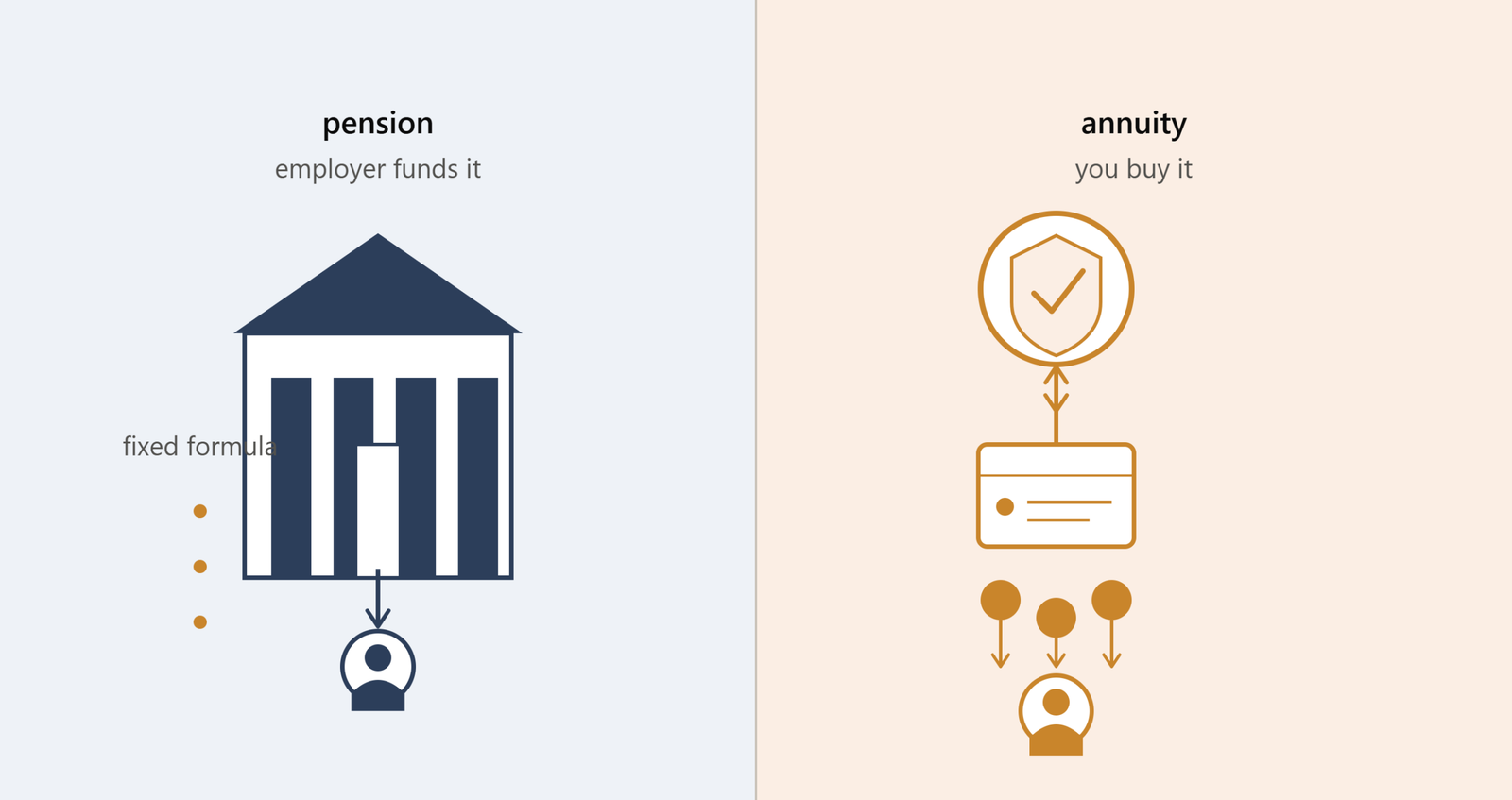
A pension is a retirement benefit your employer sets up and funds for you. An annuity is an insurance contract you buy yourself to turn savings into steady income. The main difference between annuity and pension is who pays for it and who controls it.
Quick Comparison Table
| Feature | Pension | Annuity |
| Who sets it up | Employer | You, through an insurance company |
| Who pays for it | Employer (sometimes with your contributions) | You, usually with a lump sum |
| Who controls the money | Employer or plan trustees | You choose the contract terms |
| When payments start | Usually after retirement, based on a formula | Right away or after a chosen deferral period |
| Portability | Tied to one employer | Yours to keep, no matter where you work |
| Backup protection | PBGC insurance (private-sector plans) | State guaranty associations |
| Flexibility | Low — fixed formula | High — you pick payout options |
Introduction
Planning for retirement means thinking about where your income will come from. Two common sources are pensions and annuities. Both can pay you money every month for life. But they work in very different ways.
This guide explains the real difference between annuity and pension. You will learn what each one is, how they are funded, and when you might use one or the other.
What Is a Pension?
A pension is a retirement plan set up by an employer. A pension is a retirement benefit offered by an employer, while an annuity is a contract between a customer and an insurance company. Your employer promises to pay you income after you retire.
The Pension Benefit Guaranty Corporation (PBGC) is a government corporation established by the Employee Retirement Income Security Act of 1974 to protect the pensions of workers covered by private-sector defined benefit plans. This law set rules for how pensions must be managed and protected.
Main Characteristics of a Pension
- Set up and usually funded by your employer
- Pays a fixed monthly amount, often based on your salary and years of service
- You do not choose how the money is invested
- Tied to your job: you may lose or reduce benefits if you leave early
- Backed by the PBGC for many private-sector plans
Most pensions are called “defined benefit” plans. This means the payout amount is fixed by a formula. It does not change based on the stock market.
What Is an Annuity?
An annuity is different. It is an insurance product, not a job benefit. An annuity is an insurance product you can purchase through a provider rather than through your employer. You buy it with your own money.
When you purchase an annuity, your premium accumulates interest for a number of years before being converted into a stream of payments. In simple terms, you hand the insurance company a sum of money. In return, they promise to pay you income later.
Main Characteristics of an Annuity
- Purchased by you from an insurance company
- Funded with your own savings, often a lump sum
- You choose the type of annuity and payout options
- Not tied to any employer — fully portable
- Backed by state guaranty associations, not the government
Anyone can buy an annuity. You do not need an employer plan to get one.
Core Difference Between Annuity and Pension
Difference 1: Who Funds It
This is the biggest difference. Either your employer fully funds your pension, or you also add to it by contributing a percentage of your salary each paycheck, and your employer manages the account as part of your benefits package. In contrast, you fund an annuity using your savings to secure future income.
- Pension: mostly employer money
- Annuity: your own money
Difference 2: Who Controls the Investment
- Pension: the employer handles the funds and makes any investment decisions
- Annuity: you pick the insurance provider and the type of contract that fits your goals
This means annuities give you more say. But that also means more decisions for you to make.
Difference 3: Cost
Pensions usually cost you nothing beyond any salary contributions you choose to make. Annuities work differently. Annuities are entirely funded by the person purchasing the annuity, usually with a large lump sum premium, and because of how they are funded, annuities are much costlier than pensions, requiring not only an initial investment but also fees and extra charges.
Difference 4: Portability
- Pension: stays with your employer. Change jobs, and you may lose future benefit growth.
- Annuity: annuities can be taken with you when you move from job to job, while a pension is typically tied to one employer.
Difference 5: Access to Pensions Today
Pensions are becoming rare. Only about 15% of private sector workers now have access to a defined benefit pension, according to the Bureau of Labor Statistics. This is one reason more people are turning to annuities to build guaranteed income on their own.
Difference 6: Backup Protection If the Provider Fails
Both pensions and annuities have a safety net, but the nets are different.
- Pension: private sector pensions are insured by the PBGC up to about $93,477 per year (2026, straight-life at age 65) For pension plans terminating in 2026, the maximum PBGC guarantee for a participant retiring at age 65 is $7,789.77 per month under a straight-life annuity.
- Annuity: annuities are backed by state guaranty associations with limits that vary by state
Similarities
What Annuities and Pensions Have in Common
- Both can pay guaranteed income for life
- Both are designed to help you avoid running out of money in retirement
- Both offer tax advantages, though in different ways
- Both can be paid as a lump sum or as regular payments
- Both can factor in your life expectancy to set payment amounts
Practical Examples
Pension example: Maria worked for a city government for 25 years. When she retires, the city pays her a fixed monthly check for life, based on her final salary and years worked. She never had to choose an investment.
Annuity example: James is self-employed. He never had an employer pension. At age 60, he uses $200,000 of his savings to buy an annuity. The insurance company now sends him a monthly check for the rest of his life.
When to Use a Pension or an Annuity
You often do not get to “choose” a pension — it depends on your employer. But you can always choose to buy an annuity.
Use (or Rely On) a Pension When:
- Your employer offers one as part of your job benefits
- You plan to stay with the same employer long enough to vest
- You prefer a fixed, predictable payment with no decisions to make
Use an Annuity When:
- You do not have access to an employer pension
- You want to turn a lump sum, such as savings or a 401(k) rollover, into steady income
- You want more control over payout options, like survivor benefits
- You are deciding what to do with a pension lump-sum buyout offer
Common Misconceptions
Misconception 1: “A Pension and an Annuity Are the Same Thing”
They are related but not identical. A pension is an employer-managed plan where the company is responsible for funding and investments, whereas an annuity is a private insurance contract you purchase and control individually. The monthly check might look the same in your bank account, but the source and structure are different.
Misconception 2: “You Cannot Use Both”
Many retirees use both. Some people even a portion of their pension money to buy an annuity, giving them more flexibility and security in retirement</cite>. A pension can act as a base income, while an annuity fills gaps.
Misconception 3: “Annuities Are Always a Bad Deal”
Annuities have real costs and fees. But they also offer something pensions cannot: choice. You can select payout length, survivor options, and start dates. That flexibility has value for people without a pension.
FAQs
Is an annuity better than a pension? Neither is better for everyone. An annuity is funded by you and offers more control and flexibility, while a pension provides guaranteed income typically fully funded by your employer. The better option depends on your access to a pension and how much control you want.
Can I turn my pension into an annuity? Yes. When you retire, many pension plans let you choose a lump sum instead of monthly payments. You can then use that lump sum to buy a private annuity. This is sometimes called a “pension annuity.”
Are pension payments and annuity payments taxed the same way? Often yes. Both are usually taxed as ordinary income at the federal level. The difference is in the funding. Pension contributions are often made with pre-tax dollars. Annuity earnings grow tax-deferred until you withdraw them.
What happens to my annuity if the insurance company fails? State guaranty associations offer some protection, but limits vary by state and are not backed by the federal government the way pensions are.
Can I lose money with an annuity or a pension? With a traditional pension, your promised payment does not change with the market. With most annuities, the payout is also fixed once you buy the contract. However, annuities can carry fees, and some types do carry investment risk, so it pays to read the contract closely.
Is Social Security a pension or an annuity? Social Security is neither. It is a separate government program. However, it works like a pension in one way: it pays guaranteed monthly income for life based on your work history.
Conclusion
The difference between annuity and pension comes down to funding and control. A pension is a benefit your employer builds and pays for. An annuity is a contract you buy yourself to create guaranteed income. Pensions are becoming less common, so more people now rely on annuities to build income they cannot outlive. If you have a pension, keep it as your income base. If you do not, an annuity can help you build the same kind of steady, lifelong payment on your own.

Hi! I am Arshad Ullah presently working as linguist in Punjab Education Department. I have done MA in English Literature while M.Phil in Applied Linguistics. I have taught creative writing to the post graduation classes for 15 years. Presently I am working as content writer, and offering classes for blog writing. On this site, I research each topic from authoritative sources and edit every comparison for accuracy and clear, simple language.