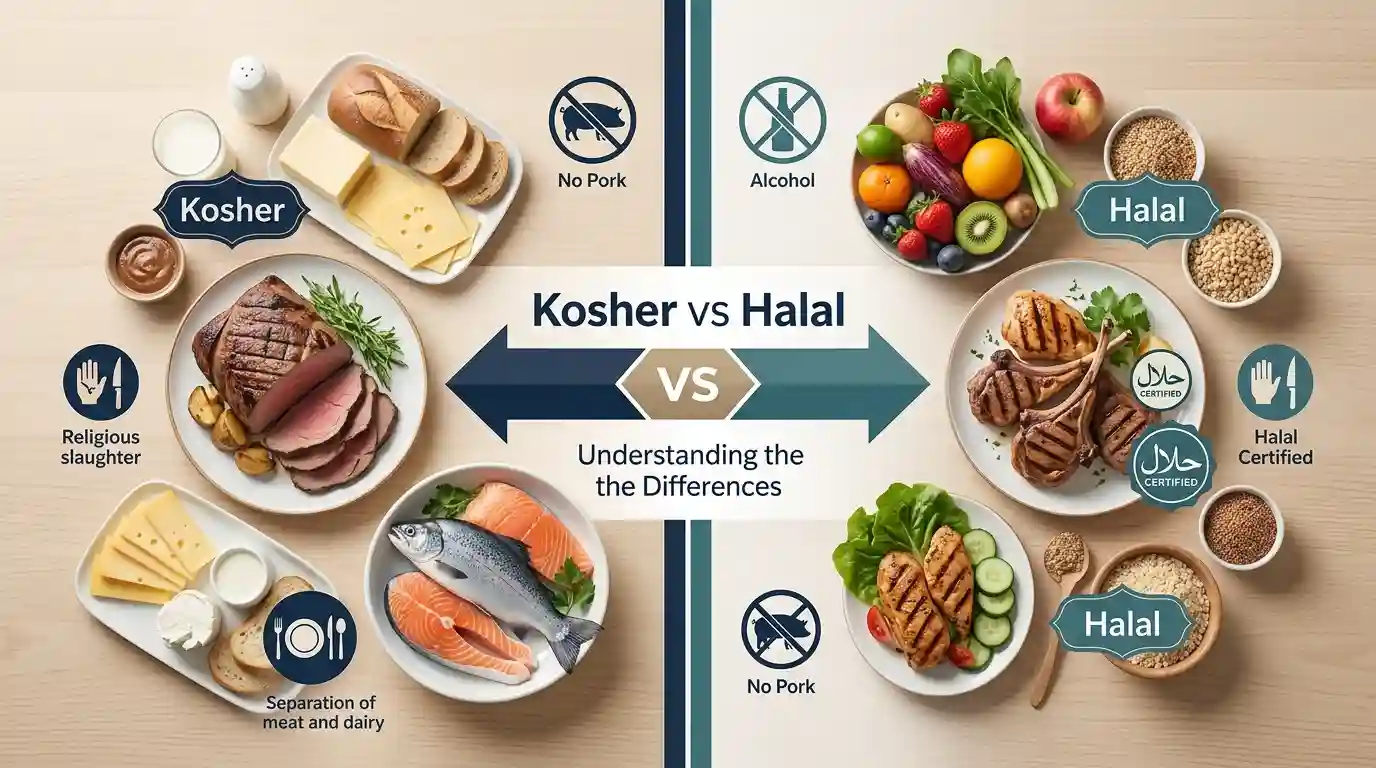
The main difference between kosher and halal is that kosher follows Jewish dietary law, while halal follows Islamic dietary law. Both prohibit pork, blood, and improperly slaughtered animals, but they differ in areas such as alcohol, seafood, meat preparation, slaughter rules, and the separation of meat and dairy.
Quick Comparison Table
| Attribute | Kosher | Halal |
| Religion | Judaism | Islam |
| Meaning | Fit or proper under Jewish law | Permitted or lawful under Islamic law |
| Pork | Not allowed | Not allowed |
| Alcohol | Some alcoholic products can be kosher under specific rules | Alcohol is prohibited |
| Blood | Not allowed | Not allowed |
| Meat slaughter | Shechitah by a trained Jewish slaughterer | Islamic slaughter according to halal requirements |
| Meat and dairy | Must be kept separate | No general religious rule requiring separation |
| Shellfish | Not kosher | Generally permitted in many Islamic interpretations, but rules can vary |
| Certification | Kosher supervision/certification | Halal certification |
| Main religious law | Kashrut | Islamic dietary law |
Introduction
Kosher and halal are two religious systems that guide what people may eat and how food should be prepared.
Kosher comes from Jewish law. The word means “fit” or “proper.” Kosher rules are called kashrut.
Halal comes from Islamic law. The word means “permissible” or “lawful.” Its opposite is haram, meaning forbidden.
The two systems have several similarities. Both place rules on meat, slaughter, blood, and certain animals. However, they are not the same system. A food can be kosher but not halal, or halal but not kosher.
What Is Kosher?
Kosher food follows the dietary laws of Judaism.
These laws determine:
- Which animals may be eaten
- How certain animals must be slaughtered
- How blood is removed
- How meat and dairy are handled
- Which ingredients may be used
- How food and equipment are supervised
Jewish dietary rules identify certain animals as permitted and others as forbidden. For example, pigs and shellfish are not kosher. The Torah also gives animal characteristics used to identify permitted land animals.
Kosher food can also have different categories. The major categories are meat, dairy, and pareve. Pareve foods contain neither meat nor dairy and can generally be used with either category.
Kosher Meat
Kosher meat must come from an animal permitted by Jewish law.
For mammals, the animal must meet specific requirements. Kosher slaughter is called shechitah.
A trained person called a shochet performs the slaughter using a specially prepared knife. Kosher meat also goes through additional inspection and blood-removal procedures.
Meat and Dairy Must Be Separate
One of the most important kosher rules is the separation of meat and dairy.
For example, a kosher meal cannot simply combine meat and cheese in the way an ordinary meal might. Kosher kitchens may use separate dishes, utensils, and equipment for meat and dairy.
This is one of the clearest differences between kosher and halal.
What Is Halal?
Halal food follows Islamic dietary rules.
Muslims may eat foods that are halal, or permitted. Some foods are clearly forbidden, or haram.
Important halal restrictions include:
- Pork and pork products
- Blood
- Carrion, or animals that died without proper slaughter
- Alcoholic substances
- Certain animal-derived ingredients
- Meat that does not meet the required Islamic slaughter rules
The Quran specifically prohibits carrion, blood, pork, and animals dedicated to something other than Allah, among other categories.
Halal food rules can also apply to processed foods. Ingredients such as gelatin, animal fats, enzymes, and flavorings may need to be checked because their sources can affect halal status.
Halal Meat
For meat to be halal, the animal must be a permitted species and the slaughter must meet applicable Islamic requirements.
The exact details can differ among Islamic legal schools and halal certification organizations. This is important because not every halal certification standard is identical.
Halal certification may also check ingredients, processing equipment, production areas, and possible contamination with forbidden substances.
Core Differences Between Kosher and Halal
1. Pork
Both kosher and halal prohibit pork.
This is one of the strongest similarities between the two systems.
Jewish dietary law specifically excludes pigs, while Islamic dietary law prohibits swine and its derivatives.
Example:
- Pork sausage → Not kosher
- Pork sausage → Not halal
- Bacon made from pork → Neither kosher nor halal
However, a product labeled “bacon” could sometimes be made from another animal. The actual ingredients and preparation would need to be checked.
2. Alcohol
Alcohol is a major difference.
Halal: Alcoholic substances are prohibited under common halal standards.
Kosher: Alcohol itself is not automatically treated in exactly the same way. Some alcoholic products can be kosher if they meet Jewish dietary requirements. Wine and grape juice have special kosher requirements and normally need reliable kosher certification.
So:
Halal does not allow alcoholic drinks, while kosher rules are more complex and can permit some alcoholic products.
This means a drink can be kosher but not halal.
3. Meat and Dairy
This is perhaps the easiest difference to remember.
Kosher: Meat and dairy must be kept separate.
Halal: There is no equivalent general rule requiring Muslims to keep meat and dairy separate.
For example, a cheeseburger made with properly halal meat may be halal from the standpoint of the meat and dairy combination.
A cheeseburger cannot be kosher simply because the beef and cheese are individually kosher. The combination of meat and dairy violates kosher rules.
4. Seafood
Kosher and halal rules can differ greatly for seafood.
Under Jewish dietary law, aquatic animals must meet specific requirements. Fish need fins and scales, while shellfish such as shrimp, crab, and lobster are not kosher.
Islamic dietary rules are different. Many Islamic interpretations allow seafood broadly, although specific rulings can differ between Islamic schools of law.
This means:
- Shrimp → Not kosher
- Crab → Not kosher
- Lobster → Not kosher
- Many seafood items → May be halal, depending on the Islamic interpretation followed
Therefore, seafood is an important reason why kosher and halal cannot be treated as identical labels.
5. Slaughter
Both systems have religious rules for slaughter, but the requirements are different.
Kosher slaughter is called shechitah. It is performed by a specially trained Jewish slaughterer called a shochet, using a particular knife and procedure.
Halal slaughter follows Islamic requirements. These can include requirements concerning the animal, the slaughter method, and the invocation of God’s name.
Because the religious requirements are not identical, kosher meat should not automatically be assumed to be halal, and halal meat should not automatically be assumed to be kosher.
There are Islamic scholarly differences about whether kosher meat may be accepted as halal in particular circumstances. A Muslim who follows a specific school or halal certification standard should follow that authority’s guidance.
6. Blood
Both traditions prohibit consuming blood.
Kosher meat therefore goes through a special process to remove blood. Kosher rules include soaking and salting meat, while some organs require additional treatment.
Islamic dietary rules also prohibit blood and require meat to come from animals slaughtered according to applicable halal requirements.
So, both systems share the rule, but the complete procedures and religious requirements are not identical.
7. Food Processing and Equipment
Kosher rules can be very strict about food production equipment.
Kosher certification can consider:
- Ingredients
- Processing equipment
- Production lines
- Meat and dairy status
- Possible contact with non-kosher substances
The Orthodox Union explains that kosher certification reviews ingredients, equipment, and production processes and may require separate production procedures or kosherization of equipment.
Halal certification can also examine production areas and equipment to prevent contact with forbidden substances. IFANCA notes that halal integrity includes avoiding contamination with non-halal substances.
The basic idea is similar, but the religious rules behind the systems are different.
Are Kosher and Halal the Same?
No.
Kosher and halal overlap in several important areas, but they come from different religious laws.
Both generally:
- Prohibit pork
- Prohibit consuming blood
- Regulate meat
- Have religious slaughter rules
- Pay attention to food ingredients
- Can require religious certification or supervision
But they differ in important areas such as:
- Alcohol
- Seafood
- Meat and dairy
- Slaughter requirements
- Certain ingredients
- Certification standards
Chabad’s comparison of the two systems also emphasizes that halal does not equal kosher and that kosher food has additional requirements, including specific slaughter, supervision, and processing rules.
Can Halal Food Be Kosher?
Sometimes a food may meet some requirements of both systems, but halal certification does not automatically make a food kosher.
Kosher certification involves its own religious requirements, including kosher ingredients, equipment, preparation, and supervision.
For a person who follows kosher law strictly, the safest approach is to look for a reliable kosher certification.
Can Kosher Food Be Halal?
Again, not automatically.
There are areas where kosher and halal rules overlap. Some Muslims may accept certain kosher meat under particular interpretations of Islamic law, especially because Jewish people are considered among the People of the Book in Islamic tradition.
However, this does not mean that every kosher product is halal.
For example, kosher food may contain an alcoholic ingredient or wine that would not meet a particular halal standard. Kosher meat also follows Jewish slaughter requirements rather than the complete set of requirements used by a given halal authority.
A Muslim consumer who requires halal certification should therefore check the relevant halal standard rather than assuming that a kosher label is sufficient.
Why a Kosher Label Does Not Mean Halal
A kosher label tells consumers that the product meets a particular Jewish dietary standard.
A halal label tells Muslim consumers that the product meets a particular Islamic dietary standard.
These certifications answer different religious questions.
For example:
Kosher certification asks:
Does this food meet the applicable requirements of Jewish dietary law?
Halal certification asks:
Does this food meet the applicable requirements of Islamic dietary law?
Some foods may satisfy both systems, but the labels are not interchangeable.
Common Misconceptions
Misconception 1: Kosher and halal are exactly the same
They are not.
They share several food restrictions, especially concerning pork and blood, but their rules come from different religious traditions.
Misconception 2: If meat is halal, it must be kosher
Not necessarily.
Kosher meat has specific requirements for the permitted animal, slaughter, inspection, blood removal, and supervision.
Misconception 3: If food is kosher, it must be halal
Not necessarily.
Some kosher foods can contain ingredients or follow rules that do not meet a particular halal standard. Alcohol-related ingredients and different slaughter requirements are important examples.
Misconception 4: All seafood is kosher
No.
Kosher law places specific requirements on aquatic animals. Shellfish such as shrimp, crab, and lobster are not kosher.
Misconception 5: Halal and kosher only apply to meat
No.
Both systems can affect processed foods and ingredients. Halal certification may require checking ingredients such as gelatin, fats, enzymes, and flavorings. Kosher certification also examines ingredients and food-processing equipment.
Similarities Between Kosher and Halal
Although the two systems are different, they have a strong area of overlap.
Both Have Religious Foundations
Kosher is based on Jewish dietary law.
Halal is based on Islamic dietary law.
Both Restrict Certain Animals
Neither system permits pork.
Both also have rules that determine which animals may be eaten.
Both Regulate Meat
Meat cannot simply be judged by the animal alone. Religious rules can also govern how the animal is slaughtered and processed.
Both Restrict Blood
Both systems prohibit consuming blood.
The same Can Require Certification
Modern food products may contain many ingredients that are difficult for consumers to check themselves. Religious certification helps consumers identify products that meet a particular standard.
Which Is Better: Kosher or Halal?
Neither is “better.”
Kosher and halal are not competing food-quality systems. They are religious dietary systems followed by different communities.
A Jewish consumer who follows kosher law needs kosher food.
A Muslim consumer who follows halal dietary law needs halal food.
Some foods may satisfy both requirements, but consumers should check the appropriate certification when strict compliance matters.
FAQs
Is kosher the same as halal?
No. Kosher is based on Jewish dietary law, while halal is based on Islamic dietary law. They share some rules, such as prohibitions on pork and blood, but they differ in areas such as alcohol, seafood, meat and dairy, slaughter, and food preparation.
Can Muslims eat kosher food?
It depends on the food and the Islamic interpretation being followed. Some Muslims accept certain kosher meat because Jewish people are considered People of the Book, while others follow halal certification standards more strictly. A Muslim should follow the guidance of the Islamic authority or halal standard they trust.
Can Jews eat halal food?
Halal food is not automatically kosher. Jewish dietary law has specific requirements for ingredients, slaughter, processing, and supervision. Therefore, someone who strictly follows kosher law generally needs to check for reliable kosher certification.
Is kosher meat halal?
Not automatically. Kosher meat is produced according to Jewish slaughter requirements. Some Islamic scholars may permit certain kosher meat, but acceptance can depend on the interpretation and conditions being followed.
Is halal food healthier than kosher food?
Neither label automatically means that the food is healthier. Kosher and halal are religious classifications, not general health ratings. A kosher or halal product can still be high in sugar, salt, fat, or calories.
Why do kosher and halal have similar rules?
Both Judaism and Islam have religious laws governing food. Their traditions share some dietary restrictions, including prohibitions on pork and blood and rules concerning animal slaughter. However, the detailed requirements developed within each religious legal tradition are different.
Is alcohol kosher?
Some alcoholic products can be kosher, but they must meet applicable kosher requirements. Wine and grape products have especially important kosher rules and may require reliable kosher certification.
Is shrimp halal or kosher?
Shrimp is not kosher because kosher seafood must meet specific requirements concerning fins and scales. In many Islamic interpretations, shrimp is considered permissible, although seafood rulings can vary among Islamic schools.
Conclusion
The difference between kosher and halal is mainly a difference between two religious food-law systems. Kosher follows Jewish dietary law, while halal follows Islamic dietary law. Both restrict pork, blood, and improperly prepared meat, but they are not interchangeable. Kosher has special rules about meat and dairy, while halal has a strong prohibition on alcohol. Seafood rules also differ. Slaughter and food-processing requirements are different as well. When religious compliance is important, the best approach is to look for the appropriate kosher or halal certification rather than assuming that one label automatically satisfies the other.

Hi! I am Arshad Ullah presently working as linguist in Punjab Education Department. I have done MA in English Literature while M.Phil in Applied Linguistics. I have taught creative writing to the post graduation classes for 15 years. Presently I am working as content writer, and offering classes for blog writing. On this site, I research each topic from authoritative sources and edit every comparison for accuracy and clear, simple language.