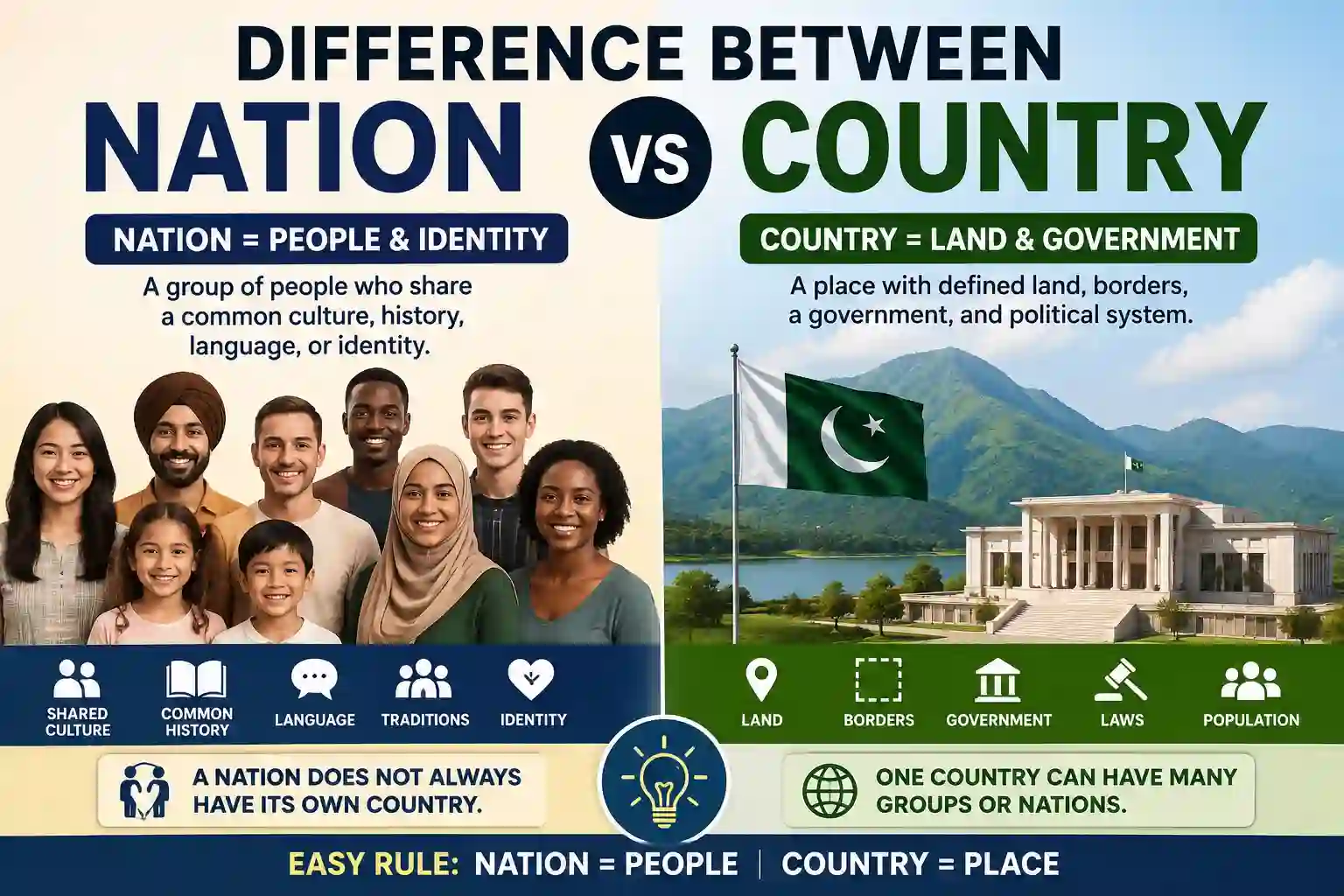
The difference between nation and country is simple. A nation is a group of people who share a common identity, history, culture, or language. A country is a place with land, borders, and a government. The two words often mean the same thing in daily English. But they can have different meanings in history, culture, and politics.
Quick Comparison
| Nation | Country |
| Focuses on people | Focuses on a place |
| Linked to shared identity | Linked to land and borders |
| Can be based on culture or history | Has a government |
| Does not always have its own land | Has a defined territory |
| Can exist without a state | Usually has political control |
Introduction
The words nation and country are easy to mix up.
People often use them in the same way. For example, we may say, “France is a nation” or “France is a country.”
Both can be correct.
But there is a small difference.
A nation is more about people. It can be about their shared culture, history, language, or identity.
A country is more about a place. It has land, borders, and a government.
This difference is useful when you talk about geography, history, culture, or politics.
What Is a Nation?
A nation is a group of people who feel that they belong together.
They may share:
- A common history
- A common culture
- A common language
- Common traditions
- A shared identity
The key idea is people.
A nation does not always need its own country.
For example, the Kurdish people are often described as a nation. They live in more than one country. They have a shared identity and history, but they do not have one independent country of their own.
What Is a Country?
A country is a place with its own land and political system.
A country normally has:
- Borders
- Land
- A government
- Laws
- People
Pakistan, France, Japan, and Brazil are examples of countries.
The United Nations lists 193 Member States. These are commonly called countries in everyday English.
Source: United Nations Member States
The key idea is place and government.
Core Difference Between Nation and Country
The easiest way to remember the difference is:
Nation = people and identity
Country = land and government
A nation is about who people are.
A country is about where they live and how that place is governed.
Key Differences
1. People vs. Place
A nation mainly means people.
A country mainly means place.
For example:
- A nation can have a shared culture.
- A country can have borders and land.
2. Identity vs. Government
A nation is linked to identity.
A country is linked to government.
People may feel that they belong to a nation because of their history, culture, or traditions.
A country has a government that makes and applies laws.
3. A Nation May Not Have Its Own Country
This is an important difference.
A nation does not always have its own independent country.
The Kurdish people are one example. They have a shared national identity, but they live across several countries.
So, a nation and a country are not always the same thing.
4. One Country Can Have Many Groups
A country can have people from many cultures and backgrounds.
These groups may have different languages, traditions, or identities.
So, one country does not always mean one nation.
5. Nation Can Have a Cultural Meaning
The word nation can show a strong sense of belonging.
It can describe people who feel connected by their history or culture.
The word country is more often used for the land and political area.
Examples
Let us look at Pakistan.
Pakistan is a country.
It has:
- Its own land
- Borders
- A government
- Laws
- A political system
Pakistan can also be called a nation.
In this case, the word can focus on the people and their shared national identity.
So:
Pakistan as a country = land and government
Pakistan as a nation = people and identity
Are Nation and Country the Same?
Sometimes, but not always.
In daily English, people often use the words in the same way.
For example:
- “India is a country.”
- “India is a nation.”
Both sentences can refer to India as a sovereign political place.
But the focus can change.
Use nation when you want to focus on people and identity.
Use country when you want to focus on land, borders, or government.
Nation, Country, and State
The word state can make this topic more confusing.
In simple terms:
| Word | Simple Meaning |
| Nation | A group of people with a shared identity |
| Country | A place with land and government |
| State | A political area with a government and sovereignty |
In everyday English, country and state can mean almost the same thing.
But in politics and law, state can have a more exact meaning.
Common Mistakes
Mistake 1: Every nation has a country
Not true.
Some nations do not have their own independent country.
Mistake 2: Every country has only one nation
Not true.
A country can have many groups with different cultures and identities.
Mistake 3: Nation and country always mean the same thing
Not always.
They often have the same meaning in daily speech. But nation can focus on people, while country can focus on place.
Mistake 4: Country and state always mean different things
Not in daily English.
People often use country and state in the same way.
But state has a more exact meaning in political science and law.
When Should You Use Nation or Country?
Use nation when you are talking about:
- People
- Culture
- History
- Identity
- Traditions
- National feeling
Use country when you are talking about:
- Land
- Borders
- Government
- Laws
- Geography
- Political systems
Simple Examples
“The country has large cities.”
Here, the focus is on the place.
“The nation has a strong cultural identity.”
Here, the focus is on the people.
FAQs
Is a nation the same as a country?
Not always. A nation is mainly a group of people with a shared identity. A country is mainly a place with land, borders, and a government. In daily English, however, the two words are often used as synonyms.
Can a nation exist without a country?
Yes. A nation can exist without having its own independent country. People can share a strong identity, culture, and history even when they live in more than one country.
Can one country have many nations?
Yes. A country can have many groups with different cultures and identities. Its borders do not always match the borders of every national group.
Is Pakistan a nation or a country?
Pakistan can be called both. It is a country because it has land, borders, and a government. It can also be called a nation when the focus is on its people and shared national identity.
Which word should I use?
It depends on your meaning. Use nation when you are talking about people and identity. Use country when you are talking about land, borders, or government.
What is the easiest way to remember the difference?
Use this simple rule:
Nation = people.
Country = place.
This rule is not perfect for every case, but it works well for basic English.
Conclusion
The difference between nation and country is mainly about focus. A nation is about people and their shared identity. A country is about land, borders, and government. The two words often mean the same thing in daily English. But they are not always the same. A nation can exist without its own country. A country can also have many different groups. The easiest rule is simple: nation means people, while country means place. Remembering this basic difference can help you use both words correctly.
Meta Description: Learn the difference between nation and country in simple English. See clear definitions, examples, key differences, and easy tips.
Slug: difference-between-nation-and-country

Hi! I am Arshad Ullah presently working as linguist in Punjab Education Department. I have done MA in English Literature while M.Phil in Applied Linguistics. I have taught creative writing to the post graduation classes for 15 years. Presently I am working as content writer, and offering classes for blog writing. On this site, I research each topic from authoritative sources and edit every comparison for accuracy and clear, simple language.