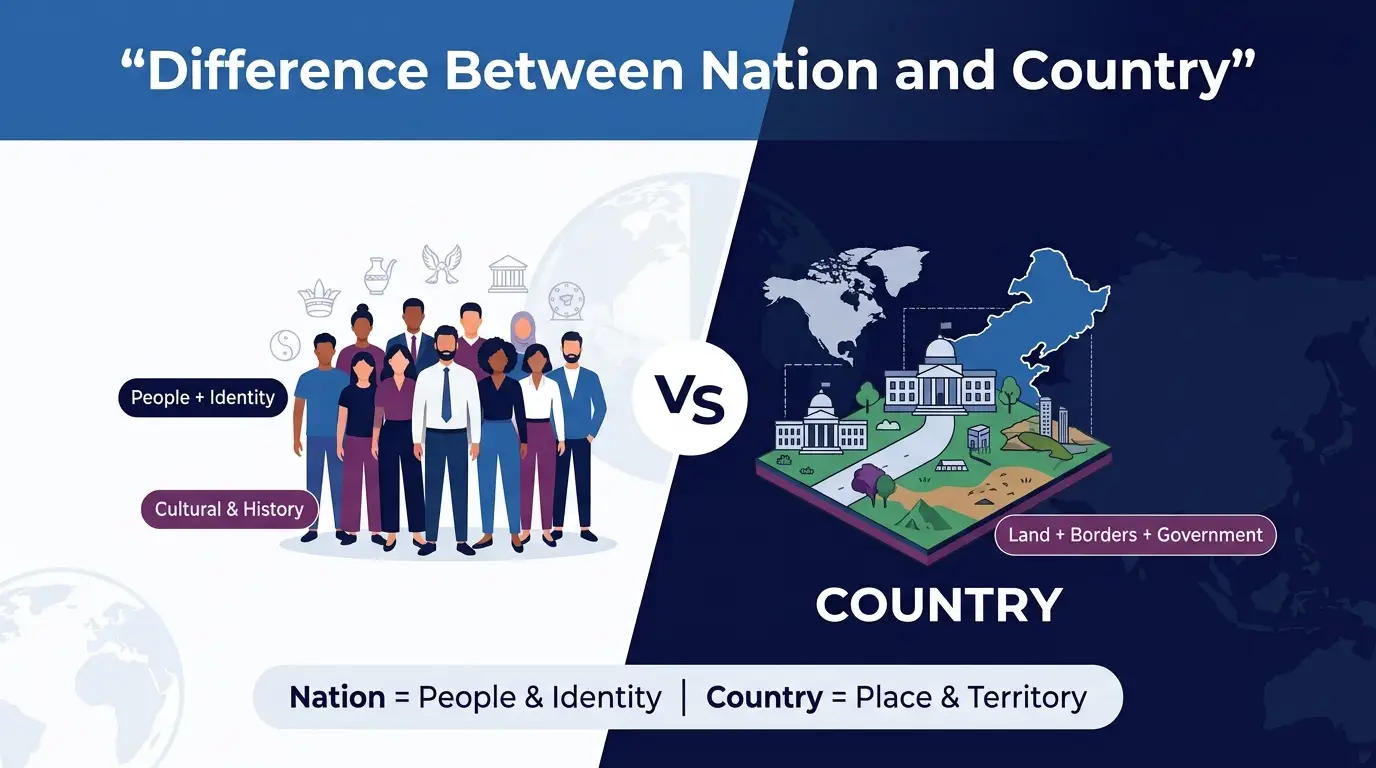
The difference between nation and country is mainly about identity versus territory. A nation is a group of people connected by a shared identity, history, culture, language, or traditions. A country usually refers to a particular geographical or political territory, often with its own government. The two terms can overlap, but they are not always identical.
Quick Comparison Table
| Attribute | Nation | Country |
| Main focus | People and shared identity | Territory and political unit |
| Based on | Culture, history, language, identity, or shared traditions | Land, borders, government, and political organization |
| Requires territory? | Not necessarily | Usually refers to a particular territory |
| Requires its own government? | Not necessarily | Usually, in the common political meaning |
| Can exist without a sovereign state? | Yes | A country may be sovereign, dependent, or have another political status |
| Example | The Kurdish nation | Pakistan |
| Common usage | Often emphasizes people or national identity | Often emphasizes place or political unit |
| Relationship | A nation can exist across countries | A country can contain more than one national identity |
Introduction
The words nation and country are very common in English.
Many people use them in the same way. In many cases, this is fine.
For example, we can say:
- “France is a country.”
- “France is a nation.”
Both sentences can be correct.
But there is a small difference in meaning.
A country usually means a place. It has land, borders, and a government.
A nation usually means a group of people. These people may share a culture, history, language, or sense of identity.
So, the easiest way to remember the difference is:
Country = place
Nation = people and identity
What Is a Nation?
A nation is a group of people who feel that they belong together.
They may share:
- History
- Culture
- Language
- Traditions
- Heritage
- National identity
For example, when we say:
“The nation celebrated the victory.”
The word nation focuses on the people.
It does not only mean the land. It means the people as a group.
A nation does not always need its own country.
A group of people can have a strong national identity even if they do not have a separate independent state.
What Is a Country?
A country is mainly a place.
It is a geographical and political area. It usually has:
- Land
- Borders
- A government
- People living there
- Political control over its territory
For example:
“Pakistan is a country in South Asia.”
Here, the word country tells us about a place.
We often use country when talking about travel, geography, borders, and government.
For example:
- “I live in Pakistan.”
- “She visited five countries.”
- “Which country are you from?”
- “The country has new laws.”
Core Difference Between Nation and Country
The main difference between nation and country is the focus.
- A nation focuses more on people and identity.
- A country focuses more on place and territory.
Compare these two sentences:
“The nation is proud of its history.”
- This focuses on the people and their shared identity.
“The country has large mountains.”
- This focuses on the land and place.
So:
Nation → Who are the people?
Country → Where is the place?
This is a simple rule. It works well for most basic English situations.
Key Differences
1. Nation Focuses on People
A nation is often connected with people.
For example:
“The nation came together after the event.”
Here, nation means the people as a group.
The word can show a feeling of unity and shared identity.
2. Country Focuses on Place
A country is mainly connected with land and territory.
For example:
“Pakistan is a country in South Asia.”
The sentence tells us where Pakistan is.
It describes Pakistan as a geographical and political place.
3. A Nation May Not Have Its Own Country
A nation does not always have its own independent country.
People may share a strong national identity while living in one or more countries.
This is an important point.
Nation and country are not always the same thing.
4. A Country Can Have Different Groups
One country can have many cultural, language, or national groups.
These groups may have their own history and traditions.
So, the borders of a country do not always match the identity of every group living inside it.
5. Nation Is Linked to Identity
The word nation is often used when we talk about:
- National identity
- National culture
- National history
- National traditions
- National pride
For example:
“The nation has a rich culture.”
The focus is on the people and their shared culture.
6. Country Is Common in Daily English
Country is very common in everyday English.
We use it when talking about:
- Travel
- Geography
- Borders
- Places
- Governments
For example:
“Which country do you live in?”
This is much more common than:
“Which nation do you live in?”
7. The Two Words Can Overlap
The words are not always completely separate.
In everyday English, nation can also mean country.
For example:
“Japan is a nation.”
“Japan is a country.”
Both can be correct.
The best word depends on what you want to stress.
Nation vs Country: Examples
Example 1: Pakistan
Pakistan can be called a country.
“Pakistan is a country in South Asia.”
Here, we are talking about its location and political territory.
Pakistan can also be called a nation.
“The Pakistani nation celebrated Independence Day.”
Here, the focus is on the people and their national identity.
Example 2: France
France can also be both a country and a nation.
“France is a country in Europe.”
This focuses on geography.
“The French nation has a long history.”
This focuses more on people and history.
Example 3: Scotland
Scotland is often called a country.
- It is also a nation in many cultural and historical contexts.
- However, Scotland is part of the United Kingdom and is not a separate sovereign state.
This shows why country, nation, and state should not always be treated as exactly the same words.
Similarities Between Nation and Country
Nation and country have some important similarities.
Both Can Describe the Same Place
In normal conversation, both words can refer to the same place.
For example:
- “Japan is a country.”
- “Japan is a nation.”
Both statements can be correct.
Both Can Refer to People
Both words can sometimes refer to people.
For example:
- “The country voted for a new government.”
- Here, country can mean the people of the country.
We can also say:
- “The nation voted for a new government.”
- Here, nation clearly refers to the people as a group.
Both Are Used in Politics
Both words are common in discussions about:
- Government
- History
- Independence
- Elections
- Culture
- International relations
The right word depends on the meaning we want to show.
When to Use Nation or Country
Use country when you are talking about a place.
Examples
- “Which country are you from?”
- “I visited another country.”
- “Japan is an island country.”
- “The country has strict borders.”
Use nation when you are talking more about people or shared identity.
Examples
- “The nation celebrated the win.”
- “The nation has a rich history.”
- “The nation came together.”
- “The nation’s culture is very diverse.”
Easy Memory Trick
Remember:
Country = Place
Nation = People
This is not a perfect rule. But it is a very useful rule for English learners.
Common Misconceptions
Is Every Nation a Country?
No.
A nation does not always have its own independent country.
A group can have a strong shared identity without having its own sovereign state.
Are Nation and Country the Same?
Not always.
They often overlap in everyday English.
But nation usually puts more focus on people and identity.
Country usually puts more focus on place and territory.
Does Country Always Mean an Independent State?
No.
The word country is used in everyday English in a broad way.
In political or legal writing, sovereign state can be a more exact term.
Does Nation Always Mean a Group With the Same Ethnicity?
No.
A nation can be based on many things.
People may share:
- History
- Culture
- Language
- Political identity
- Traditions
- A sense of belonging
So, nation does not always mean ethnicity.
Read More: Difference Between Fall and Autumn: A Simple Study
FAQs
What is the simple difference between a nation and a country?
A country is mainly a place with land, borders, and political organization. A nation is mainly a group of people who share a common identity, culture, history, or other strong connection. The two words often overlap, so the difference is not always strict in everyday English.
Can a nation exist without a country?
Yes. A nation can have its own shared identity without having a separate independent country. People may live within the borders of another country or across several countries. This is why a nation and a country are not always the same thing.
Can a country have more than one nation?
Yes. A country can contain different groups with different cultures, histories, languages, or national identities. The political borders of a country do not always match the borders of every national or cultural group living there.
Is Pakistan a nation or a country?
Pakistan can be called both a nation and a country. It is a country when we are talking about its land, borders, and political system. It can be called a nation when we are talking about its people, shared national identity, history, and culture.
Is a nation bigger than a country?
No fixed size rule exists. A nation is not defined by physical size. It is mainly about people and identity. A country is mainly about territory and political organization. A nation can exist within a country or across more than one country.
Which word should I use: nation or country?
Use country when you are talking about a place, travel, geography, or borders. Use nation when you want to focus on people, culture, history, or national identity. In many everyday sentences, either word may work, but one may sound more natural depending on the context.
Conclusion
The main difference between nation and country is simple. A country mainly refers to a place with land, borders, and political organization. A nation mainly refers to people who share a common identity, history, culture, language, or traditions. The two words can describe the same place, so they are often used in the same way in everyday English. However, they are not always identical. A nation can exist without its own independent country, and a country can include different national or cultural groups. For a quick memory tip, think country = place and nation = people and identity.

Hi! I am Arshad Ullah presently working as linguist in Punjab Education Department. I have done MA in English Literature while M.Phil in Applied Linguistics. I have taught creative writing to the post graduation classes for 15 years. Presently I am working as content writer, and offering classes for blog writing. On this site, I research each topic from authoritative sources and edit every comparison for accuracy and clear, simple language.