Last night, Sara wrote a message: “I payed the bill.” Her friend replied, “It should be paid.” Sara got confused. Many learners face this problem. The difference between payed and paid is tricky. The words look similar, but they are not the same.
In fact, the difference between payed and paid matters in writing and exams. One word is common. The other is rare. If you use the wrong one, your sentence may look incorrect. So, this guide will help you understand both words in a very simple way. Let’s begin.
What is “Payed”?
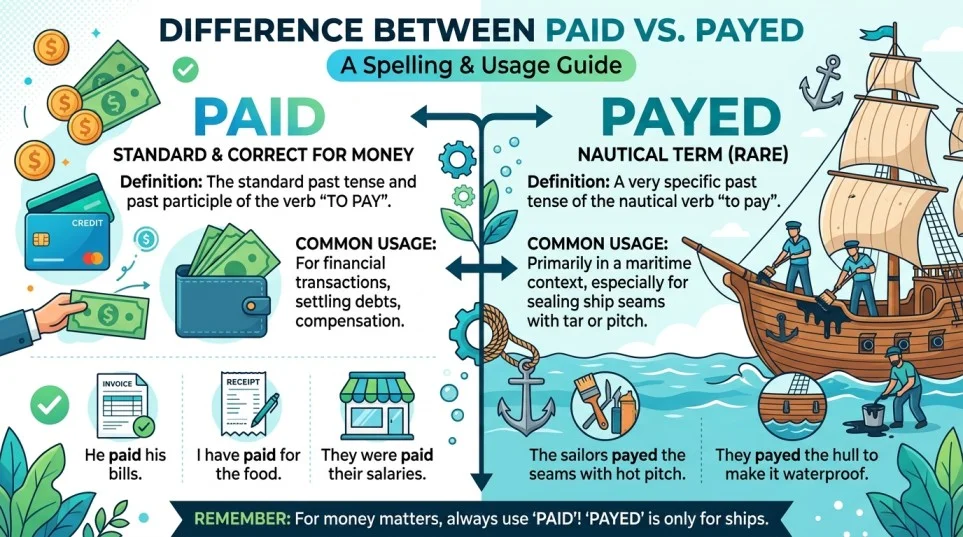
“Payed” is a rare form of the verb “pay.” It is mostly used in sailing. It means to seal or cover something with material like tar.
History of Payed
The word “payed” comes from old English and nautical use. Sailors used it many years ago. They “payed” ropes and ships with tar to protect them from water. This helped ships stay strong in the sea. Over time, this meaning stayed only in marine language. It did not grow in daily use. Today, “payed” is still correct, but only in this special context. Most people do not use it in normal speech. That is why many learners think it is a mistake. But it is not wrong, just very limited in use.
What is “Paid”?
“Paid” is the correct past tense of “pay.” It means to give money or clear a bill.
History of Paid
“Paid” comes from the verb “pay.” It has been used for many centuries. In early English, people used different forms, but “paid” became standard. It spread in daily life, business, and writing. People used it for money, debts, and rewards. Over time, it became the accepted past tense. Today, “paid” is used all over the world. It is common in schools, offices, and daily talk. You will see it in books, emails, and messages. Unlike “payed,” this word is widely known and used in almost every situation.
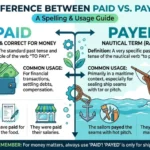
Payed vs Paid
Payed: Used in sailing (to seal or coat)
Paid: Past tense of pay (money or bills)
Now let’s look deeper to understand clearly.
How “Payed” Works
Key features:
- Rare word
- Used in sailing
- Means to seal with tar
- Not used for money
🔵 The sailor payed the rope with tar.
🔵 They payed the ship to stop leaks.
Uses:
- Marine work
- Old texts
- Technical writing
How “Paid” Works
Key features:
- Common word
- Past tense of pay
- Used for money
- Used in daily life
🟢 I paid the shopkeeper.
🟢 She paid her school fee.
Uses:
- School writing
- Office work
- Daily talk
- Banking
Which one should you use?
Use “paid” in almost all cases.
Use “payed” only in sailing context.
10 Differences Between Payed and Paid
1. Meaning
Payed: To seal with tar
🔴 He payed the deck.
🔴 They payed the boat.
Paid: Gave money
🔴 I paid the bill.
🔴 She paid the rent.
2. Usage
Payed: Rare use
🔴 Payed is used in ships.
🔴 It appears in marine texts.
Paid: Common use
🔴 Paid is used daily.
🔴 It is used in school.
3. Context
Payed: Technical
🔴 Payed fits sea work.
🔴 It suits ship repair.
Paid: General
🔴 Paid fits daily life.
🔴 It suits all people.
4. Frequency
Payed: Very rare
🔴 You may not see it often.
🔴 It is uncommon in speech.
Paid: Very common
🔴 You see it daily.
🔴 It is used everywhere.
5. Learning Level
Payed: Advanced knowledge
🔴 It needs special learning.
🔴 It is not for beginners.
Paid: Basic word
🔴 It is easy to learn.
🔴 It is taught early.
6. Field
Payed: Marine field
🔴 Used by sailors.
🔴 Found in ship work.
Paid: All fields
🔴 Used in business.
🔴 Used in homes.
7. Grammar Role
Payed: Special verb form
🔴 It has limited grammar use.
🔴 It is not standard for money.
Paid: Standard past tense
🔴 It follows grammar rules.
🔴 It is correct for pay.
8. Common Error
Payed: Often used wrongly
🔴 Many write payed for money.
🔴 This is a mistake.
Paid: Correct form
🔴 Paid is correct usage.
🔴 It avoids errors.
9. Recognition
Payed: Less known
🔴 Few people know it.
🔴 It confuses learners.
Paid: Well known
🔴 Everyone knows it.
🔴 It is easy to understand.
10. Purpose
Payed: Protect surfaces
🔴 Payed rope stays safe.
🔴 Payed wood resists water.
Paid: Settle money
🔴 Paid bill is complete.
🔴 Paid debt is cleared.
Why People Get Confused About Their Use
People get confused because both words look similar. Also, “payed” seems like a regular past form. But English has irregular verbs. So, “paid” is correct for money.
Table: Difference and Similarity
| Feature | Payed | Paid | Similarity |
| Meaning | Seal with tar | Give money | Both from “pay” |
| Usage | Rare | Common | Verb forms |
| Context | Marine | Daily life | English words |
| Frequency | Low | High | Used in sentences |
| Grammar | Limited | Standard | Past forms |
Which is Better in What Situation?
Payed:
Use “payed” only in special cases. It fits ship work and sailing. If you write about boats, you may need it.
Paid:
Use “paid” in daily life. It is correct for money and bills. It is best for school, exams, and work.
How Are “Payed” and “Paid” Used in Metaphors and Similes?
🟣 “He paid the price of his mistake.”
🟣 “Her effort paid off like gold.”
Connotative Meaning
Paid: Positive or neutral
🟣 Paid work feels rewarding.
Payed: Neutral
🟣 Payed has no strong feeling.
Idioms or Proverbs
🟣 “Pay the price” = face result
Example: He paid the price for lying.
🟣 “Paid off” = success
Example: Hard work paid off.
Works in Literature
🟣 Great Expectations by Charles Dickens (1861) — money themes
🟣 Pride and Prejudice by Jane Austen (1813) — social and financial life
Movies Related to the Keywords
🟣 The Pursuit of Happyness (2006, USA) — hard work pays
🟣 Wall Street (1987, USA) — money and success
Frequently Asked Questions
1. Is “payed” wrong?
No, but it is rare.
2. Is “paid” correct for money?
Yes, always.
3. Can I use “payed” in exams?
No, avoid it unless needed.
4. Why is “paid” irregular?
English has many irregular verbs.
5. Which is more common?
“Paid” is very common.
Final Words
Now you know the right choice. Practice daily. Soon, you will never confuse them again.
Conclusion
The difference between payed and paid is simple once you learn it. “Paid” is the correct word for money. “Payed” is rare and used in sailing only. Always choose wisely. Understanding the difference between payed and paid will improve your writing and confidence.

Hi! I am Arshad Ullah presently working as linguist in Punjab Education Department. I have done MA in English Literature while M.Phil in Applied Linguistics. I have taught creative writing to the post graduation classes for 15 years. Presently I am working as content writer, and offering classes for blog writing.