A student once met two travelers at a market. One said he was Arab. The other said he was Persian. The student felt confused. Both looked similar. Both spoke languages from the same region. So he asked, “What is the difference between Arab and Persian?”
This is a common question. The difference between Arab and Persian is not about one thing only. It is about culture, language, history, and identity. Many learners mix them. But the difference between Arab and Persian is clear when we learn step by step.
In this article, we will explain the difference between Arab and Persian in a simple and friendly way.
Arab vs Persian
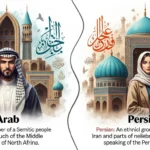
The main difference is simple:
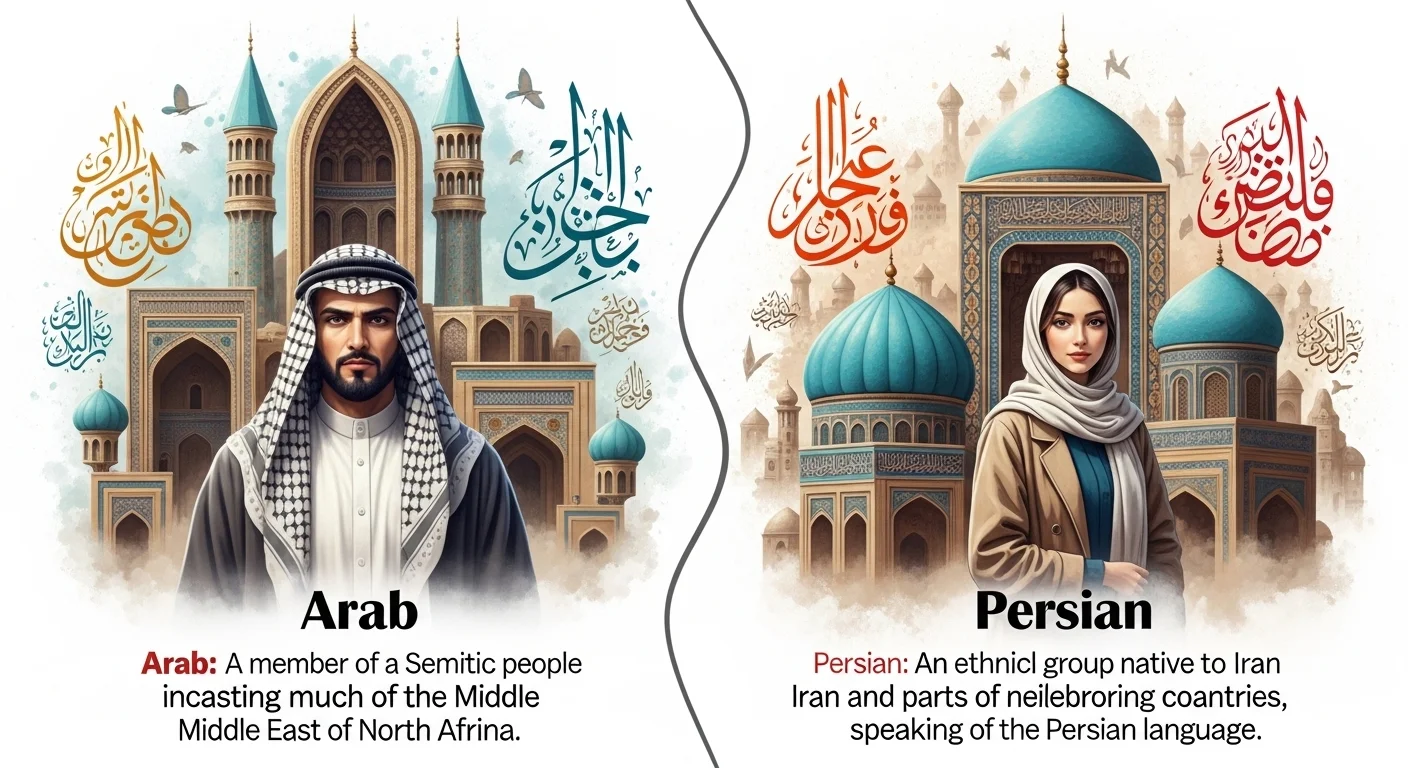
- Arab refers to people from Arab countries who speak Arabic.
- Persian refers to people from Iran who speak Persian (Farsi).
Why Is Their Difference Important in Society?
Knowing the difference helps us respect people’s identity. It avoids confusion in culture and language. For students, it builds clear knowledge. For experts, it improves communication. In society, it supports understanding and harmony between different groups.
Pronunciation (US & UK)
- Arab
- US: /ˈær.əb/
- UK: /ˈær.əb/
- Persian
- US: /ˈpɝː.ʒən/
- UK: /ˈpɜː.ʒən/
Now that you know the basic idea, let’s explore the difference between Arab and Persian in detail with clear examples.
A List of 10 Differences Between Arab and Persian
1. Origin
- Arabs come from Arab countries like Saudi Arabia and Egypt.
- Persians come from Iran.
Examples:
- 🔴 Arab: He is an Arab from Egypt.
- 🟣 Persian: She is Persian from Iran.
2. Language
- Arabs speak Arabic.
- Persians speak Persian (Farsi).
Examples:
- 🔴 Arab: I am learning Arabic from an Arab teacher.
- 🟣 Persian: He writes poetry in Persian.
3. Culture
- Arab culture includes desert traditions and Bedouin life.
- Persian culture includes ancient art and poetry.
Examples:
- 🔴 Arab: Arab culture values hospitality.
- 🟣 Persian: Persian culture loves poetry.
4. History
- Arabs have Islamic and tribal history.
- Persians have ancient empires like Persia.
Examples:
- 🔴 Arab: Arab history is rich in trade.
- 🟣 Persian: Persian history is very old.
5. Script
- Arabic uses Arabic script.
- Persian uses a modified Arabic script.
Examples:
- 🔴 Arab: Arabic script is written from right to left.
- 🟣 Persian: Persian script has extra letters.
6. Food
- Arab food includes hummus and falafel.
- Persian food includes kebabs and rice dishes.
Examples:
- 🔴 Arab: I ate Arab bread today.
- 🟣 Persian: Persian rice is very tasty.
7. Clothing
- Arabs wear thobes and abayas.
- Persians wear modern and traditional mixed styles.
Examples:
- 🔴 Arab: The Arab man wore a white thobe.
- 🟣 Persian: Persian dress is colorful.
8. Geography
- Arabs live in many countries across the Middle East.
- Persians mainly live in Iran.
Examples:
- 🔴 Arab: Arabs live in many regions.
- 🟣 Persian: Persians mostly live in Iran.
9. Identity
- Arab is an ethnic and linguistic identity.
- Persian is mainly an ethnic identity.
Examples:
- 🔴 Arab: He feels proud to be Arab.
- 🟣 Persian: She calls herself Persian.
10. Literature
- Arab literature includes Arabic poetry.
- Persian literature includes famous poets.
Examples:
- 🔴 Arab: Arab stories are ancient.
- 🟣 Persian: Persian poetry is famous worldwide.
Nature and Behaviour
- Arabs: Known for strong community bonds and hospitality.
- Persians: Known for politeness, art, and deep thinking.
Why People Get Confused About Their Use
Many people think Arab and Persian are the same because of religion and location. Both groups may follow Islam and live in nearby regions. This creates confusion.
Table: Difference and Similarity
| Feature | Arab | Persian | Similarity |
| Language | Arabic | Persian (Farsi) | Both use similar script |
| Country | Many Arab countries | Iran | Same region |
| Culture | Desert & tribal | Art & poetry | Rich traditions |
| Religion | Mostly Islam | Mostly Islam | Shared beliefs |
Which Is Better in What Situation?
Arab culture is helpful when learning Arabic language or understanding Middle Eastern trade and traditions. It is useful in travel across many countries.
Persian culture is better when studying poetry, art, and ancient history. It is useful for literature lovers and historians.
How Are the Keywords Used in Metaphors and Similes?
🟣 “His voice flowed like Persian poetry.”
🟣 “Their unity was strong like Arab tribes.”
Connotative Meaning
- Arab: Neutral, sometimes positive (culture, unity)
- Example: Arab hospitality is famous.
- Persian: Positive (art, beauty)
- Example: Persian art is elegant.
Idioms and Proverbs
🟣 “An Arab’s promise is strong.” – meaning trust
🟣 “Persian patience brings success.” – meaning calm effort
Works in Literature
🟣 Arabian Nights — Folk tales, unknown writers, 9th century
🟣 Shahnameh — Epic poetry, Ferdowsi, 1010
Movies
🟣 The Message (1976, Arab world)
🟣 A Separation (2011, Iran)
FAQs
1. Are Arabs and Persians the same?
No, they are different in language and culture.
2. Do they speak the same language?
No, Arabic and Persian are different.
3. Where do Persians live?
Mostly in Iran.
4. Can Arabs be Persian?
No, they are different identities.
5. Why do people confuse them?
Because of shared religion and region.
How Are Both Useful for Surroundings?
Arabs contribute to global trade, language, and culture. Persians contribute to art, poetry, and history. Both enrich the world in different ways.
Final Words
Arab and Persian identities are unique. Each has its own beauty, culture, and value.
Conclusion
The difference between Arab and Persian is simple when we break it down. Arabs are linked with Arabic language and many countries. Persians are linked with Iran and Persian language. Both share some similarities, but they are not the same. Understanding this helps us respect cultures and avoid confusion. When we learn clearly, we grow as global citizens. So next time you hear these words, you will know the true difference between Arab and Persian with confidence.

Hi! I am Arshad Ullah presently working as linguist in Punjab Education Department. I have done MA in English Literature while M.Phil in Applied Linguistics. I have taught creative writing to the post graduation classes for 15 years. Presently I am working as content writer, and offering classes for blog writing.