I still remember the first time I learned Python. I saw lists and tuples and thought, “They look almost identical. Why does Python even have both?”
Many beginners feel the same confusion.
Both lists and tuples store multiple values. Both can contain numbers, text, and even other collections. At first glance, they seem interchangeable. Because of that, many new programmers use one when the other would be a better choice.
The difference between list and tuple may look small, but it affects performance, memory usage, data safety, and code quality. Choosing the wrong one can make programs harder to maintain or even introduce unexpected bugs.
This guide explains everything in simple English with practical examples so you can clearly understand the real difference.
What Is a List?
A list is a built-in Python data structure used to store multiple items in a single variable.
Lists are mutable, which means their contents can be changed after creation.
Example
fruits = [“apple”, “banana”, “orange”]
You can:
- Add items
- Remove items
- Modify existing items
- Reorder elements
Example of Modification
fruits[1] = “mango”
Result:
[“apple”, “mango”, “orange”]
Why Lists Are Used
Lists are useful when data changes frequently.
Common uses include:
- Shopping lists
- Student records
- Task management apps
- Inventory systems
- Dynamic datasets
Real-World Example
Imagine a shopping cart on an e-commerce website.
Customers constantly add or remove products. Since the data changes often, a list is the ideal choice.
What Is a Tuple?
A tuple is another built-in Python data structure used to store multiple values.
Unlike a list, a tuple is immutable, meaning its contents cannot be changed after creation.
Example
colors = (“red”, “green”, “blue”)
If you try to modify an item:
colors[0] = “yellow”
Python will generate an error.
Why Tuples Are Used
Tuples are useful when data should remain fixed.
Common uses include:
- Geographic coordinates
- Database records
- Configuration settings
- Days of the week
- Mathematical points
Real-World Example
The coordinates of a city should not accidentally change.
location = (31.5204, 74.3587)
A tuple protects that data from modification.
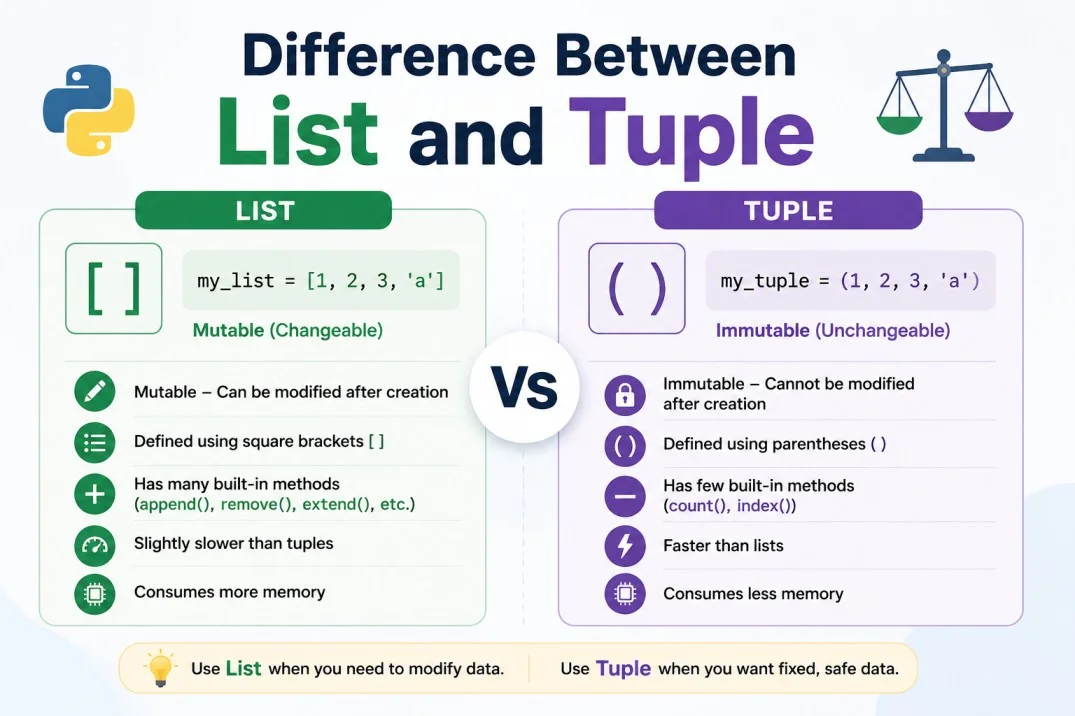
Quick Comparison Table
| Feature | List | Tuple |
| Meaning | Ordered collection | Ordered collection |
| Syntax | [] | () |
| Mutable | Yes | No |
| Purpose | Changing data | Fixed data |
| Speed | Slightly slower | Slightly faster |
| Memory Usage | More memory | Less memory |
| Data Safety | Lower | Higher |
| Modification | Allowed | Not allowed |
| Performance | Good | Better for read-only data |
| Popularity | Very common | Common for fixed values |
| Best Use Case | Dynamic information | Permanent information |
| Main Advantage | Flexibility | Security and efficiency |
| Main Drawback | Can be modified accidentally | Cannot be updated |
Biggest Difference
The biggest difference between list and tuple is mutability.
List
A list can be changed after creation.
numbers = [1, 2, 3]
numbers.append(4)
Result:
[1, 2, 3, 4]
Tuple
A tuple cannot be changed.
numbers = (1, 2, 3)
Adding or removing items will produce an error.
Why This Matters
Many people first assume this difference is minor.
In real-world use, it is often the deciding factor.
If your data will change, use a list.
If your data should stay constant, use a tuple.
Over the long term, this helps prevent mistakes and improves code reliability.
Key Differences Explained
1. Mutability
List
Lists can be edited anytime.
items = [10, 20, 30]
items[0] = 50
Tuple
Tuples cannot be edited.
items = (10, 20, 30)
Practical Impact
Use lists for changing data and tuples for protected data.
2. Syntax
List
Uses square brackets.
[1, 2, 3]
Tuple
Uses parentheses.
(1, 2, 3)
Practical Impact
The visual difference helps programmers identify whether data should change.
3. Memory Usage
List
Consumes more memory.
Tuple
Consumes less memory.
Practical Impact
For large datasets, tuples can improve memory efficiency.
This matters more than many beginners realize.
4. Performance
List
Slightly slower because Python must allow modifications.
Tuple
Slightly faster because values remain fixed.
Practical Impact
Performance gains become noticeable in larger programs.
5. Data Protection
List
Data can be changed accidentally.
Tuple
Data remains protected.
Example
days = (“Monday”, “Tuesday”, “Wednesday”)
Nobody can accidentally modify the values.
6. Built-In Methods
List
Provides many methods.
Examples:
- append()
- remove()
- insert()
- sort()
- pop()
Tuple
Provides only a few methods.
Examples:
- count()
- index()
Practical Impact
Lists offer greater flexibility.
7. Use as Dictionary Keys
List
Cannot be used as dictionary keys.
Tuple
Can be used if it contains immutable elements.
Example:
locations = {
(10, 20): “Home”
}
Practical Impact
Tuples are useful for mapping fixed coordinates and identifiers.
8. Modification Cost
List
Easy to modify.
Tuple
Requires creating a new tuple.
Practical Impact
Lists are better for frequently updated data.
9. Hashability
List
Not hashable.
Tuple
Usually hashable.
Practical Impact
Tuples can work in sets and dictionary keys.
10. Intended Purpose
List
Designed for dynamic collections.
Tuple
Designed for fixed collections.
Practical Impact
Choosing the right structure improves code readability.
11. Developer Intent
List
Signals that values may change.
Tuple
Signals that values should remain constant.
Practical Impact
Other programmers instantly understand your intentions.
Similarities Between Them
Despite their differences, lists and tuples share many features.
Both:
- Store multiple values
- Maintain order
- Support indexing
- Support slicing
- Allow duplicate values
- Can contain mixed data types
- Can be nested
- Work with loops
Because they look and behave similarly, beginners often confuse them.
Pros and Cons
Pros of List
- Easy to modify
- Flexible
- Rich set of methods
- Great for dynamic applications
- Beginner-friendly
Cons of List
- Uses more memory
- Slightly slower
- Vulnerable to accidental changes
- Not hashable
Pros of Tuple
- Faster performance
- Less memory usage
- Better data protection
- Hashable
- Excellent for fixed values
Cons of Tuple
- Cannot be modified
- Fewer methods
- Less flexible
- Requires recreation for changes
Which Is Better for Different Situations?
For Beginners
Lists are usually easier because they allow experimentation.
For Students
Lists help when learning Python fundamentals.
For Professional Developers
Both are important depending on the situation.
For Fixed Data
Tuples are usually better.
Examples:
- Coordinates
- RGB colors
- Configuration values
For Frequently Changing Data
Lists are the better option.
Examples:
- Shopping carts
- User records
- Task lists
For Large Applications
Many developers use tuples whenever data should remain constant because it improves safety and clarity.
Common Mistakes People Make
Using Lists for Permanent Data
Some users later regret storing constant values in lists because accidental changes become possible.
Thinking Tuples Are Faster in Every Situation
The speed difference exists but is usually small.
Choosing Based on Popularity
Lists are more common, but that does not mean they are always better.
Ignoring Future Changes
Always ask:
“Will this data need modification later?”
Confusing Syntax
Many beginners accidentally use parentheses when they intended a list.
Expert Recommendation
Choose List If:
- Data changes often
- You need to add items
- You need to remove items
- You need sorting features
- Flexibility is important
Choose Tuple If:
- Data should remain constant
- You need better data protection
- Memory efficiency matters
- Values represent fixed records
- You want dictionary keys
Avoid List If:
- Data must never change
- You need immutable structures
- Memory optimization is critical
Avoid Tuple If:
- Frequent updates are expected
- User input constantly changes data
- Dynamic collections are required
Final Verdict
When comparing the difference between list and tuple, the answer is not about which one is universally better. It is about choosing the right tool for the job.
Lists shine when flexibility is important. They allow you to add, remove, and update values with ease. For projects involving changing information, lists are often the most practical choice.
Tuples excel when data should remain fixed. They offer better protection against accidental changes, use less memory, and can improve code clarity.
After using both for some time, most Python developers naturally develop a habit: use a list when data changes and a tuple when it should stay the same. Following this simple rule will help you write cleaner, safer, and more professional Python code.
FAQ Section
Which is better, a list or a tuple?
Neither is universally better. Lists are best for changing data, while tuples are best for fixed data. The right choice depends on your specific programming needs.
Is a tuple faster than a list?
Yes. Tuples are generally slightly faster because Python does not need to support modifications. However, the difference is usually small in everyday programs.
Which uses less memory?
Tuples use less memory than lists because they are immutable. This makes them useful for storing large amounts of fixed data.
Which is easier for beginners?
Lists are often easier because beginners can add, remove, and edit values freely while learning Python concepts.
Can a tuple contain a list?
Yes. A tuple can contain a list as one of its elements. However, the list itself can still be modified even though the tuple cannot.
Are lists and tuples interchangeable?
Not always. While both store collections of values, their mutability differences make them suitable for different situations.
What do most Python developers prefer?
Most developers use both. Lists are common for dynamic data, while tuples are preferred for fixed values and data integrity.
What mistake should beginners avoid?
A common mistake is using lists for data that should never change. In such cases, tuples provide better protection and clearer code design.
Conclusion
The difference between list and tuple is one of the first Python concepts every programmer should understand. Although they look similar, they serve different purposes. A list is designed for flexibility and change, while a tuple is designed for stability and protection. Many beginners focus only on syntax, but the real distinction is how the data behaves over time. In practical programming, choosing the right structure improves performance, readability, and code reliability. Lists work best for dynamic collections such as shopping carts, user inputs, and task managers. Tuples are ideal for fixed information like coordinates, settings, and constant records. Understanding when to use each will make your programs more professional and easier to maintain. Once you master this simple concept, many other Python data structure decisions become much easier to understand.

Hi! I am Arshad Ullah presently working as linguist in Punjab Education Department. I have done MA in English Literature while M.Phil in Applied Linguistics. I have taught creative writing to the post graduation classes for 15 years. Presently I am working as content writer, and offering classes for blog writing. On this site, I research each topic from authoritative sources and edit every comparison for accuracy and clear, simple language.