A few years ago, I spoke with a family member who had just been told he needed a heart device. The doctor mentioned a pacemaker, but later another specialist talked about an ICD. He was confused. Aren’t they the same thing?
Many people first assume an ICD and a pacemaker do the exact same job because both are small devices placed inside the chest to help the heart. In reality, they serve different purposes and are designed to treat different heart problems.
Understanding the difference between ICD and pacemaker is important because choosing the wrong device can mean receiving treatment that does not fully address a heart condition. Patients, caregivers, and families often struggle to understand the terms used during medical appointments.
This guide explains everything in simple English with practical examples so you can clearly understand the real difference.
What Is an ICD?
Understanding an Implantable Cardioverter Defibrillator (ICD)
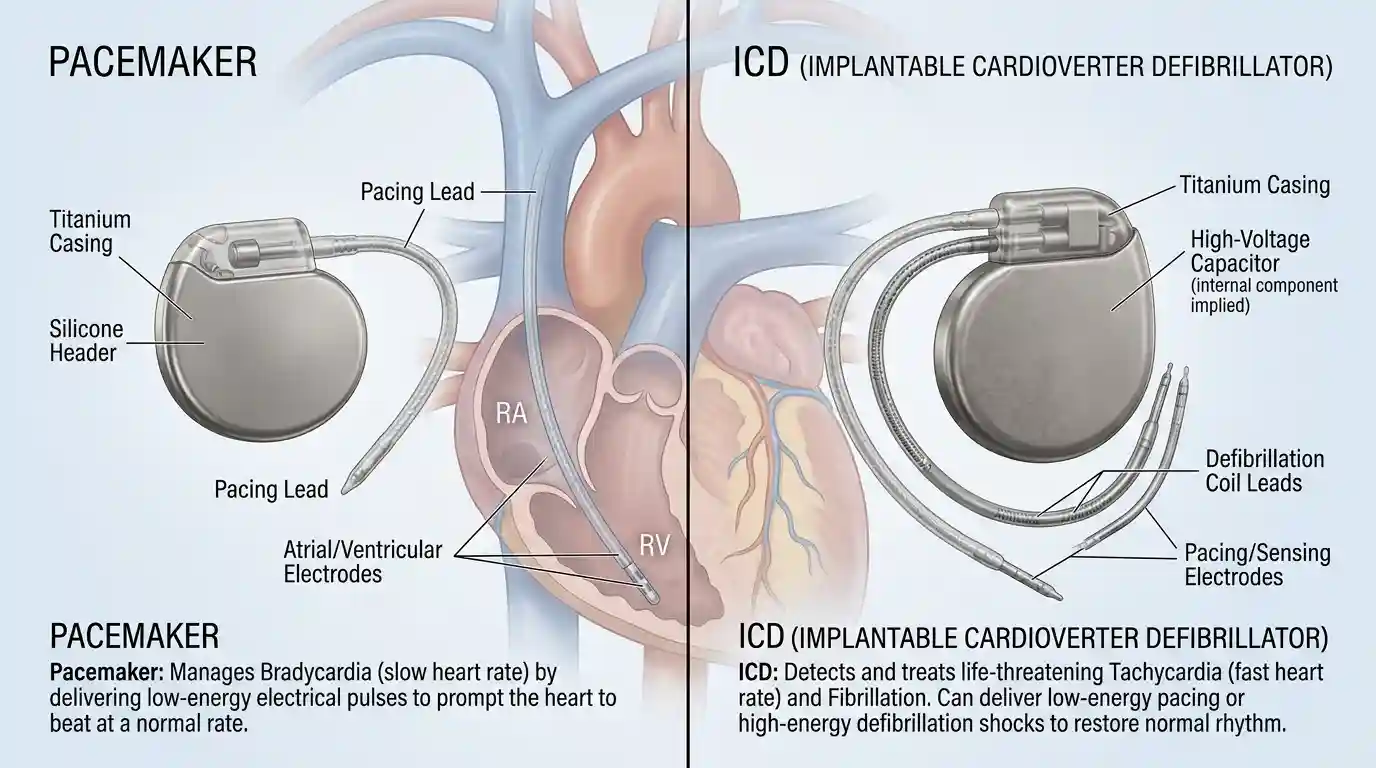
An Implantable Cardioverter Defibrillator (ICD) is a small electronic device placed under the skin, usually near the collarbone.
Its main job is to prevent sudden cardiac death caused by dangerous heart rhythms.
How It Works
The ICD constantly monitors the heartbeat.
If it detects a life-threatening rhythm such as:
- Ventricular tachycardia (VT)
- Ventricular fibrillation (VF)
it can:
- Deliver a small pacing signal
- Give a stronger electrical shock
- Restore a normal heart rhythm
Who Needs an ICD?
Doctors may recommend an ICD for people who:
- Have severe heart failure
- Have survived cardiac arrest
- Have dangerous ventricular arrhythmias
- Are at high risk of sudden cardiac death
Real-World Example
Imagine a smoke detector in your home.
Most of the time it simply watches for danger. When it detects a serious problem, it immediately sounds an alarm.
An ICD works similarly by constantly watching for dangerous heart rhythms and acting when necessary.
What Is a Pacemaker?
Understanding a Pacemaker
A pacemaker is a small implanted device that helps the heart maintain a steady heartbeat.
Its primary role is to prevent the heart from beating too slowly.
How It Works
The device sends tiny electrical impulses to the heart when it detects that the heart rate has fallen below a safe level.
These signals help the heart beat at a normal pace.
Who Needs a Pacemaker?
A pacemaker is often used for people with:
- Bradycardia (slow heart rate)
- Heart block
- Certain rhythm disorders
- Age-related electrical problems in the heart
Real-World Example
Think of a pacemaker as a backup coach.
When the heart slows down too much, the pacemaker steps in and tells it when to beat.
Quick Comparison Table
| Feature | ICD | Pacemaker |
| Full Name | Implantable Cardioverter Defibrillator | Pacemaker |
| Main Purpose | Prevent sudden cardiac death | Prevent slow heartbeat |
| Treats | Dangerous fast rhythms | Slow heart rhythms |
| Delivers Shock | Yes | No |
| Monitors Rhythm | Yes | Yes |
| Corrects Fast Heartbeats | Yes | Limited |
| Corrects Slow Heartbeats | Often Yes | Yes |
| Size | Slightly larger | Usually smaller |
| Battery Life | 5–10 years | 7–15 years |
| Cost | Generally higher | Generally lower |
| Complexity | More advanced | Simpler |
| Best For | High-risk heart patients | Slow heartbeat patients |
| Main Advantage | Can save life during cardiac arrest | Improves normal heart rhythm |
| Main Drawback | Shocks can be uncomfortable | Cannot stop dangerous arrhythmias |
Biggest Difference
The biggest difference between an ICD and a pacemaker is their primary purpose.
A pacemaker prevents the heart from beating too slowly.
An ICD prevents sudden death from dangerously fast or chaotic heart rhythms.
This matters more than many beginners realize.
A patient with a slow heartbeat may do perfectly well with a pacemaker. However, someone at risk of ventricular fibrillation may need an ICD because a pacemaker alone cannot deliver the life-saving shock needed during an emergency.
Key Differences Explained
1. Primary Function
ICD
- Protects against life-threatening fast rhythms.
- Can stop sudden cardiac arrest.
Pacemaker
- Maintains a healthy heart rate.
- Prevents slow heartbeats.
Real-World Impact
An ICD is more focused on emergency protection, while a pacemaker provides daily rhythm support.
2. Ability to Deliver a Shock
ICD
- Can deliver a powerful electrical shock.
- Restores normal rhythm during emergencies.
Pacemaker
- Does not provide defibrillation shocks.
Example
If the heart suddenly enters ventricular fibrillation, an ICD can respond immediately.
3. Conditions Treated
ICD
Treats:
- Ventricular tachycardia
- Ventricular fibrillation
- High sudden death risk
Pacemaker
Treats:
- Bradycardia
- Heart block
- Slow electrical conduction
4. Risk Level of Patients
ICD
Usually implanted in higher-risk patients.
Pacemaker
Often used for patients with less dangerous rhythm problems.
Why It Matters
The patient’s medical condition largely determines which device is needed.
5. Device Complexity
ICD
- More sophisticated programming
- Multiple treatment options
Pacemaker
- Simpler operation
- Focused on pacing
6. Battery Usage
ICD
Battery drains faster because it must be ready to deliver shocks.
Pacemaker
Generally lasts longer because it uses less energy.
7. Cost
ICD
- More expensive device
- Higher implantation costs
Pacemaker
- Usually less expensive
One small difference most people overlook is the long-term replacement cost when batteries need changing.
8. Emotional Experience
ICD
Some users worry about receiving an unexpected shock.
Pacemaker
Many patients rarely notice it after recovery.
Real-Life Observation
Over the long term, anxiety about shocks can affect some ICD users.
9. Follow-Up Care
ICD
Requires closer monitoring.
Pacemaker
Requires routine monitoring but often fewer adjustments.
10. Emergency Protection
ICD
Provides emergency intervention.
Pacemaker
Provides ongoing rhythm support.
Practical Difference
An ICD acts like both a monitor and an emergency responder.
11. Impact on Survival
ICD
Can significantly reduce the risk of sudden cardiac death in appropriate patients.
Pacemaker
Improves symptoms and quality of life but is not designed to stop sudden cardiac arrest caused by ventricular fibrillation.
Similarities Between Them
Although they have different purposes, ICDs and pacemakers share several similarities.
- Both are implanted under the skin.
- Both use electrical leads connected to the heart.
- Both monitor heart rhythms.
- Both require periodic follow-up visits.
- Both run on internal batteries.
- Both improve heart rhythm management.
- Both are prescribed by heart specialists.
These similarities explain why many people confuse the two devices.
Pros and Cons
Pros of ICD
- Can prevent sudden cardiac death
- Monitors heart rhythm continuously
- Provides emergency treatment automatically
- Often includes pacing functions
Cons of ICD
- Higher cost
- Possible painful shocks
- More frequent monitoring
- Can cause anxiety in some patients
Pros of Pacemaker
- Effective for slow heart rates
- Improves energy levels
- Reduces dizziness and fainting
- Longer battery life
Cons of Pacemaker
- Cannot treat dangerous ventricular arrhythmias
- Requires surgery
- Battery replacement eventually needed
- Activity restrictions during recovery
Which Is Better for Different Situations?
For Patients With Slow Heartbeats
A pacemaker is usually the better choice.
For High-Risk Cardiac Patients
An ICD is generally preferred.
For Long-Term Protection Against Sudden Cardiac Arrest
ICD is often the recommended option.
For Lower Cost Treatment
Pacemakers are generally less expensive.
For Everyday Symptom Relief
Pacemakers often provide excellent results.
For Patients With Previous Cardiac Arrest
ICDs are commonly considered essential.
Common Mistakes People Make
Assuming They Are the Same Device
Many people use the terms interchangeably even though the devices have different purposes.
Choosing Based on Cost Alone
The cheaper option is not always the safest option.
Ignoring Long-Term Needs
A person’s future risk of dangerous arrhythmias may influence device selection.
Focusing Only on Symptoms
Some patients feel fine but still need an ICD because of hidden risks.
Fear of Shocks
Some users later regret refusing an ICD because they worry about shocks rather than focusing on the life-saving benefits.
Expert Recommendation
Choose ICD If:
- You have survived cardiac arrest
- You have ventricular tachycardia
- You have ventricular fibrillation risk
- Your doctor believes sudden cardiac death is a concern
- You need emergency rhythm protection
Choose Pacemaker If:
- Your heart beats too slowly
- You have heart block
- You experience fainting from bradycardia
- You need rhythm support rather than emergency shock treatment
Avoid ICD If:
- Your condition does not involve dangerous ventricular arrhythmias
- Risks outweigh benefits according to your cardiologist
Avoid Pacemaker If:
- You need protection from sudden cardiac arrest
- Your doctor recommends defibrillation capability
Final Verdict
When comparing the difference between ICD and pacemaker, the most important point is understanding what problem each device solves.
A pacemaker helps when the heart beats too slowly. It improves daily symptoms, supports normal heart function, and helps many people live comfortably for years.
An ICD goes a step further. It watches for life-threatening heart rhythms and can deliver a shock when necessary. For patients at risk of sudden cardiac arrest, this protection can be lifesaving.
Neither device is automatically better than the other. The right choice depends entirely on the patient’s heart condition, medical history, and future risk factors. In real-world use, the best device is the one that matches the specific problem being treated. Working closely with a cardiologist ensures the safest and most effective decision.
Frequently Asked Questions (FAQs)
Which is better, an ICD or a pacemaker?
Neither is universally better. A pacemaker is best for slow heart rhythms, while an ICD is best for protecting against dangerous fast rhythms that may lead to sudden cardiac arrest.
Is an ICD worth it?
For patients at high risk of sudden cardiac death, an ICD can be extremely valuable. It provides automatic treatment when dangerous arrhythmias occur and may save a person’s life.
Which lasts longer, an ICD or a pacemaker?
Pacemakers typically have longer battery life. Many pacemakers last between 7 and 15 years, while ICD batteries often require replacement sooner because of their additional functions.
Which is easier to live with?
Many patients find pacemakers easier to live with because they do not deliver shocks. However, most ICD users adapt well and appreciate the added safety.
Can an ICD work as a pacemaker?
Yes. Many modern ICDs include pacing capabilities. They can help manage slow heartbeats while also providing protection against dangerous fast rhythms.
Are ICD and pacemaker interchangeable?
No. Although they look similar and share some features, they are designed for different medical conditions and should not be considered interchangeable.
What do most patients prefer?
Patients generally prefer the device that best addresses their condition. Comfort, safety, symptom relief, and long-term protection all influence satisfaction.
What mistakes should beginners avoid?
Avoid assuming the devices are identical, choosing based solely on cost, or ignoring medical advice. The correct device depends on individual heart health and risk factors.
Conclusion
The difference between ICD and pacemaker is not simply about technology—it is about the specific type of heart protection a person needs. A pacemaker helps regulate slow heartbeats and improves everyday quality of life, while an ICD is designed to detect and treat life-threatening heart rhythms that can lead to sudden cardiac arrest. Because both devices are implanted and help manage heart rhythm problems, people often confuse them. However, their roles are very different. Understanding those differences can help patients ask better questions, make informed decisions, and feel more confident about their treatment options. If you or a loved one has been advised to consider one of these devices, the best approach is to discuss your individual risk factors and health goals with a cardiologist. The right choice is always the one that best matches your heart condition.

Hi! I am Arshad Ullah presently working as linguist in Punjab Education Department. I have done MA in English Literature while M.Phil in Applied Linguistics. I have taught creative writing to the post graduation classes for 15 years. Presently I am working as content writer, and offering classes for blog writing. On this site, I research each topic from authoritative sources and edit every comparison for accuracy and clear, simple language.