When I first stared at the onboarding paperwork for my new job, my eyes glazed over. I had to choose between a 457(b) and a 401(k) plan. They both looked like a random soup of numbers and letters. Many people first assume that all retirement accounts are pretty much the same. I thought so too, until I almost made a costly mistake with my own savings.
What is a 401k?
A 401(k) is a retirement savings plan offered by private, for-profit companies. It is named after a specific section of the tax code. It was created decades ago to help everyday corporate workers save for the future as traditional pensions started to disappear.
In real-world use, a 401(k) works through automatic payroll deductions. You choose a percentage of your paycheck, and that money goes straight into your investment account
before taxes touch it. Tech startups, retail giants, and local businesses use this as their main tool to attract talent. For example, if you work at a software company or a grocery chain, your boss will likely hand you a 401(k) packet on day one.
What is a 457?
A 457 plan—specifically the 457(b)—is a retirement plan designed for state and local government employees, as well as certain non-profit workers. Think of it as the cousin to the 401(k), but built for public service.
If you are a public school teacher, a firefighter, a police officer, or a doctor at a state hospital, this is the account you will see. It works similarly to other plans by letting you save pre-tax dollars straight from your paycheck. However, because it is built for civil servants who might retire earlier than corporate workers, it has its own unique, powerful rules.
Quick Comparison Table
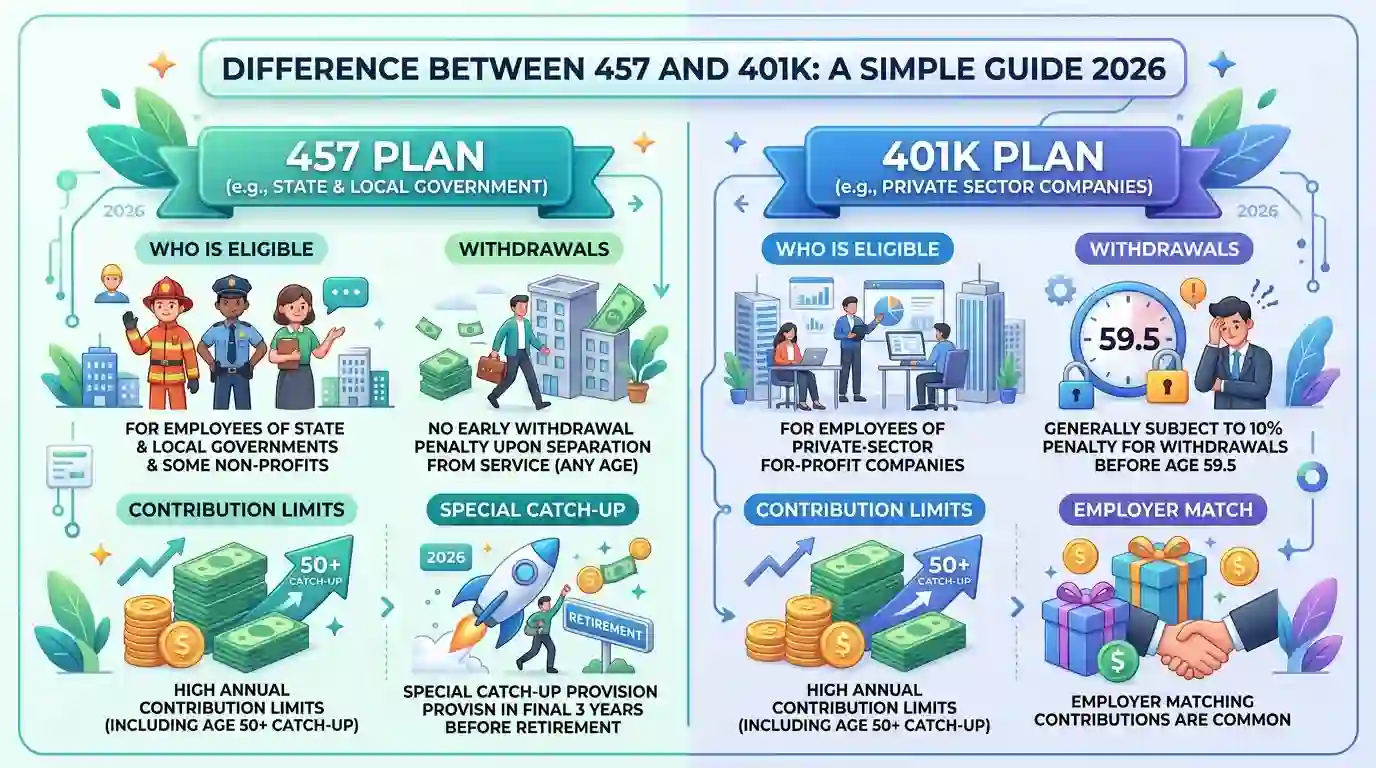
| Feature | 401(k) Plan | 457(b) Plan |
| Primary Users | For-profit corporate employees | Government and non-profit workers |
| Early Withdrawal Penalty | 10% penalty if taken before age 59½ | No 10% penalty after leaving the job |
| Employer Match | Very common (free money) | Rare, but does happen |
| Catch-Up Contributions | Standard catch-up for age 50+ | Standard catch-up OR Special 3-year rule |
| Difficulty to Manage | Simple, mostly automated | Simple, mostly automated |
| Usability | Great for steady, long-term growth | Exceptional for early retirement flexibility |
| Popularity | Extremely high across America | High among civil servants and teachers |
| Best Use Case | Maximizing free company matching dollars | Retiring early without tax penalties |
The Biggest Difference
The absolute biggest difference between a 457 and a 401(k) comes down to when you can touch your money without a penalty.
With a 401(k), if you pull your money out before you turn 59½, the IRS will slap you with a painful 10% early withdrawal penalty on top of regular taxes. With a 457 plan, that 10% penalty completely vanishes the moment you separate from your employer. If you quit, get laid off, or retire from your government job at age 45, you can start spending your 457 money immediately. This matters more than many beginners realize because it offers ultimate freedom if life throws you a curveball.
Key Differences Explained
1. The Early Withdrawal Rules
- 401(k) Plan: Keeps your money locked down tight until age 59½ unless you qualify for specific, strict hardships.
- 457(b) Plan: Has zero early withdrawal penalties once you leave your job, regardless of your age.
- Real-World Impact: Imagine a firefighter who retires at age 50. With a 457, they can access their funds immediately to pay for daily life. If they only had a 401(k), they would have to wait nearly a decade or pay massive penalties.
2. Employer Matching Contribution Dynamics
- 401(k) Plan: Employers love to offer a match, like dollar-for-dollar up to 4% of your salary.
- 457(b) Plan: Matching is rare because government budgets are tightly controlled.
- Real-World Impact: Turning down a 401(k) match means leaving free money on the table. With a 457, you are usually building the balance entirely on your own.
3. Special Double-Dip Contribution Limits
- 401(k) Plan: Sharing an employer means your total personal contributions are capped at one high limit.
- 457(b) Plan: If your employer offers both a 403(b) or 401(k) alongside a 457, you can fully fund both accounts to the maximum limit.
- Real-World Impact: High earners in government or healthcare can save twice as much pre-tax income each year, drastically lowering their current tax bill.
4. The Three-Year Catch-Up Feature
- 401(k) Plan: Offers a standard catch-up contribution amount once you turn 50.
- 457(b) Plan: Offers a special “last three years” rule before normal retirement age, allowing you to save up to double the normal annual limit if you missed out in earlier years.
- Real-World Impact: Some users later regret not saving enough early in their careers. The 457 plan gives them a massive, high-speed way to make up for lost time.
5. Plan Hardship Distributions While Employed
- 401(k) Plan: Allows loans and hardship withdrawals for things like buying a first home or paying college tuition.
- 457(b) Plan: Has a much stricter definition of “unforeseeable emergencies.”
- Real-World Impact: It is much harder to get money out of a 457 while you are still working at that specific job.
Similarities Between Them
It is easy to see why people confuse these two options. At their core, both plans are built to solve the exact same problem: helping you build a nest egg so you do not have to work forever.
Both plans use pre-tax contributions, which means every dollar you save lowers your taxable income for the year. Your money grows tax-deferred in both accounts, meaning you do not pay taxes on the investment gains year after year. You only pay income tax when you finally withdraw the cash in retirement.
Pros and Cons
Pros of a 401k
- Free Money: Most companies offer a matching contribution.
- Higher Availability: Almost every major private corporation offers one.
- Easier Loans: It is generally simpler to borrow against your balance if needed.
Cons of a 401k
- Age Lock: The 10% penalty before age 59½ can trap your money.
- Investment Fees: Some corporate plans have high admin fees that eat into profits.
Pros of a 457
- No Early Penalty: Pull money out at any age once you leave the employer.
- Double Savings: Can be paired with other plans to save twice as much cash.
- Super Catch-Up: Excellent rules to save heavily right before retirement.
Cons of a 457
- No Matches: You rarely get free matching funds from a government employer.
- Strict In-Service Rules: Hard to touch the money while you are still on the payroll.
Which Is Better for Different Situations?
For Early Retirement Seekers
If you plan to step away from work before age 59½, the 457 plan is miles better. It acts as a bridge to fund your life before your other retirement accounts unlock.
For Those Who Want Free Money
If your employer offers a matching program, the 401(k) wins hands down. You should always contribute enough to get the full match before putting money anywhere else.
Common Mistakes People Make
One major mistake is assuming you have to choose just one if both are offered. Many government workers can access both a 403(b)/401(k) and a 457. Leaving one empty because you think it is redundant is a huge missed opportunity.
Another mistake is forgetting that the 457 penalty exemption only applies after you leave your job. If you try to pull money out while still happily employed there, you will face severe restrictions.
Expert Recommendation
Choose a 401(k) if:
- Your company offers a matching contribution.
- You plan to work past age 60.
Choose a 457 if:
- You work in public service and want the freedom to retire early.
- You want to maximize your savings and avoid the 10% IRS early penalty.
Avoid a 401(k) if:
- You want to retire at age 50 and need easy access to your cash.
Avoid a 457 if:
- You are looking for a plan that allows easy hardship withdrawals while staying at your current job.
Final Verdict
Choosing between a 457 and a 401(k) does not have to be stressful. In real-world use, both accounts are excellent tools that will help you grow your wealth safely. The 401(k) is the undisputed king of the corporate world, driven by the power of employer matching. The 457 is a secret weapon for government workers, offering unmatched flexibility to access your money early without IRS penalties. Look at your retirement age goals, check your employer’s match policy, and use these rules to build a secure financial future.
FAQ Section
Which is better, a 457 or a 401k?
Neither plan is universally better, as the right choice depends entirely on your employer type and retirement goals. A 401(k) is superior if your employer offers a matching contribution, giving you free money. A 457 is better if you want to retire early, because it lets you access your funds without penalty as soon as you leave your job.
Is it worth having both a 457 and a 401k?
Yes, it is absolutely worth it if you have high savings goals. If your employer offers both, the IRS allows you to contribute the maximum amount to both accounts simultaneously. This strategy lets you double your pre-tax savings, significantly lower your current income tax bill, and build wealth much faster over the long term.
Can I roll over a 457 into a 401k?
Yes, you can roll a governmental 457 plan into a 401(k) after you leave your job. However, you should exercise caution before doing this. Moving your money into a 401(k) means you lose the unique 457 benefit of penalty-free withdrawals before age 59½. Most people prefer to keep them separate to maintain that flexibility.
Which plan is easier for a beginner to manage?
Both plans are equally easy for beginners to manage because they operate through automatic payroll deductions. Once you choose your contribution percentage and select your investments—like a simple target-date fund—the entire process runs on autopilot. You do not need daily management or advanced financial knowledge to successfully grow your balance.
What is the biggest mistake to avoid with a 457?
The biggest mistake is withdrawing money while you are still working for the employer. The penalty-free withdrawal benefit only triggers after you separate from service. If you try to take money out while still employed there, you will face strict hardship rules and potential tax headaches that most beginners later regret.
Conclusion
Understanding the difference between a 457 and a 401(k) plan gives you total control over your financial journey. While both accounts help you stack up pre-tax savings and lower your annual tax bill, their withdrawal rules create completely different pathways for your future. The corporate 401(k) shines by amplifying your savings through employer matches, but it locks your money away until age 59½. The public-sector 457 plan breaks those chains by letting you access your cash at any age once you leave your job. By matching these unique rules to your personal career timeline and retirement dreams, you can avoid costly tax traps and build a safe, highly flexible nest egg.

Hi! I am Arshad Ullah presently working as linguist in Punjab Education Department. I have done MA in English Literature while M.Phil in Applied Linguistics. I have taught creative writing to the post graduation classes for 15 years. Presently I am working as content writer, and offering classes for blog writing. On this site, I research each topic from authoritative sources and edit every comparison for accuracy and clear, simple language.