One morning, a teacher asked her class to write a simple sentence. One student wrote, “Ali kicked the ball.” Another wrote, “Ali laughed.” Both sentences looked correct, but the teacher explained something interesting. The first sentence had a transitive verb, while the second had an intransitive verb.
In simple terms, the difference between transitive and intransitive verbs is about whether a verb needs an object or not.
Key Difference Between the Both
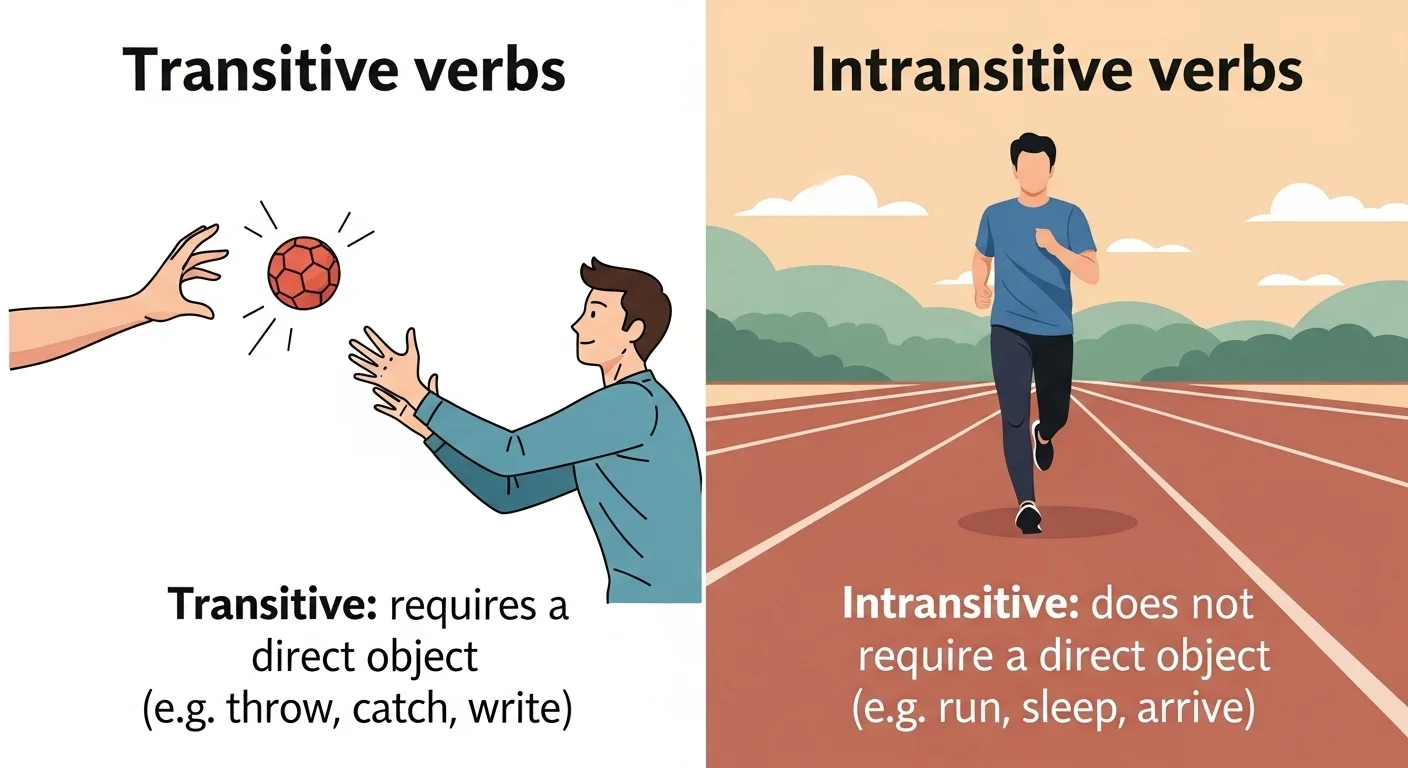
The main difference between transitive and intransitive verbs is that a transitive verb needs an object, while an intransitive verb does not need an object to complete its meaning.
Why Is Their Difference Necessary to Know for Learners and Experts?
Knowing the difference between transitive and intransitive verbs helps people write correct sentences. Students learn grammar faster. Writers create clearer stories. Teachers explain ideas easily. In society, good language skills help people communicate clearly in education, business, and media. When people understand verbs well, they can express ideas without confusion.
Pronunciation
Transitive
- US: /ˈtræn.zə.tɪv/
- UK: /ˈtræn.zɪ.tɪv/
Intransitive
- US: /ɪnˈtræn.zə.tɪv/
- UK: /ɪnˈtræn.zɪ.tɪv/
Before exploring deeper grammar ideas, let us clearly see the difference between transitive and intransitive verbs.
10 Differences between Transitive & Intransitive Verbs
1. Object Requirement
- Transitive verbs need a direct object.
- Intransitive verbs do not need an object.
🟣 Example: She bought a book.
🟣 Example: They arrived early.
2. Meaning Completion
- Transitive verbs need an object to complete meaning.
- Intransitive verbs already give a complete meaning.
🟣 Example: He opened the door.
🟣 Example: The baby cried.
3. Action Direction
- Transitive verbs pass action to someone or something.
- Intransitive verbs show action without passing it.
🟣 Example: Sara washed the car.
🟣 Example: Sara slept.
4. Sentence Structure
- Transitive verbs often follow Subject + Verb + Object.
- Intransitive verbs follow Subject + Verb.
🟣 Example: They built a house.
🟣 Example: The dog barked.
5. Passive Voice Use
- Transitive verbs can form passive sentences.
- Intransitive verbs usually cannot.
🟣 Example: The cake was eaten by Tom.
🟣 Example: The baby slept peacefully.
6. Information Detail
- Transitive verbs add more detail through objects.
- Intransitive verbs focus only on the action.
🟣 Example: She painted a picture.
🟣 Example: She smiled.
7. Question Formation
- Transitive verbs answer “what?” or “whom?”.
- Intransitive verbs do not answer these questions.
🟣 Example: He wrote a letter.
🟣 Example: He ran.
8. Sentence Expansion
- Transitive verbs easily expand sentences.
- Intransitive verbs usually stay simple.
🟣 Example: They gave the child a gift.
🟣 Example: The child laughed.
9. Learning Difficulty
- Transitive verbs need object understanding.
- Intransitive verbs are simpler.
🟣 Example: She cut the paper.
🟣 Example: She sat.
10. Grammar Role
- Transitive verbs connect action and object.
- Intransitive verbs only describe action.
🟣 Example: He fixed the bike.
🟣 Example: He fell.
Nature and Behaviour of Both
Transitive verbs show actions that move toward an object. They usually connect the subject with something receiving the action. They are common in detailed sentences.
Intransitive verbs describe actions that happen by themselves. They focus on the subject’s activity without affecting an object.
Why People Are Confused About Their Use
Many verbs can act as both transitive and intransitive depending on the sentence. For example:
- She runs every morning. (intransitive)
- She runs a company. (transitive)
Because of this flexibility, learners often mix them up.
Table Showing Difference and Similarity
| Feature | Transitive Verbs | Intransitive Verbs | Similarity |
| Object | Required | Not required | Both are verbs |
| Sentence structure | Subject + Verb + Object | Subject + Verb | Both describe actions |
| Passive voice | Possible | Not possible | Both used in grammar |
| Meaning | Needs object | Complete without object | Both show actions |
| Usage | Detailed actions | Simple actions | Used in communication |
Which Is Better in What Situation?
Transitive verbs are better when you want to give clear and detailed information. For example, in reports, instructions, and storytelling, they help explain what action affects an object.
Intransitive verbs are better when you want short and simple sentences. They work well in conversations, quick descriptions, and emotional expressions.
How Are the Keywords Used in Metaphors and Similes?
🟣 “His kindness flowed like an intransitive river, touching everyone without expecting anything.”
🟣 “Her influence was transitive like a chain reaction, spreading change everywhere.”
🟣 “Ideas moved like transitive energy, passing from one mind to another.”
🟣 “The child’s joy rose like an intransitive bird, free and complete.”
Connotative Meaning of Both Keywords
🟣 Transitive (Neutral): Often linked with action and impact.
Example: “Her leadership was transitive because it influenced others.”
🟣 Intransitive (Neutral): Often linked with independence or self-action.
Example: “His happiness felt intransitive, needing nothing else.”
Idioms or Proverbs Related to the Words
🟣 “Actions speak louder than words.”
Example: Her hard work proved the idea that actions speak louder than words.
🟣 “Practice makes perfect.”
Example: Learning verbs daily showed that practice makes perfect.
🟣 “Words have power.”
Example: Teachers remind students that words have power in grammar and life.
Works in Literature Using the Keywords
🟣 “English Grammar in Use” — Grammar Guide, Raymond Murphy, 1985
🟣 “The Cambridge Grammar of the English Language” — Linguistics Reference, Rodney Huddleston & Geoffrey Pullum, 2002
🟣 “Understanding English Grammar” — Education Book, Martha Kolln, 1994
Movies Related to Language and Grammar Themes
🟣 “Akeelah and the Bee” — 2006, USA
🟣 “The Great Debaters” — 2007, USA
🟣 “Dead Poets Society” — 1989, USA
Frequently Asked Questions
1. What is a transitive verb?
A transitive verb needs an object to complete its meaning.
2. What is an intransitive verb?
An intransitive verb does not need an object.
3. Can a verb be both transitive and intransitive?
Yes. Some verbs change depending on the sentence.
4. How can I identify a transitive verb?
Ask “what?” or “whom?” after the verb.
5. Why are these verbs important in grammar?
They help form correct sentence structures.
How Both Are Useful for Our Surroundings
Transitive and intransitive verbs help people communicate clearly in everyday life. Teachers explain lessons better. Writers create clear stories. Students express ideas correctly. Good grammar also improves education, media communication, and professional writing.
Final Words for Both
Transitive verbs connect actions to objects. They make language detailed and informative.
Intransitive verbs show actions that stand alone. They keep language simple and natural.
Both are essential for balanced communication.
Conclusion
Understanding the difference between transitive and intransitive verbs helps learners build strong grammar skills. Transitive verbs need objects and pass action to something else. Intransitive verbs do not need objects and express complete actions alone.
Both types play important roles in English communication. When people learn the difference between transitive and intransitive, they write clearer sentences and speak with confidence. From classrooms to workplaces, these verbs support effective language use. With practice, anyone can easily identify and use them correctly.

Hi! I am Arshad Ullah presently working as linguist in Punjab Education Department. I have done MA in English Literature while M.Phil in Applied Linguistics. I have taught creative writing to the post graduation classes for 15 years. Presently I am working as content writer, and offering classes for blog writing.