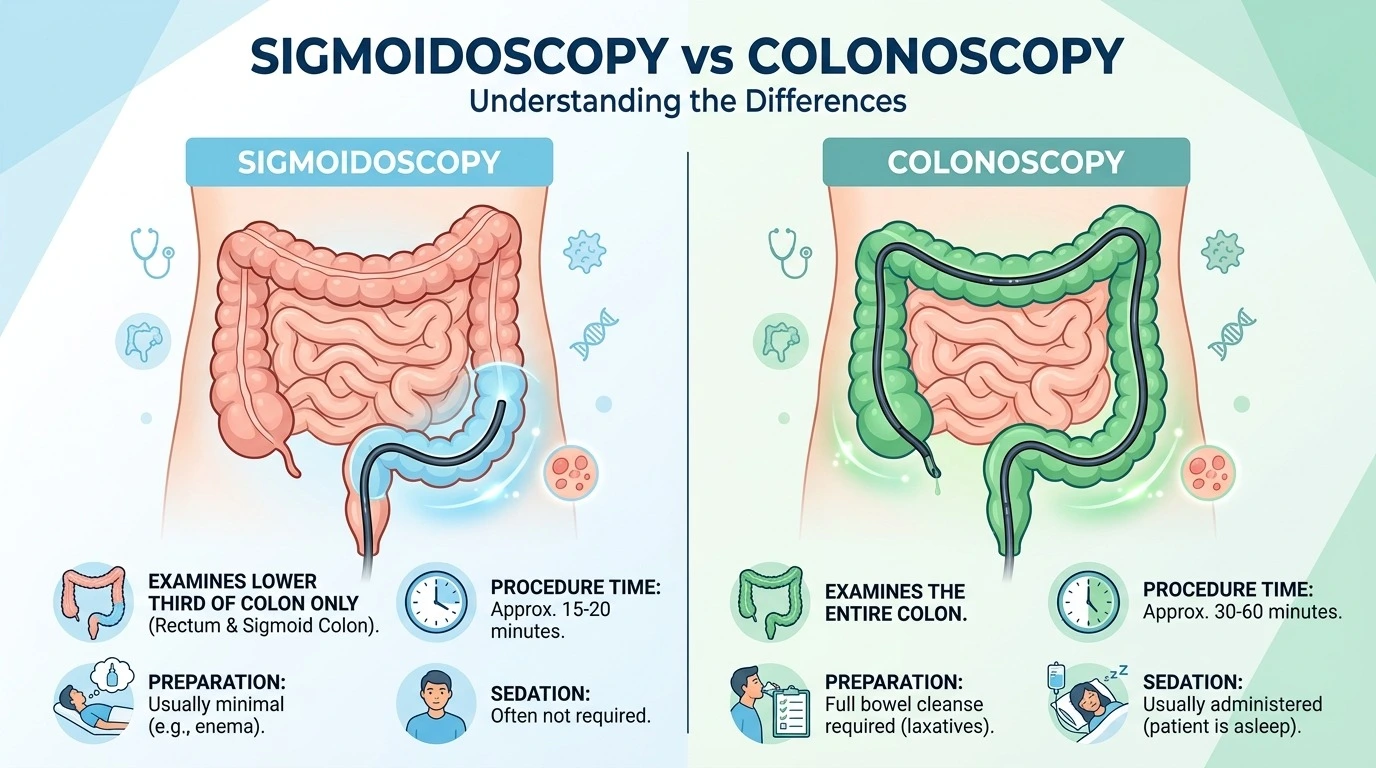
One morning, a man visited a clinic because he had been feeling discomfort in his stomach and irregular bowel movements for several weeks. The doctor suggested a test to check the large intestine. The patient heard two medical terms for the first time: sigmoidoscopy and colonoscopy. He immediately asked the doctor about the difference between sigmoidoscopy and colonoscopy. This situation is very common in hospitals around the world.
The difference between sigmoidoscopy and colonoscopy mainly relates to the part of the intestine examined and the purpose of the test. Both procedures help doctors look inside the colon using a flexible tube with a camera.
Understanding the difference between sigmoidoscopy and colonoscopy helps patients make better health decisions. Doctors and students also study the difference between sigmoidoscopy and colonoscopy because these tests are important for diagnosing digestive diseases. When people understand their difference, they feel more confident about medical examinations and treatments.
Key Difference Between the Both
The main difference is the area of the colon examined. Sigmoidoscopy examines only the lower portion of the large intestine, while colonoscopy examines the entire colon from the rectum to the beginning of the large intestine.
Why Is Their Difference Necessary to Know for Learners and Experts?
- Medical learning: Medical students must understand the difference to choose the correct diagnostic method for patients.
- Healthcare decision-making: Doctors select the appropriate procedure based on symptoms and medical history.
- Public health awareness: Early detection of colon diseases depends on choosing the correct screening test.
- Patient education: When patients know the difference, they feel less fear and understand the purpose of the test better.
Pronunciation of Both Terms
Sigmoidoscopy
US: /ˌsɪɡ.mɔɪˈdɑː.skə.pi/
UK: /ˌsɪɡ.mɔɪˈdɒs.kə.pi/
Colonoscopy
US: /ˌkoʊ.ləˈnɑː.skə.pi/
UK: /ˌkəʊ.ləˈnɒs.kə.pi/
Understanding these pronunciations helps learners communicate clearly in medical discussions.
Before exploring deeper medical details, let us examine the difference between sigmoidoscopy and colonoscopy through important aspects and examples.
Difference Between Sigmoidoscopy and Colonoscopy
1. Area Examined
Sigmoidoscopy examines only the lower part of the colon.
🟣 Example: Doctors check the rectum and sigmoid colon for bleeding.
🟣 Example: It is used to examine inflammation in the lower intestine.
Colonoscopy examines the entire colon.
🟣 Example: Doctors search for cancer in the whole colon.
🟣 Example: It helps find polyps in any section of the large intestine.
2. Length of the Instrument
Sigmoidoscopy uses a shorter flexible tube.
🟣 Example: The scope travels only a short distance in the colon.
🟣 Example: It focuses on the sigmoid region.
Colonoscopy uses a longer flexible tube.
🟣 Example: The scope travels through the full colon.
🟣 Example: Doctors examine all sections of the large intestine.
3. Preparation Needed
Sigmoidoscopy requires less preparation.
🟣 Example: Sometimes only a small enema is needed.
🟣 Example: Patients may only need short fasting.
Colonoscopy requires more preparation.
🟣 Example: Patients drink special bowel-cleansing liquids.
🟣 Example: Doctors advise a clear liquid diet before the test.
4. Time of the Procedure
Sigmoidoscopy is quicker.
🟣 Example: It usually takes 10–20 minutes.
🟣 Example: It can be done during a short clinic visit.
Colonoscopy takes longer.
🟣 Example: It may take 30–60 minutes.
🟣 Example: Doctors carefully inspect the whole colon.
5. Use of Sedation
Sigmoidoscopy usually does not require sedation.
🟣 Example: The patient stays awake during the test.
🟣 Example: Only mild discomfort may occur.
Colonoscopy usually requires sedation.
🟣 Example: The patient receives medication to relax.
🟣 Example: The patient often sleeps during the test.
6. Medical Purpose
Sigmoidoscopy is used for limited diagnostic purposes.
🟣 Example: Checking rectal bleeding.
🟣 Example: Investigating mild bowel symptoms.
Colonoscopy is used for complete screening.
🟣 Example: Colon cancer screening.
🟣 Example: Detecting polyps in the colon.
7. Cost
Sigmoidoscopy is generally less expensive.
🟣 Example: Fewer hospital resources are needed.
🟣 Example: Shorter procedure reduces cost.
Colonoscopy is more expensive.
🟣 Example: Sedation increases cost.
🟣 Example: More advanced equipment is used.
8. Risk Level
Sigmoidoscopy has fewer risks.
🟣 Example: Rare complications.
🟣 Example: Quick recovery after the test.
Colonoscopy has slightly higher risks.
🟣 Example: Possible bleeding after polyp removal.
🟣 Example: Rare chance of intestinal injury.
9. Diagnostic Coverage
Sigmoidoscopy covers only the lower colon.
🟣 Example: Detecting hemorrhoids.
🟣 Example: Identifying lower colon infections.
Colonoscopy covers the entire colon.
🟣 Example: Detecting tumors anywhere in the colon.
🟣 Example: Finding early signs of cancer.
10. Frequency of Use
Sigmoidoscopy is used for specific cases.
🟣 Example: When symptoms are limited to the lower bowel.
🟣 Example: Routine quick screenings in clinics.
Colonoscopy is widely used for full screening.
🟣 Example: Recommended for adults over 45.
🟣 Example: Used for detailed investigation of digestive problems.
Nature and Behaviour of Both
Sigmoidoscopy is a focused and limited diagnostic procedure. It is simple, faster, and mainly used to examine the lower portion of the colon.
Colonoscopy is a comprehensive diagnostic procedure. It allows doctors to examine the entire colon and even remove polyps or take tissue samples for testing.
Why People Are Confused About Their Use
People are confused because both procedures involve a flexible camera tube inserted into the colon. Their names sound similar, and both are used to detect digestive diseases. Patients often believe they are the same test, even though the scope and purpose are different.
Table Showing Difference and Similarity
| Feature | Sigmoidoscopy | Colonoscopy | Similarity |
| Area examined | Lower colon | Entire colon | Both examine the large intestine |
| Instrument | Short scope | Long scope | Both use flexible tubes |
| Preparation | Minimal | Extensive | Both require bowel cleaning |
| Sedation | Rare | Common | Both may cause mild discomfort |
| Purpose | Limited diagnosis | Full screening | Both detect colon diseases |
Which is Better in What Situation?
Sigmoidoscopy
Sigmoidoscopy is better when the doctor suspects a problem only in the lower part of the colon. It is useful for mild symptoms such as rectal bleeding or minor inflammation. The procedure is quicker, less expensive, and requires minimal preparation. For routine examinations or limited diagnostic needs, sigmoidoscopy is often sufficient.
Colonoscopy
Colonoscopy is better when a complete examination of the colon is necessary. Doctors recommend it for colon cancer screening, unexplained abdominal pain, and chronic digestive problems. Because it examines the entire colon, it provides a more accurate and detailed diagnosis.
Metaphors and Similes
These medical terms are sometimes used metaphorically.
🟣 “His investigation was like a colonoscopy—deep and thorough.”
🟣 “Her quick review of the report was like a sigmoidoscopy—focused on a small section.”
🟣 “A detailed audit works like a colonoscopy of the system.”
🟣 “A brief check is like a sigmoidoscopy of the issue.”
Connotative Meaning
Sigmoidoscopy
Positive: Focused investigation
🟣 Example: “The sigmoidoscopy quickly revealed the cause of discomfort.”
Neutral: Routine medical examination
🟣 Example: “The doctor scheduled a sigmoidoscopy for testing.”
Negative: Slightly uncomfortable procedure
🟣 Example: “Some patients feel nervous before a sigmoidoscopy.”
Colonoscopy
Positive: Thorough health screening
🟣 Example: “Regular colonoscopy can save lives through early cancer detection.”
Neutral: Standard medical test
🟣 Example: “The hospital recommended colonoscopy screening.”
Negative: Invasive examination
🟣 Example: “Many people delay colonoscopy because they fear the procedure.”
Idioms or Proverbs Related
Although no idioms use these exact words, related expressions exist.
🟣 “Prevention is better than cure.”
Example: Colonoscopy helps detect disease early and prevent serious illness.
🟣 “Look beneath the surface.”
Example: Doctors use colonoscopy to look beneath the surface of digestive problems.
Works in Literature Mentioning These Terms
🟣 The Emperor of All Maladies – Medical history, Siddhartha Mukherjee, 2010
🟣 Being Mortal – Medical nonfiction, Atul Gawande, 2014
🟣 The Cancer Journals – Memoir, Audre Lorde, 1980
Movies Related to the Topic
🟣 The C Word – Documentary, 2016, USA
🟣 Cancer: The Emperor of All Maladies – Documentary series, 2015, USA
Frequently Asked Questions
1. What is the main difference between sigmoidoscopy and colonoscopy?
Sigmoidoscopy examines the lower colon, while colonoscopy examines the entire colon.
2. Which procedure is more detailed?
Colonoscopy is more detailed because it covers the full length of the colon.
3. Is colonoscopy painful?
Most patients feel little pain because sedation is used during the procedure.
4. Why do doctors recommend colonoscopy for cancer screening?
Because it allows doctors to detect and remove polyps before they become cancerous.
5. Is sigmoidoscopy safer?
Sigmoidoscopy has slightly fewer risks because it is shorter and less invasive.
How Are Both Useful for Surroundings?
Both procedures play an important role in public health. They help detect colon diseases early and reduce the risk of serious illness in communities. Early diagnosis allows doctors to treat patients quickly and prevent the spread of health problems. Hospitals and healthcare systems use these tests to improve the overall well-being of society.
Final Words for Both
Sigmoidoscopy and colonoscopy are valuable medical tools. One focuses on a specific part of the colon, while the other examines the entire large intestine. Together, they help doctors diagnose, monitor, and prevent digestive diseases.
Conclusion
Understanding the difference between sigmoidoscopy and colonoscopy helps patients, learners, and healthcare professionals make informed decisions. Sigmoidoscopy is a quick and focused test used to examine the lower part of the colon, while colonoscopy is a comprehensive procedure that evaluates the entire colon. Both methods have their advantages depending on the patient’s symptoms and medical needs. Colonoscopy is widely used for cancer screening because it provides a detailed view of the entire large intestine. Sigmoidoscopy, on the other hand, is simpler and less invasive. When used correctly, these procedures play a vital role in early disease detection, improving treatment outcomes, and protecting public health.

Hi! I am Arshad Ullah presently working as linguist in Punjab Education Department. I have done MA in English Literature while M.Phil in Applied Linguistics. I have taught creative writing to the post graduation classes for 15 years. Presently I am working as content writer, and offering classes for blog writing.