Last week, a teacher in a small school in Lahore asked her class to choose three students for a stage show. First, she asked, “In how many ways can I choose three students?” Later, she asked, “In how many ways can I arrange those three students on stage?” The class was confused. The numbers were not the same. That day, they learned the difference between permutations and combinations.
The difference between permutations and combinations is simple but very important. It tells us when order matters and when it does not. Many students mix them up. So, learning the difference between permutations and combinations helps you solve math problems faster. In exams, business, and daily life, their difference plays a big role.
Key Difference Between the Both
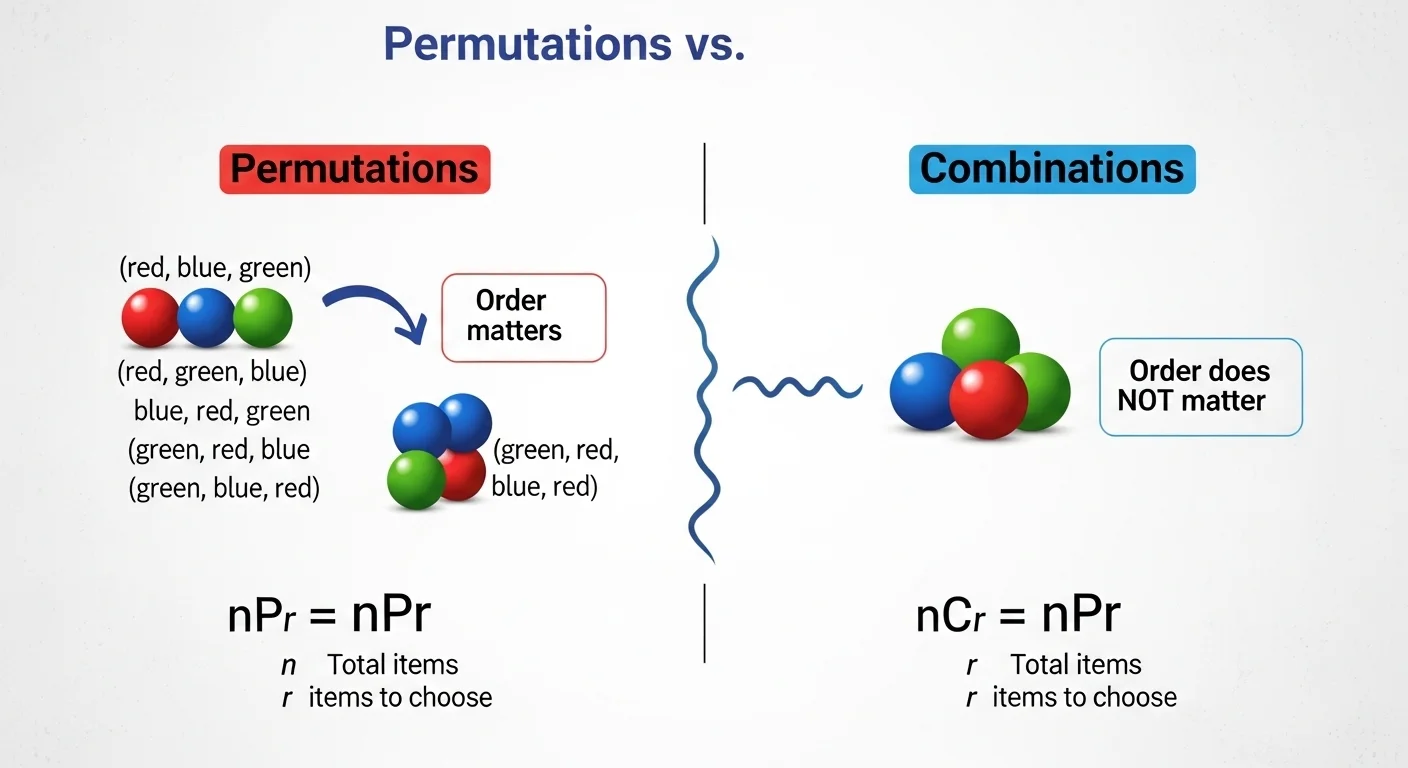
The key point in the difference between permutations and combinations is this:
- Permutation: Order matters.
- Combination: Order does not matter.
Why Is Their Difference Necessary to Know for Learners and Experts?
Knowing the difference between permutations and combinations helps students pass exams. It helps engineers design systems. It helps companies plan products. It helps computer experts create passwords. In society, we use counting rules in voting, team selection, coding, and research. If we mix them up, we get wrong answers. So, both learners and experts must understand their difference clearly.
Pronunciation (US & UK)
- Permutation
- US: /ˌpɝː.mjuːˈteɪ.ʃən/
- UK: /ˌpɜː.mjuːˈteɪ.ʃən/
- US: /ˌpɝː.mjuːˈteɪ.ʃən/
- Combination
- US: /ˌkɑːm.bəˈneɪ.ʃən/
- UK: /ˌkɒm.bɪˈneɪ.ʃən/
- US: /ˌkɑːm.bəˈneɪ.ʃən/
Now that we understand the basic idea, let us explore the main differences in detail.
Difference Between Permutations and Combinations
Here are 10 clear points. Each point has two simple examples.
1. Order
Permutation: Order matters.
- Example 1: ABC is different from ACB.
- Example 2: 123 is different from 321.
Combination: Order does not matter.
- Example 1: Choosing A, B, C is same as C, B, A.
- Example 2: Selecting apples and bananas is same as bananas and apples.
2. Meaning
Permutation: Arrangement of items.
- Example 1: Seating students in a row.
- Example 2: Arranging books on a shelf.
Combination: Selection of items.
- Example 1: Choosing 2 fruits from 5.
- Example 2: Picking team members.
3. Formula
Permutation Formula: nPr
- Example 1: Arrange 3 from 5.
- Example 2: Arrange letters of CAT.
Combination Formula: nCr
- Example 1: Choose 3 from 5.
- Example 2: Select 2 players from 4.
4. Value Size
Permutation: Usually larger number.
- Example 1: Arrange 4 people.
- Example 2: Arrange 5 numbers.
Combination: Smaller number.
- Example 1: Choose 4 people.
- Example 2: Select 5 books.
5. Use in Real Life
Permutation: Used in passwords.
- Example 1: ATM PIN order matters.
- Example 2: Lock code system.
Combination: Used in team choice.
- Example 1: Select cricket team.
- Example 2: Choose project partners.
6. Focus
Permutation: Focus on position.
- Example 1: 1st, 2nd, 3rd place.
- Example 2: Medal ranking.
Combination: Focus on group.
- Example 1: Study group members.
- Example 2: Committee members.
7. Nature
Permutation: Dynamic and positional.
- Example 1: Race results.
- Example 2: Line of dancers.
Combination: Stable and grouped.
- Example 1: Basket of fruits.
- Example 2: Set of colors.
8. Repetition
Permutation: Sometimes allowed.
- Example 1: 111 code.
- Example 2: AA in letters.
Combination: Rarely focused on order repetition.
- Example 1: Choosing same fruit type.
- Example 2: Selecting similar books.
9. Mathematics Field
Permutation: Used in probability and arrangement.
- Example 1: Lottery order.
- Example 2: Number plates.
Combination: Used in statistics and selection.
- Example 1: Survey sampling.
- Example 2: Research groups.
10. Visual Idea
Permutation: Think of a line.
- Example 1: People standing in queue.
- Example 2: Cars in parking row.
Combination: Think of a circle group.
- Example 1: Friends sitting together.
- Example 2: Fruits in basket.
Nature and Behaviour of Both
Permutation is active. It changes when order changes. It is flexible and position-based.
Combination is calm. It does not change with order. It focuses on grouping only.
Why Are People Confused About Their Use?
People see similar formulas. Both involve numbers and selection. The words sound complex. Many students forget to check if order matters. That small mistake creates confusion.
Table: Difference and Similarity
| Point | Permutation | Combination |
| Order | Matters | Does not matter |
| Meaning | Arrangement | Selection |
| Formula | nPr | nCr |
| Result Size | Larger | Smaller |
| Use | Ranking, codes | Team choice |
| Similarity | Both are counting methods in mathematics |
Which Is Better in What Situation?
Permutation is better when position is important. For example, in race results, gold and silver are not the same. In passwords, 1234 is not the same as 4321. So, when order changes meaning, permutation is better.
Combination is better when only selection matters. For example, choosing players for a team. The order of names does not change the team. So, when order does not change meaning, combination is better.
How Are the Keywords Used in Metaphors and Similes?
People sometimes use these words in creative ways.
- “Life is a permutation of choices.”
- “Her ideas are a beautiful combination of colors.”
These show variety and mix.
Connotative Meaning
Permutation: Neutral.
- Example: The permutation of numbers changed the result.
Combination: Positive.
- Example: A good combination of skills brings success.
Sometimes neutral in math use.
Idioms or Proverbs
There are no direct idioms with these words. But we use related ideas:
- “Mix and match.”
- Example: You can mix and match clothes.
- Example: You can mix and match clothes.
- “Put in order.”
- Example: Please put the files in order.
- Example: Please put the files in order.
Works in Literature
- The Art of Computer Programming (Non-fiction, Donald Knuth, 1968)
- Permutation City (Science Fiction, Greg Egan, 1994)
Movies
- Permutation (1994, USA)
- The Combination (2009, Australia)
Five Frequently Asked Questions
1. What is the main difference between permutations and combinations?
Order matters in permutation, not in combination.
2. Are formulas different?
Yes. Permutation uses nPr. Combination uses nCr.
3. Which one gives bigger value?
Permutation usually gives bigger number.
4. Where are they used?
In math, business, coding, and research.
5. Why do students confuse them?
Because both involve counting and similar formulas.
How Are Both Useful for Surroundings?
They help in planning events. They help in making teams. They help in computer security. They help in scientific research. They make daily planning easy and correct.
Final Words for the Both
Permutation is about order. Combination is about choice. Both are important in mathematics and life.
Conclusion
The difference between permutations and combinations is simple but powerful. Permutation cares about order. Combination does not. This small idea changes answers in math problems. It also affects real life tasks like passwords, team building, and research work. Many students feel confused at first. But once you remember one rule — “Does order matter?” — the confusion goes away. Both concepts help us count smartly. They improve logical thinking. When you understand the difference clearly, you become more confident in math and daily problem solving.

Hi! I am Arshad Ullah presently working as linguist in Punjab Education Department. I have done MA in English Literature while M.Phil in Applied Linguistics. I have taught creative writing to the post graduation classes for 15 years. Presently I am working as content writer, and offering classes for blog writing.