Imagine a student building a model using toy blocks. Some blocks are simple pieces, while others have extra connectors that allow them to link with many other parts. In biology, something similar exists at the molecular level. Scientists often talk about the difference between nucleoside and nucleotide when explaining how DNA and RNA are formed. Although the two terms look almost identical, the difference between nucleoside and nucleotide plays a major role in genetics and cellular processes.
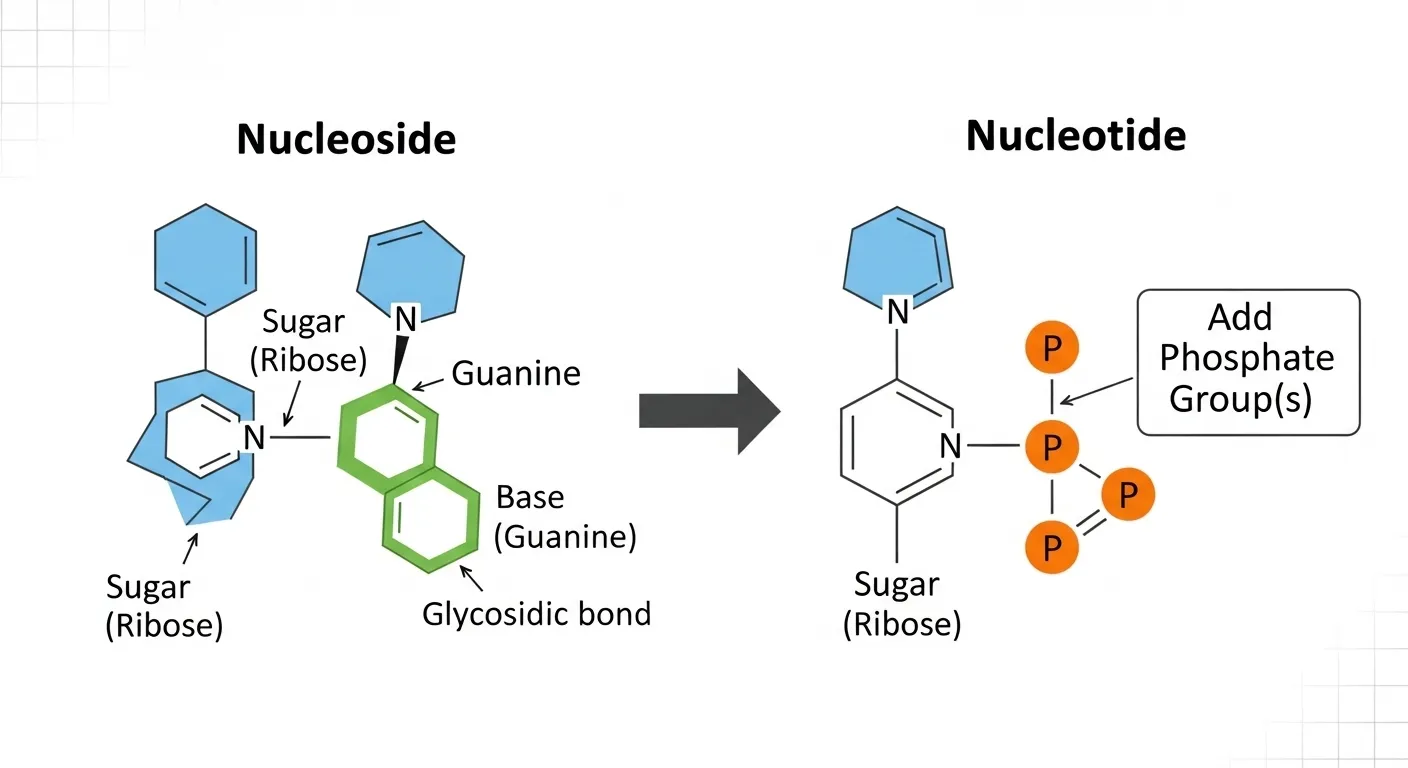
A nucleoside is a basic molecular unit made of a nitrogenous base attached to a sugar molecule. A nucleotide, however, contains the same components plus one or more phosphate groups.
This small structural change explains the difference between nucleoside and nucleotide and determines how these molecules behave inside living cells.
Understanding the difference between nucleoside and nucleotide helps students, researchers, and healthcare professionals better understand genetics, energy transfer, and molecular biology.
Pronunciation of Both Terms
| Word | US Pronunciation | UK Pronunciation |
| Nucleoside | /ˈnuː-klee-ə-saɪd/ | /ˈnjuː-klee-ə-saɪd/ |
| Nucleotide | /ˈnuː-klee-ə-taɪd/ | /ˈnjuː-klee-ə-taɪd/ |
Key Difference Between the Both
The main distinction is structural.
- Nucleoside = nitrogenous base + sugar
- Nucleotide = nitrogenous base + sugar + phosphate group(s)
This extra phosphate group allows nucleotides to form long chains in DNA and RNA and participate in cellular energy reactions.
Before exploring the topic further, let’s dive deeper into the difference between nucleoside and nucleotide through clear comparisons.
10 Differences Between the Keywords
1. Structural Composition
Nucleoside
A nucleoside contains only two components: a nitrogenous base and a sugar molecule.
🔮 Example 1: Adenosine
🔮 Example 2: Guanosine
Nucleotide
A nucleotide consists of a nitrogenous base, sugar, and one or more phosphate groups.
🔮 Example 1: ATP (Adenosine triphosphate)
🔮 Example 2: AMP (Adenosine monophosphate)
2. Presence of Phosphate Group
Nucleoside
It does not contain phosphate groups.
🔮 Example 1: Cytidine
🔮 Example 2: Uridine
Nucleotide
It contains phosphate groups, which enable bonding in nucleic acids.
🔮 Example 1: ADP
🔮 Example 2: GTP
3. Role in DNA and RNA
Nucleoside
Acts as a precursor molecule that later becomes a nucleotide.
🔮 Example 1: Thymidine used in DNA synthesis
🔮 Example 2: Adenosine in RNA processes
Nucleotide
Forms the actual building blocks of DNA and RNA strands.
🔮 Example 1: Deoxyadenosine monophosphate
🔮 Example 2: Cytidine triphosphate
4. Biological Function
Nucleoside
Mostly involved in cell signaling and metabolism.
🔮 Example 1: Adenosine regulating sleep
🔮 Example 2: Inosine in RNA editing
Nucleotide
Plays roles in energy transfer and genetic storage.
🔮 Example 1: ATP storing cellular energy
🔮 Example 2: cAMP acting as a messenger molecule
5. Complexity
Nucleoside
A simpler molecule with fewer components.
🔮 Example 1: Guanosine
🔮 Example 2: Cytidine
Nucleotide
A more complex molecule due to phosphate groups.
🔮 Example 1: ATP
🔮 Example 2: GDP
6. Chemical Formation
Nucleoside
Formed by linking a sugar with a nitrogenous base.
🔮 Example 1: Ribose + Adenine → Adenosine
🔮 Example 2: Deoxyribose + Thymine → Thymidine
Nucleotide
Formed by adding phosphate groups to nucleosides.
🔮 Example 1: Adenosine + phosphate → AMP
🔮 Example 2: Guanosine + phosphate → GMP
7. Role in Energy Transfer
Nucleoside
Does not directly participate in cellular energy transfer.
🔮 Example 1: Adenosine
🔮 Example 2: Uridine
Nucleotide
Key molecules for energy storage and transfer.
🔮 Example 1: ATP powering cell reactions
🔮 Example 2: GTP used in protein synthesis
8. Participation in Metabolism
Nucleoside
Mainly involved in metabolic pathways as intermediates.
🔮 Example 1: Adenosine in metabolic signaling
🔮 Example 2: Inosine in purine metabolism
Nucleotide
Directly participates in DNA replication and metabolism.
🔮 Example 1: dATP in DNA replication
🔮 Example 2: UTP in carbohydrate metabolism
9. Polymer Formation
Nucleoside
Cannot form long chains by itself.
🔮 Example 1: Adenosine
🔮 Example 2: Guanosine
Nucleotide
Can join together to create DNA and RNA polymers.
🔮 Example 1: DNA nucleotides
🔮 Example 2: RNA nucleotides
10. Biological Importance
Nucleoside
Important for drug development and biochemical pathways.
🔮 Example 1: Antiviral nucleoside analogs
🔮 Example 2: Cancer treatment drugs
Nucleotide
Essential for genetic information storage and energy metabolism.
🔮 Example 1: ATP
🔮 Example 2: NADP
Nature and Behaviour
Nucleosides are relatively simple molecules. They act mainly as intermediate structures in the synthesis of nucleotides and sometimes function in cellular signaling.
Nucleotides, however, are highly active molecules. They participate in DNA formation, energy transfer, enzyme reactions, and many biochemical processes essential for life.
Why are People Confused About Their Use?
People often confuse nucleosides and nucleotides because their names look almost identical and both contain the same basic components—sugar and nitrogenous base. The only structural difference is the phosphate group in nucleotides. In textbooks and scientific discussions, the terms are sometimes used closely together, which adds to the confusion for beginners.
Difference and Similarity Table
| Feature | Nucleoside | Nucleotide | Similarity |
| Structure | Sugar + base | Sugar + base + phosphate | Both contain sugar and base |
| Complexity | Simple | More complex | Both organic molecules |
| Role | Precursor molecule | DNA/RNA building block | Both involved in genetics |
| Energy Role | Limited | Major role (ATP) | Both participate in metabolism |
| Chain Formation | Cannot form chains | Forms DNA/RNA chains | Both found in cells |
Which is Better in What Situation?
Nucleoside (100 words)
Nucleosides are more useful when scientists study biochemical pathways or design medicines. Many antiviral and anticancer drugs are based on nucleoside analogs because they can interfere with viral replication or abnormal cell growth. Researchers often modify nucleosides to create therapeutic compounds. In metabolic studies, nucleosides also help scientists understand how cells synthesize nucleotides. Therefore, nucleosides are particularly valuable in pharmacology and molecular research where simple molecular frameworks are needed.
Nucleotide (100 words)
Nucleotides are essential when the focus is energy production and genetic information. They form the backbone of DNA and RNA, which carry hereditary information. Nucleotides like ATP act as the main energy currency of the cell. In biological systems, processes such as muscle contraction, nerve signaling, and protein synthesis depend on nucleotide molecules. Because of these roles, nucleotides are indispensable in cellular biology, genetics, and biotechnology.
Metaphors and Similes
People sometimes explain these molecules using simple comparisons.
Nucleoside
- “A nucleoside is like a half-built brick waiting for the final piece.”
- “It is like a key without a handle, almost complete but not ready for full use.”
Nucleotide
- “A nucleotide is like a fully equipped building block ready to construct DNA.”
- “It works like a battery, storing energy for the cell.”
Connotative Meaning
| Word | Connotation | Example |
| Nucleoside | Neutral | “The nucleoside acted as a precursor in the experiment.” |
| Nucleotide | Positive/Neutral | “ATP, a nucleotide, powers the activities of the cell.” |
Idioms or Proverbs Related to the Words
These scientific terms rarely appear in traditional idioms, but they can be used creatively.
- “Every nucleotide counts.”
Example: In genetics research, every nucleotide counts when identifying mutations. - “Build it nucleotide by nucleotide.”
Example: Scientists built the artificial gene nucleotide by nucleotide.
Works in Literature (Scientific Texts)
- Molecular Biology of the Cell – Bruce Alberts – Science Textbook – 1983
- The Double Helix – James Watson – Scientific Memoir – 1968
- Biochemistry – Jeremy Berg – Academic Text – 2002
Movies Related to Genetics Themes
- Gattaca – 1997 – USA
- Jurassic Park – 1993 – USA
- Splice – 2009 – Canada/France
Frequently Asked Questions
1. What is the main difference between nucleoside and nucleotide?
The main difference is that nucleotides contain phosphate groups while nucleosides do not.
2. Which one forms DNA and RNA?
Nucleotides form the backbone of DNA and RNA molecules.
3. Can nucleosides become nucleotides?
Yes. When phosphate groups are added to nucleosides, they become nucleotides.
4. Is ATP a nucleoside or nucleotide?
ATP is a nucleotide because it contains phosphate groups.
5. Why are nucleotides important in cells?
They store genetic information and supply energy for cellular activities.
How are Both Useful for Surroundings?
These molecules are fundamental to life. They allow organisms to store genetic information, grow, reproduce, and maintain metabolism. In medicine and biotechnology, understanding nucleosides and nucleotides helps scientists develop vaccines, antiviral drugs, and genetic engineering techniques that benefit society.
Final Words for Both
Nucleosides and nucleotides may seem like small chemical structures, but they are crucial components of life. Their interaction forms the basis of genetics, energy transfer, and cellular communication.
Conclusion
The difference between nucleoside and nucleotide lies mainly in the presence of phosphate groups, yet this small distinction has enormous biological significance. Nucleosides act as simpler precursor molecules, while nucleotides serve as the active building blocks of DNA, RNA, and cellular energy systems. Understanding this distinction helps students grasp molecular biology more easily and enables researchers to design drugs and therapies that target genetic processes. From powering cells with ATP to storing genetic information in DNA, nucleotides and nucleosides together form the foundation of life at the molecular level.

Hi! I am Arshad Ullah presently working as linguist in Punjab Education Department. I have done MA in English Literature while M.Phil in Applied Linguistics. I have taught creative writing to the post graduation classes for 15 years. Presently I am working as content writer, and offering classes for blog writing.