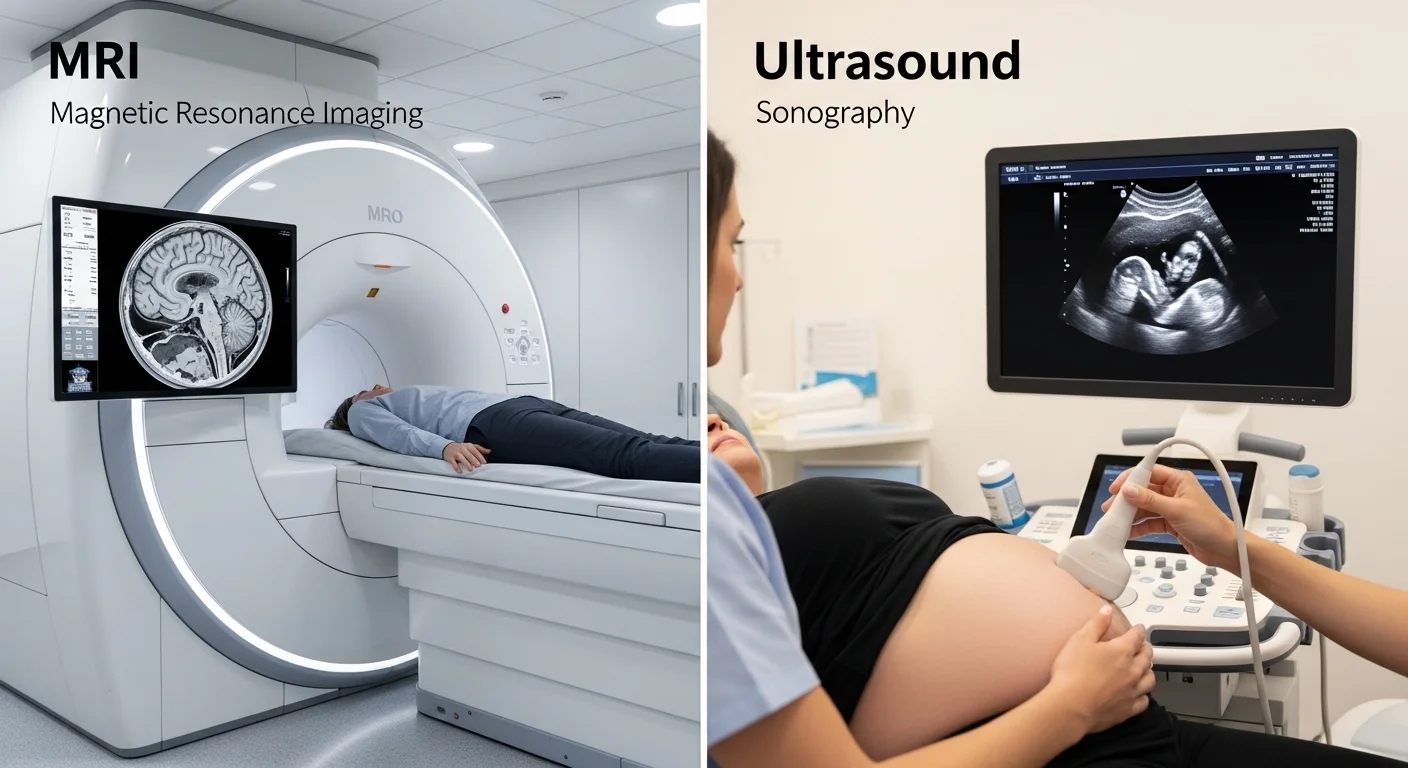
A few months ago, a worried father took his son to the hospital after a sports injury. The doctor suggested an ultrasound first. Later, another specialist advised an MRI scan. The father was confused. What is the real difference between MRI and ultrasound? Why would doctors choose one over the other?
MRI means Magnetic Resonance Imaging. Ultrasound is a scan that uses sound waves to create images inside the body. The difference between MRI and ultrasound matters because both tools help doctors see what is happening inside us. Yet, they work in very different ways.
Understanding the difference between MRI and ultrasound helps patients feel safe and helps medical learners make smart decisions.
In this guide, we will explain their in simple words.
Key Difference Between MRI and Ultrasound
The main difference is technology.
MRI uses strong magnets and radio waves.
Ultrasound uses high-frequency sound waves.
MRI gives very detailed images of soft tissues.
Ultrasound gives real-time images and is often used for pregnancy and quick checks.
Why Is Their Difference Necessary to Know for Learners and Experts?
Knowing the difference saves time, money, and sometimes lives.
- Medical students must choose the right test.
- Doctors must avoid unnecessary risks.
- Patients must understand what to expect.
- Society benefits from correct diagnosis and better treatment.
If a brain tumor is suspected, MRI is vital.
If a baby’s growth in the womb needs monitoring, ultrasound is ideal.
Understanding their difference improves healthcare quality.
Pronunciation (US & UK)
MRI
- US: /ˌem ɑːr ˈaɪ/
- UK: /ˌem ɑːr ˈaɪ/
Ultrasound
- US: /ˈʌltrəˌsaʊnd/
- UK: /ˈʌltrəsaʊnd/
Now that we understand the basics, let us explore the detailed comparison.
Difference Between MRI and Ultrasound
1. Technology Used
MRI uses magnetic fields and radio waves.
Example 1: Brain imaging for tumors.
Example 2: Spinal cord injury scan.
Ultrasound uses sound waves.
Example 1: Pregnancy check-up.
Example 2: Detecting kidney stones.
2. Image Detail
MRI shows very detailed soft tissue images.
Example1: Ligament tear in knee.
Example 2: Brain inflammation.
Ultrasound shows moving images but less detail.
Example1: Baby’s heartbeat.
Example 2: Blood flow in arteries.
3. Safety
MRI has no radiation but uses strong magnets.
Example1: Not safe for patients with pacemakers.
Example2: Metal implants can be risky.
Ultrasound is very safe and widely used.
Example1: Safe for pregnant women.
Example2: Safe for newborn babies.
4. Cost
MRI is expensive.
Example1: Brain scan in private hospital.
Example2: Full body scan.
Ultrasound is cheaper.
Example1: Routine pregnancy test.
Example 2: Abdominal scan.
5. Time Required
MRI takes longer (20–60 minutes).
Example1: Full spine scan.
Example2: Brain imaging session.
Ultrasound is quick (10–20 minutes).
Example1: Emergency room check.
Example2: Fetal growth scan.
6. Noise Level
MRI is loud.
Example1: Machine makes knocking sounds.
Example2: Patients wear ear protection.
Ultrasound is quiet.
Example1: Only soft machine hum.
Example 2: Comfortable for infants.
7. Portability
MRI machines are large and fixed.
Example 1: Installed in big hospitals.
Example2: Needs special room.
Ultrasound machines can be portable.
Example1: Used in ambulances.
Example2: Used in rural clinics.
8. Use in Pregnancy
MRI is used only if necessary.
Example 1: Complex fetal abnormality.
Example2: Placenta problems.
Ultrasound is routine in pregnancy.
Example1: 20-week anomaly scan.
Example2: Checking baby position.
9. Claustrophobia Factor
MRI can cause fear in small spaces.
Example1: Patient feels anxious inside tube.
Example2: Sedation sometimes needed.
Ultrasound is open and comfortable.
Example1: Patient lies on bed.
Example2: Technician moves probe gently.
10. Best Body Areas
MRI is best for brain, joints, and soft tissues.
Example1: Multiple sclerosis diagnosis.
Example2: Torn cartilage.
Ultrasound is best for abdomen and pregnancy.
Example1: Gallbladder stones.
Example2: Fetal monitoring.
Nature and Behaviour of Both
MRI is powerful and precise. It behaves like a deep investigator. It looks inside complex tissues carefully.
Ultrasound is quick and flexible. It behaves like a fast reporter. It shows movement in real time.
Why Are People Confused About Their Use?
People think both scans do the same job. They believe any scan can show all body parts clearly. The word “scan” creates confusion. Many patients do not know that technology and purpose are different.
Table: Difference and Similarity Between MRI and Ultrasound
| Feature | MRI | Ultrasound | Similarity |
| Technology | Magnets & radio waves | Sound waves | Both create body images |
| Cost | Expensive | Affordable | Used in hospitals |
| Time | Longer | Shorter | Non-invasive |
| Safety | No radiation | No radiation | Safe when used properly |
| Portability | Fixed machine | Portable | Diagnostic tools |
Which Is Better in What Situation?
MRI is better when doctors need deep and clear images. It is best for brain disorders, joint injuries, and tumors. It helps specialists plan surgery. It gives high detail and accuracy.
Ultrasound is better for pregnancy, emergency checks, and quick diagnosis. It is safe, fast, and affordable. It works well for abdominal organs and blood flow studies.
Both are excellent. The choice depends on the medical need.
How Are the Keywords Used in Metaphors and Similes?
MRI is often compared to “a powerful magnet searching for truth.”
Example: “The investigation was like an MRI, revealing every hidden detail.”
Ultrasound is compared to “echoes of life.”
Example: “Her voice echoed like an ultrasound, gentle but clear.”
Connotative Meaning
MRI
- Positive: Accurate, advanced technology
- Example: “The MRI gave hope by finding the problem early.”
- Example: “The MRI gave hope by finding the problem early.”
- Neutral: Medical procedure
- Negative: Expensive, scary machine
Ultrasound
- Positive: Safe, caring, motherhood
- Example: “The ultrasound showed new life.”
- Example: “The ultrasound showed new life.”
- Neutral: Routine test
- Negative: Limited detail in some cases
Idioms or Proverbs Related to the Words
There are no direct idioms for MRI or ultrasound, but related expressions exist:
- “Sound it out” – to test something
- Example: “Let us sound it out like an ultrasound.”
- Example: “Let us sound it out like an ultrasound.”
- “Magnetic personality”
- Example: “His ideas had a magnetic pull like an MRI.”
- Example: “His ideas had a magnetic pull like an MRI.”
Works in Literature Mentioning MRI or Ultrasound
- My Sister’s Keeper — Novel, Jodi Picoult, 2004 (Medical drama genre)
- Handle with Care — Novel, Jodi Picoult, 2009
Movies Related to Medical Imaging
- Something the Lord Made — 2004, USA
- The English Patient — 1996, UK/USA
- My Sister’s Keeper — 2009, USA
Five Frequently Asked Questions
1. Is MRI safer than ultrasound?
Both are safe. Ultrasound is generally simpler and more flexible.
2. Can MRI detect pregnancy?
Yes, but ultrasound is preferred.
3. Is MRI painful?
No, but it may feel uncomfortable.
4. Why is MRI expensive?
Because the machine and maintenance cost more.
5. Can ultrasound replace MRI?
No. They serve different purposes.
How Are Both Useful for Surroundings?
They improve public health. They reduce unnecessary surgeries. They help in early diagnosis. They support safe pregnancy care. They strengthen healthcare systems worldwide.
Final Words for Both
MRI is powerful and detailed.
Ultrasound is safe and fast.
Both are vital in modern medicine.
Conclusion
The difference between MRI and ultrasound is not just technical. It is practical and life-saving. MRI uses magnets to show deep, detailed images. Ultrasound uses sound waves for quick and safe scanning. Each tool has strengths and limits. Choosing the right one depends on the situation. When we understand their difference, we make better healthcare decisions. Both technologies work together to protect human life and improve diagnosis. Knowledge about them reduces fear and builds trust in medical science.

Hi! I am Arshad Ullah presently working as linguist in Punjab Education Department. I have done MA in English Literature while M.Phil in Applied Linguistics. I have taught creative writing to the post graduation classes for 15 years. Presently I am working as content writer, and offering classes for blog writing.