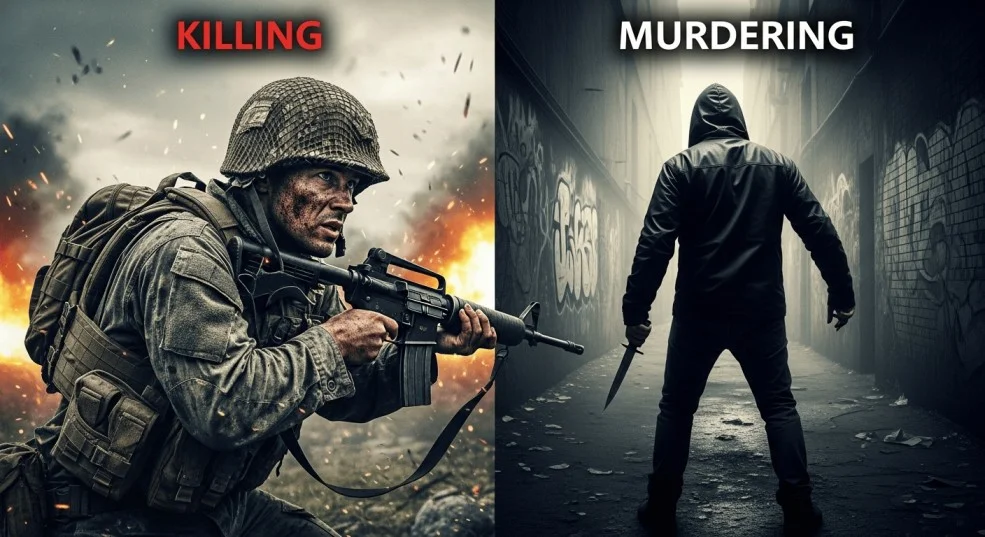
One evening, two neighbors argued about a news story. One said, “The man killed someone.” The other replied, “No, he murdered him.” At first, the words seemed the same, but they are not. The difference between killing and murdering is important in language and law.
Killing means causing someone’s death. It can happen in many ways, such as self-defense, war, or accidents. Murdering means killing someone on purpose and in an illegal way. It is always a serious crime.
Many learners mix these words because both involve death. But the difference between killing and murdering is about intention and legality. When people learn their differences, they can communicate more accurately in daily life.
Pronunciation
Killing
- US: /ˈkɪlɪŋ/
- UK: /ˈkɪlɪŋ/
Murdering
- US: /ˈmɝːdərɪŋ/
- UK: /ˈmɜːdərɪŋ/
Understanding these meanings leads us to explore the difference between killing and murdering in detail.
Key Difference Between the Two
The main difference is intent and legality. Killing means causing death in general, while murdering means intentionally killing someone in an unlawful way.
Why Knowing the Difference Matters in Society
Knowing the difference between killing and murdering is important for learners, writers, lawyers, and the public. These words appear in news, court cases, books, and conversations.
When people use the wrong word, they may create confusion or unfair judgment. For example, a soldier may kill in war, but that does not mean murder. Accurate language helps people understand justice, ethics, and responsibility in society.
10 Differences between Killing & Murdering
1. Meaning/Definition
- Killing: Causing death in any way.
- Murdering: Intentionally killing someone illegally.
Examples
🟣 The hunter was killing animals for food.
🟣 The criminal was murdering innocent people
2. Intention
- Killing: May be accidental or intentional.
- Murdering: Always intentional.
Examples
🟣 The driver was killing someone by accident.
🟣 The villain planned the murdering carefully.
3. Legal Status
- Killing: Not always illegal.
- Murdering: Always illegal.
Examples
🟣 The soldier was killing enemies during war.
🟣 The gang member was arrested for murdering a man.
4. Moral Judgment
- Killing: May be justified.
- Murdering: Always considered wrong.
Examples
🟣 The guard stopped the attacker by killing him.
🟣 The killer was punished for murdering the victim.
5. Context of Use
- Killing: Used in many situations.
- Murdering: Used mainly in crime context.
Examples
🟣 Pollution is killing fish in the river.
🟣 The criminal was murdering people in the city.
6. Emotional Impact
- Killing: Sometimes neutral.
- Murdering: Strong negative emotion.
Examples
🟣 The disease is killing thousands each year.
🟣 The story described a man murdering his rival.
7. Legal Consequences
- Killing: May not bring punishment.
- Murdering: Leads to severe punishment.
Examples
🟣 The accident caused killing but no crime.
🟣 The court punished him for murdering his neighbor.
8. Planning
- Killing: May happen suddenly.
- Murdering: Often planned.
Examples
🟣 The explosion was killing people instantly.
🟣 The suspect was murdering victims after planning.
9. Use in War
- Killing: Common term for war situations.
- Murdering: Rarely used for soldiers in battle.
Examples
🟣 Soldiers were killing enemies in battle.
🟣 The news accused the dictator of murdering civilians.
10. Tone in Language
- Killing: Broader and neutral term.
- Murdering: Specific and serious term.
Examples
🟣 Smoking is slowly killing people.
🟣 The detective investigated a case of murdering.
Nature and Behaviour of Both
Killing
Killing is a broad concept. It includes accidents, self-defense, war, hunting, or disease. The word often describes the act of causing death without always judging the action.
Murdering
Murdering is a very serious act. It means a person planned or intentionally caused death in an unlawful way. Society strongly condemns murder because it breaks moral and legal rules.
Why People Confuse Killing and Murdering
Many people confuse these words because both involve the death of a person or animal. In daily talk, people often use “kill” and “murder” as if they mean the same thing.
Another reason is movies and news headlines. Writers sometimes use dramatic language, which blurs the real legal difference. Learning their meanings helps people use them correctly.
Table Showing Difference and Similarity
| Aspect | Killing | Murdering | Similarity |
| Meaning | Causing death | Intentional illegal killing | Both involve death |
| Intention | May or may not exist | Always intentional | Both actions affect life |
| Legality | Sometimes legal | Always illegal | Both may appear in law |
| Context | War, accident, hunting | Crime situations | Both used in stories |
| Emotion | Neutral or mild | Strong negative | Both create serious impact |
Which Is Better in What Situation?
Killing
The word killing is better when speaking about general situations. For example, accidents, war, hunting, or disease. It is a neutral term and does not always blame someone. Writers and journalists use it when the cause of death is unclear.
Murdering
The word murdering is better when the death is intentional and illegal. It clearly shows that a crime happened. This word is often used in law, crime reports, and serious discussions about justice.
Use in Metaphors and Similes
🟣 “This heat is killing me.” (means extreme discomfort)
🟣 “The workload is killing him.” (too much stress)
🟣 “The critic murdered the movie in his review.” (strong criticism)
🟣 “The comedian killed the audience with laughter.” (great success)
Connotative Meaning of Both Words
🟣 Killing – often neutral or negative
Example: “The cold weather is killing the plants.”
🟣 Murdering – strongly negative
Example: “The criminal was jailed for murdering a traveler.”
Idioms or Proverbs Related to the Words
🟣 “Kill two birds with one stone.”
Example: She studied while traveling and killed two birds with one stone.
🟣 “Time to kill.”
Example: I had an hour to kill, so I read a book.
🟣 “You’re killing me!”
Example: His jokes were so funny that I said, “You’re killing me!”
Works in Literature Related to the Words
🟣 Murder on the Orient Express — Mystery novel, Agatha Christie, 1934
🟣 A Time to Kill — Legal thriller novel, John Grisham, 1989
🟣 The Killing Joke — Graphic novel, Alan Moore, 1988
Movies Based on the Keywords
🟣 A Time to Kill — 1996, USA
🟣 The Killing — 1956, USA
🟣 Murder on the Orient Express — 2017, USA/UK
Frequently Asked Questions
1. Are killing and murdering the same?
No. Killing means causing death in general. Murdering means intentional illegal killing.
2. Can killing be legal?
Yes. For example, self-defense or war situations.
3. Is murdering always a crime?
Yes. Murder is always illegal and punishable by law.
4. Why do people use kill instead of murder sometimes?
Because kill is a broader and more neutral word.
5. Which word is stronger?
Murder is stronger because it implies intent and crime.
Usefulness of Both Words in Our Surroundings
Both words help people describe serious events clearly. News reporters use them to explain crimes or accidents. Teachers use them to explain law and ethics. Writers use them to build strong stories.
Understanding these words also helps people discuss justice, safety, and responsibility in society.
Final Words for Both Terms
Killing is a general word that describes causing death in many situations. Murdering is a specific word that describes an intentional and illegal act of killing.
Conclusion
The difference between killing and murdering mainly lies in intention and legality. Killing is a broad term that can include accidents, self-defense, war, or natural causes. Murdering, however, always means intentionally and unlawfully taking someone’s life. Because these words carry serious meaning, using them correctly is very important. Clear language helps people understand justice, law, and social responsibility. When learners know the difference between killing and murdering, they communicate more accurately and avoid misunderstanding in conversations, writing, and media discussions.

Hi! I am Arshad Ullah presently working as linguist in Punjab Education Department. I have done MA in English Literature while M.Phil in Applied Linguistics. I have taught creative writing to the post graduation classes for 15 years. Presently I am working as content writer, and offering classes for blog writing.