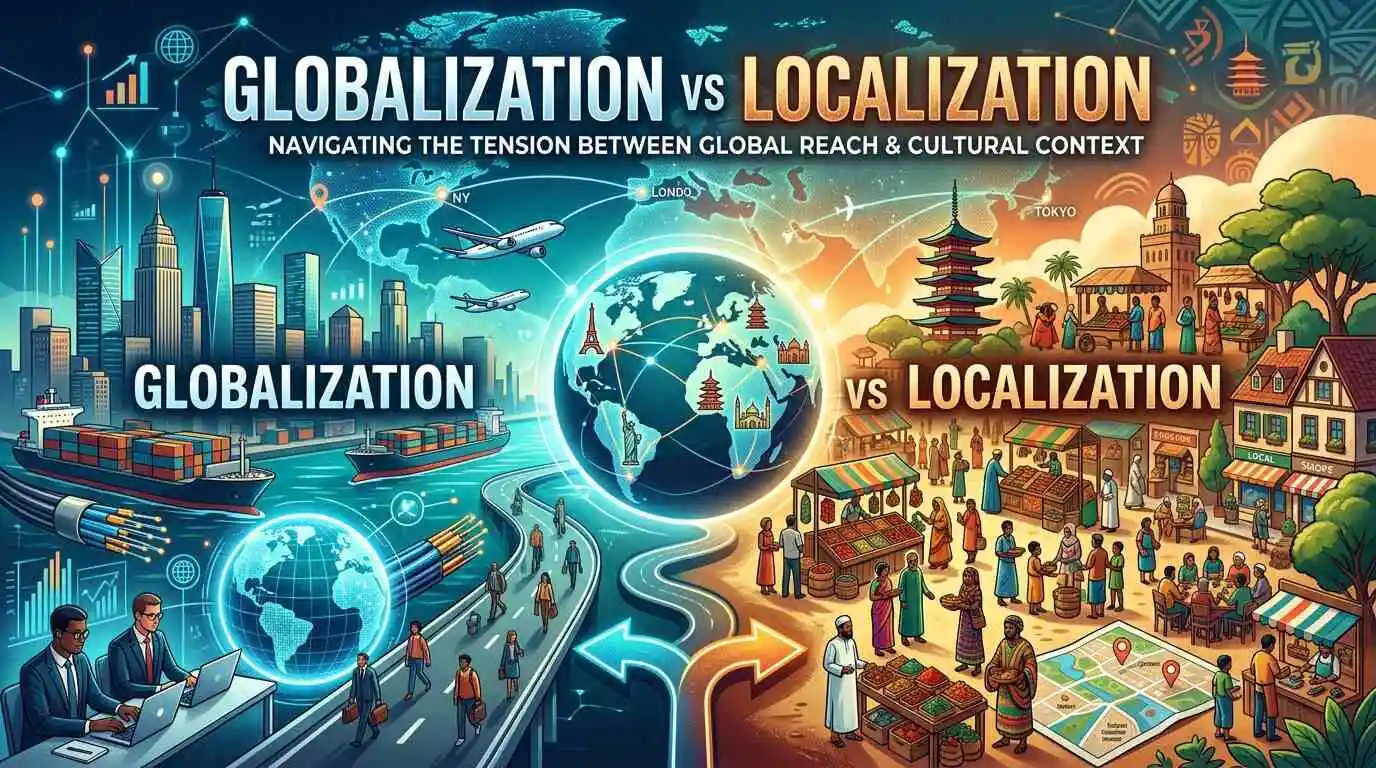
In 2016, when McDonald’s opened more stores in India, it did not sell beef burgers. It added paneer and spicy chicken items. This story shows the difference between globalization and localization in real life.
Globalization means spreading ideas, goods, and culture across the world. Localization means changing those ideas or goods to fit local needs. The difference between globalization and localization becomes clear when a global brand adjusts to local taste.
Many students ask about the difference between globalization and localization in business and society. In simple words, the difference between globalization and localization is about going global versus fitting local. Both work together, but they are not the same.
Pronunciation:
- Globalization (US): /ˌɡloʊ.bə.ləˈzeɪ.ʃən/
- Globalisation (UK): /ˌɡləʊ.bə.laɪˈzeɪ.ʃən/
- Localization (US): /ˌloʊ.kə.ləˈzeɪ.ʃən/
- Localisation (UK): /ˌləʊ.kə.laɪˈzeɪ.ʃən/
Now, let us move deeper to understand how these two ideas differ in many ways.
Key Difference Between the Both
Globalization spreads one idea or product across many countries.
Localization changes that idea or product to suit one country or place.
Why Their Difference Is Necessary to Know for Learners and Experts in Society
Knowing the difference helps students understand world trade and culture. It helps experts make better business plans. In society, this knowledge builds respect for cultures. It also supports smart growth. When people know when to go global and when to stay local, they make wise choices.
10 Differences between Globalization and Localization
1. Meaning
Globalization means worldwide spread.
🟣 Example: Netflix works in many countries.
🟣 Example: English is used in global business.
Localization means local adjustment.
🟣 Example: Netflix adds Urdu subtitles in Pakistan.
🟣 Example: A website changes currency to rupees.
2. Focus
Globalization focuses on the world.
🟣 Example: A brand sells same shoes everywhere.
🟣 Example: A company uses one global logo.
Localization focuses on one area.
🟣 Example: The shoe size chart changes in Asia.
🟣 Example: Ads use local language.
3. Culture
Globalization mixes cultures.
🟣 Example: Korean music becomes famous worldwide.
🟣 Example: International food chains open abroad.
Localization respects one culture.
🟣 Example: Food chains remove pork in Muslim countries.
🟣 Example: Ads show local dress.
4. Language
Globalization uses common languages.
🟣 Example: English in global meetings.
🟣 Example: Global websites in English.
Localization uses local language.
🟣 Example: Product labels in Urdu.
🟣 Example: Customer care in Punjabi.
5. Business Strategy
Globalization uses one main plan.
🟣 Example: Same product design worldwide.
🟣 Example: One price system in dollars.
Localization changes the plan.
🟣 Example: Different flavors in each country.
🟣 Example: Local price offers.
6. Cost
Globalization lowers cost by mass production.
🟣 Example: One factory for many countries.
🟣 Example: Bulk shipping worldwide.
Localization may increase cost.
🟣 Example: Special packaging for each country.
🟣 Example: Hiring local experts.
7. Technology
Globalization spreads technology fast.
🟣 Example: Smartphones sold worldwide.
🟣 Example: Global social media apps.
Localization adapts technology.
🟣 Example: Local keyboard language setting.
🟣 Example: Apps follow local laws.
8. Nature and Behaviour
Globalization is broad and open. It connects nations. It moves fast.
Localization is careful and detailed. It studies people’s habits. It moves step by step.
9. Market Reach
Globalization reaches many markets.
🟣 Example: A global car brand sells in 100 countries.
🟣 Example: International online stores ship worldwide.
Localization reaches one market deeply.
🟣 Example: A brand studies one city’s taste.
🟣 Example: Local shop sells homemade goods.
10. Goal
Globalization aims for global growth.
🟣 Example: Expanding to new continents.
🟣 Example: Building worldwide fame.
Localization aims for local success.
🟣 Example: Winning local trust.
🟣 Example: Meeting cultural needs.
Why Are People Confused About Their Use?
People think both mean “expansion.” Both deal with markets and culture. Both happen at the same time in business. That is why people mix them up.
Table: Difference and Similarity
| Point | Globalization | Localization | Similarity |
| Scope | Worldwide | Local area | Both relate to business |
| Culture | Mixes cultures | Protects culture | Both affect society |
| Language | Common language | Local language | Both use communication |
| Goal | Global reach | Local fit | Both seek success |
| Strategy | Same plan | Adjusted plan | Both need planning |
Which Is Better in What Situation?
Globalization is better when a company wants fast growth. It works well for technology and online services. It helps brands become famous worldwide. It lowers cost in big production.
Localization is better when culture matters most. It is best for food, education, and media. It builds trust with local people. It makes customers feel respected and valued.
How Are the Keywords Used in Metaphors and Similes?
Globalization is called “a global village.” It means the world feels small.
Example: The internet made the world a global village.
Localization is like “wearing local clothes in a foreign land.”
Example: The brand dressed in local colors.
Connotative Meaning
Globalization: Often positive (growth, unity). Sometimes negative (loss of culture).
Example: Globalization brought jobs.
Example: Some say globalization harms tradition.
Localization: Positive (respect, identity). Neutral in business sense.
Example: Localization saved local taste.
Idioms or Proverbs Related
“Think global, act local.”
Example: The company thought global but acted local in ads.
“The world is one family.”
Example: Globalization supports the idea that the world is one family.
Works in Literature
- Globalization and Its Discontents – Non-fiction, Joseph Stiglitz, 2002
- The Lexus and the Olive Tree – Non-fiction, Thomas L. Friedman, 1999
Movies on the Topic
- The True Cost – 2015, USA
- Outsourced – 2006, USA
Five Frequently Asked Questions
1. Are globalization and localization opposite?
No. They work together.
2. Can a company use both?
Yes. Many global brands localize products.
3. Which is older?
Localization is older in small trade.
4. Does globalization remove culture?
Sometimes it affects culture.
5. Why is localization important?
It builds trust and respect.
How Are Both Useful for Surroundings?
Globalization brings jobs and new ideas. It connects nations.
Localization protects culture and language. It keeps traditions alive.
Final Words for the Both
Globalization connects the world.
Localization protects the heart of each place.
Conclusion
The difference between globalization and localization is simple but deep. One spreads ideas worldwide. The other shapes them for local people. Both are important in modern society. Businesses need both to grow and survive. Students and experts must understand their roles. When used wisely, globalization and localization create balance. They join the world while respecting roots.

Hi! I am Arshad Ullah presently working as linguist in Punjab Education Department. I have done MA in English Literature while M.Phil in Applied Linguistics. I have taught creative writing to the post graduation classes for 15 years. Presently I am working as content writer, and offering classes for blog writing.