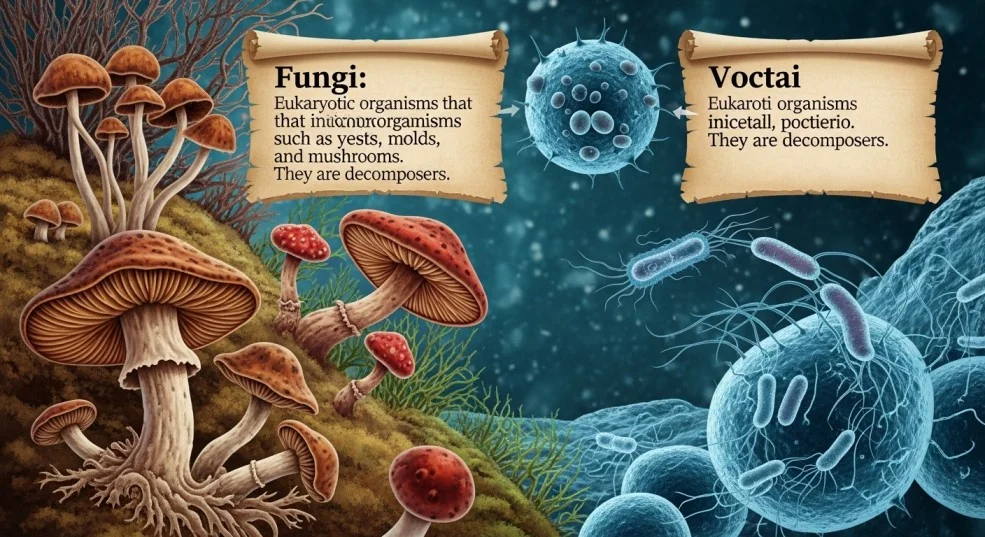
Have you ever seen mold growing on old bread or wondered why yogurt is thick and sour? These are real-life examples of fungi and bacteria in action. Fungi are organisms like mushrooms, yeast, and molds, while bacteria are tiny microbes that can be found everywhere – in soil, water, and even in our bodies.
Understanding the difference between fungi and bacteria is important because both affect our health, environment, and food. Many learners and experts often confuse them because they are both microscopic and can grow in similar places.
By learning their differences, you can better appreciate their roles in nature, medicine, and daily life.
Pronunciation:
- Fungi – US: /ˈfʌn.dʒaɪ/, UK: /ˈfʌŋ.ɡaɪ/
- Bacteria – US & UK: /bækˈtɪə.ri.ə/
Now, let’s explore the main differences and unique roles of fungi and bacteria.
10 Differences Between Fungi and Bacteria
1. Cell Type
- Fungi: Eukaryotic cells (have nucleus and organelles).
🔴 Example 1: Yeast cells have a nucleus and can reproduce sexually.
🔴 Example 2: Mushrooms grow complex structures with organized cells. - Bacteria: Prokaryotic cells (no nucleus, simple structure).
🟣 Example 1: E. coli bacteria live in the intestines and are simple cells.
🟣 Example 2: Streptococcus causes throat infection without a nucleus.
2. Size
- Fungi: Usually larger than bacteria.
🔴 Example 1: A mushroom cap can be seen easily.
🔴 Example 2: Mold strands on bread are visible to the naked eye. - Bacteria: Very small, mostly microscopic.
🟣 Example 1: Salmonella can only be seen under a microscope.
🟣 Example 2: Lactobacillus in yogurt is tiny and invisible without tools.
3. Reproduction
- Fungi: Can reproduce sexually and asexually through spores.
🔴 Example 1: Mushrooms release spores into the air.
🔴 Example 2: Yeast multiplies through budding. - Bacteria: Reproduce asexually by binary fission.
🟣 Example 1: E. coli divides rapidly in water.
🟣 Example 2: Streptococcus multiplies quickly in the throat.
4. Cell Wall Composition
- Fungi: Made of chitin.
🔴 Example 1: Fungal mold walls contain chitin for strength.
🔴 Example 2: Mushroom stems have chitin in cell walls. - Bacteria: Made of peptidoglycan.
🟣 Example 1: E. coli has peptidoglycan walls.
🟣 Example 2: Bacillus anthracis wall is made of peptidoglycan.
5. Nutrition Type
- Fungi: Mostly saprophytic (feed on dead matter).
🔴 Example 1: Mold feeds on old bread.
🔴 Example 2: Mushrooms get nutrients from decaying leaves. - Bacteria: Can be autotrophic or heterotrophic.
🟣 Example 1: Cyanobacteria make food from sunlight.
🟣 Example 2: E. coli gets nutrients from the gut.
6. Habitat
- Fungi: Prefer warm, damp, and dark places.
🔴 Example 1: Bread mold grows in humid kitchens.
🔴 Example 2: Mushrooms grow in moist forests. - Bacteria: Can live almost anywhere, including extreme conditions.
🟣 Example 1: Thermophilic bacteria survive in hot springs.
🟣 Example 2: Soil bacteria thrive in dry fields.
7. Movement
- Fungi: Generally non-motile (don’t move).
🔴 Example 1: Mushroom stays in one spot.
🔴 Example 2: Yeast grows but does not move. - Bacteria: Some are motile with flagella.
🟣 Example 1: E. coli swims using flagella.
🟣 Example 2: Salmonella moves in water to find nutrients.
8. Role in Disease
- Fungi: Cause infections like athlete’s foot and ringworm.
🔴 Example 1: Candida causes oral infections.
🔴 Example 2: Aspergillus affects lungs in weak patients. - Bacteria: Cause infections like tuberculosis and strep throat.
🟣 Example 1: Streptococcus causes sore throat.
🟣 Example 2: Mycobacterium tuberculosis infects lungs.
9. Beneficial Uses
- Fungi: Used in food, medicine, and fermentation.
🔴 Example 1: Yeast helps in baking bread.
🔴 Example 2: Penicillium produces antibiotics. - Bacteria: Used in food, medicine, and biotechnology.
🟣 Example 1: Lactobacillus makes yogurt.
🟣 Example 2: Bacteria help in waste treatment.
10. Structure Complexity
- Fungi: Multicellular (except yeast), complex.
🔴 Example 1: Mushroom has stem, cap, and gills.
🔴 Example 2: Molds have hyphae networks. - Bacteria: Unicellular, simple.
🟣 Example 1: Streptococcus is a chain of single cells.
🟣 Example 2: Bacillus is a single rod-shaped cell.
Nature and Behaviour of Fungi
Fungi grow slowly, prefer dark and moist places, and decompose dead material. They are mostly harmless but some can be pathogenic.
Nature and Behaviour of Bacteria
Bacteria multiply rapidly, adapt to almost all environments, and can be both helpful and harmful.
Why Are People Confused About Their Use?
People often confuse fungi and bacteria because both are tiny, can grow on food, and sometimes cause diseases. However, understanding their structure, habitat, and reproduction clears the confusion.
Difference and Similarity Table
| Feature | Fungi | Bacteria | Similarity |
| Cell Type | Eukaryotic | Prokaryotic | Both are microorganisms |
| Size | Larger | Smaller | Both can be microscopic |
| Reproduction | Sexual & asexual | Asexual (binary fission) | Both reproduce |
| Cell Wall | Chitin | Peptidoglycan | Both have cell walls |
| Nutrition | Saprophytic | Auto/Heterotrophic | Both need nutrients |
| Habitat | Warm & damp | Anywhere | Both live on surfaces |
| Movement | Non-motile | Some motile | Both spread in nature |
| Disease | Fungal infections | Bacterial infections | Both can affect humans |
| Benefits | Food & medicine | Food & biotech | Both are useful to humans |
| Complexity | Multicellular | Unicellular | Both are alive |
Which Is Better in What Situation?
Fungi are better for fermentation, decomposing organic matter, and antibiotic production. Bacteria are better for food production (like yogurt), nitrogen fixation, and biotechnology. Both are essential, but their usefulness depends on the purpose and environment.
How Are Fungi and Bacteria Used in Metaphors and Similes?
🟣 Fungi: “Growing like a mushroom” – something appearing quickly.
🟣 Bacteria: “Spreading like bacteria” – something multiplying fast.
Connotative Meaning:
🟣 Fungi – neutral to positive (used in food, medicine), negative in disease context.
🟣 Bacteria – neutral to negative (helpful in digestion, harmful in infections).
Idioms/Proverbs:
🟣 “Mold grows in dark corners” – secrets or issues grow unnoticed.
🟣 “Bacteria of doubt” – small doubts can spread quickly.
Works in Literature:
🟣 “The Mushroom” – short story, John Doe, 1952.
🟣 “Microbes: Invisible World” – science book, Jane Smith, 2010.
Movies on Keywords:
🟣 “The Fungus Among Us” – 2015, USA
🟣 “Bacteria Wars” – 2018, UK
Frequently Asked Questions
- Are fungi and bacteria the same?
No, fungi are eukaryotic, bacteria are prokaryotic. - Which grows faster, fungi or bacteria?
Bacteria grow faster than fungi. - Can fungi be harmful?
Yes, some fungi cause infections. - Are all bacteria harmful?
No, many bacteria are beneficial, like Lactobacillus. - Where are fungi mostly found?
In damp, dark, organic matter.
How Are Both Useful for Surroundings?
Fungi decompose dead matter, recycle nutrients, and produce antibiotics. Bacteria help in soil fertility, water purification, and food production. Both maintain ecological balance.
Final Words
Fungi and bacteria may seem similar, but they are very different in structure, growth, and usefulness. Both play vital roles in life and the environment.
Conclusion
Understanding the difference between fungi and bacteria is important for students, scientists, and nature lovers. Fungi are complex, mostly multicellular organisms that decompose matter and produce medicine. Bacteria are simple, unicellular microbes that support digestion, agriculture, and industry. By learning their differences, we can prevent infections, use them in food and medicine, and appreciate their ecological roles. Knowing these tiny organisms helps in science, health, and daily life.

Hi! I am Arshad Ullah presently working as linguist in Punjab Education Department. I have done MA in English Literature while M.Phil in Applied Linguistics. I have taught creative writing to the post graduation classes for 15 years. Presently I am working as content writer, and offering classes for blog writing.