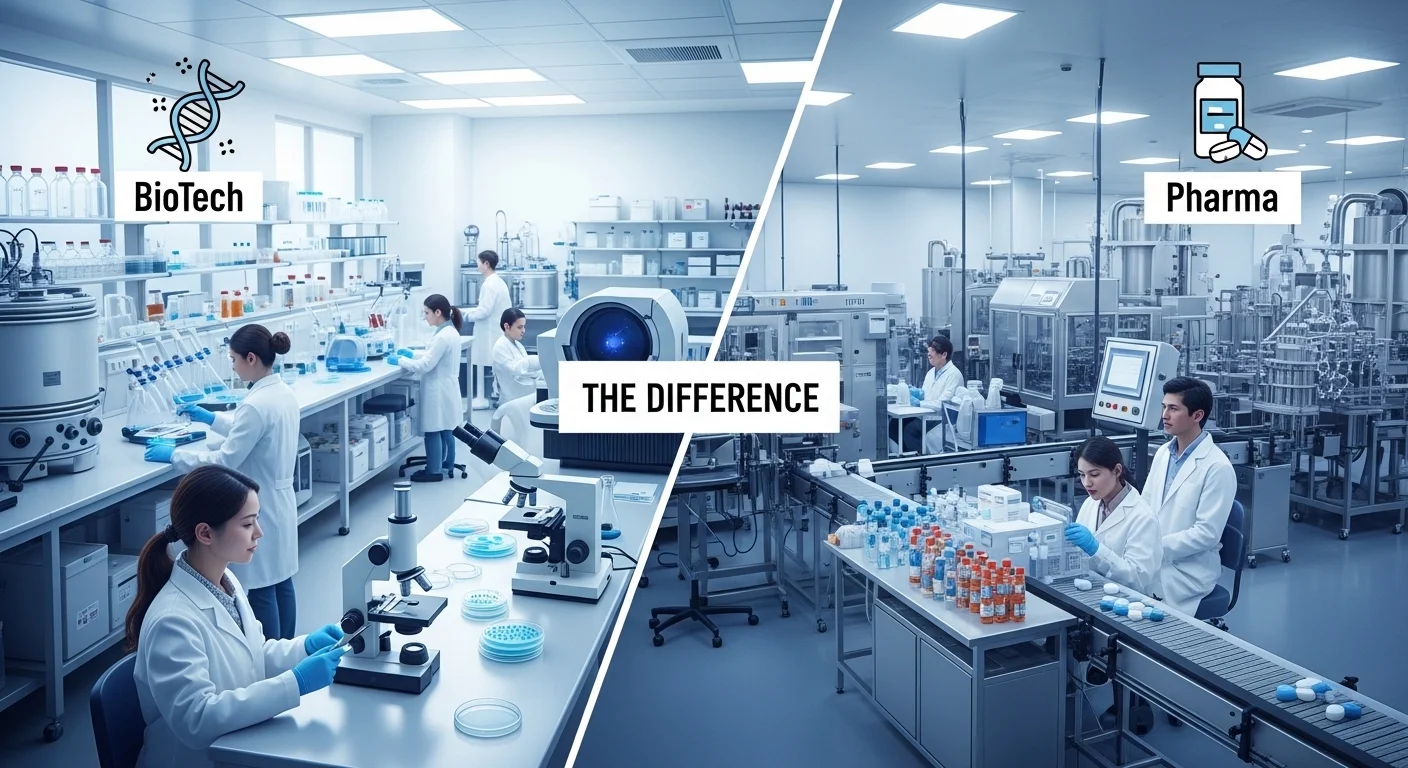
One day, a student visited a hospital laboratory during a science tour. On one side, scientists were working with living cells and genes to create new treatments. On the other side, chemists were mixing compounds to produce medicines in large batches. The guide explained that the first group worked in biotech, while the second group worked in pharma.
This simple moment shows the difference between biotech and pharma. Both fields help people stay healthy, but they work in different ways. Understanding the difference between biotech and pharma helps students, researchers, and healthcare workers choose the right career and technology.
The difference between biotech and pharma also explains how modern medicine grows and improves. When people learn their differences, they better understand how new treatments are discovered and produced for society.
Key Difference Between the Both
The main difference is simple. Biotech uses living organisms such as cells, bacteria, or DNA to develop medical products. Pharma mainly uses chemical compounds to create drugs and medicines.
Why Is Their Difference Necessary to Know for Learners and Experts?
Knowing the difference between biotech and pharma helps people understand how modern medicine works. Students can choose the right field for study. Researchers can focus on the best method for treatment. Doctors and policy makers can also decide how to invest in health technology.
In society, these two industries support medical progress, disease control, and economic growth. Biotech often leads to new discoveries like gene therapy, while pharma focuses on large-scale drug production. Understanding both fields helps communities support innovation and better healthcare.
Pronunciation of Both Words
Biotech
- US: /ˈbaɪ.oʊ.tɛk/
- UK: /ˈbaɪ.əʊ.tɛk/
Pharma
- US: /ˈfɑːr.mə/
- UK: /ˈfɑː.mə/
Before we explore deeper ideas, let us look closely at the detailed difference between biotech and pharma.
10 Differences between Biotech and Pharma
1. Source of Products
- Biotech: Uses living organisms, cells, or genes to make treatments.
🟣 Example: Insulin made from genetically modified bacteria.
🟣 Example: Gene therapy used to treat rare diseases. - Pharma: Uses chemical compounds created in laboratories.
🟣 Example: Painkiller tablets produced through chemical reactions.
🟣 Example: Antibiotic drugs synthesized in factories.
2. Research Approach
- Biotech: Research focuses on biology, genetics, and molecular science.
🟣 Example: Scientists study DNA to create targeted cancer therapy.
🟣 Example: Research on stem cells for tissue repair. - Pharma: Research focuses on chemistry and drug formulation.
🟣 Example: Chemists test chemical compounds for medicine.
🟣 Example: Researchers design new pain relief molecules.
3. Type of Medicines
- Biotech: Produces biological drugs called biologics.
🟣 Example: Monoclonal antibody treatments.
🟣 Example: Protein-based vaccines. - Pharma: Produces small-molecule chemical drugs.
🟣 Example: Aspirin tablets.
🟣 Example: Anti-allergy medicine.
4. Production Method
- Biotech: Uses living cells grown in special tanks.
🟣 Example: Cell cultures used to produce vaccines.
🟣 Example: Fermentation processes for biological drugs. - Pharma: Uses chemical synthesis in factories.
🟣 Example: Large machines produce tablets.
🟣 Example: Chemical reactors make drug ingredients.
5. Technology Used
- Biotech: Uses biotechnology tools like gene editing.
🟣 Example: CRISPR technology to modify genes.
🟣 Example: DNA sequencing in research labs. - Pharma: Uses chemical engineering and drug design tools.
🟣 Example: Chemical compound screening.
🟣 Example: Drug stability testing machines.
6. Product Complexity
- Biotech: Products are complex biological molecules.
🟣 Example: Protein-based cancer therapy.
🟣 Example: Advanced vaccines using mRNA. - Pharma: Products are usually simpler chemical structures.
🟣 Example: Fever medicines.
🟣 Example: Blood pressure tablets.
7. Development Time
- Biotech: Often takes longer due to complex research.
🟣 Example: Gene therapy trials for years.
🟣 Example: Long testing for biological vaccines. - Pharma: Development can be faster in some cases.
🟣 Example: Improving existing drugs.
🟣 Example: Reformulating known medicines.
8. Industry Focus
- Biotech: Focuses on innovation and new biological discoveries.
🟣 Example: Personalized medicine.
🟣 Example: Genetic disease treatment. - Pharma: Focuses on producing and distributing medicines widely.
🟣 Example: Mass production of antibiotics.
🟣 Example: Global supply of pain medicines.
9. Company Structure
- Biotech: Often small research-focused startups.
🟣 Example: A startup researching rare disease therapy.
🟣 Example: Small lab developing new vaccines. - Pharma: Usually large global corporations.
🟣 Example: Companies producing millions of drug tablets.
🟣 Example: Firms selling medicines worldwide.
10. Risk Level
- Biotech: Higher research risk but high innovation potential.
🟣 Example: New therapy may succeed or fail in trials.
🟣 Example: Experimental gene editing treatments. - Pharma: Lower risk with established drug models.
🟣 Example: Updating an existing medicine formula.
🟣 Example: Producing approved generic drugs.
Nature and Behaviour of Both
Biotech is innovative and experimental. It explores living systems to create new treatments. The field grows quickly with new scientific discoveries.
Pharma is structured and production-focused. It takes scientific discoveries and turns them into medicines that people can buy and use safely.
Why People Confuse Biotech and Pharma
Many people think biotech and pharma are the same because both work in healthcare and medicine. They also share research labs, scientists, and medical goals. Another reason is that many pharmaceutical companies now invest in biotechnology research. Because the industries cooperate closely, the boundaries often appear blurred.
Table Showing Difference and Similarity
| Aspect | Biotech | Pharma | Similarity |
| Main Focus | Living organisms | Chemical compounds | Both create medicines |
| Research Field | Biology and genetics | Chemistry and drug design | Both require science research |
| Product Type | Biological drugs | Chemical drugs | Both treat diseases |
| Production | Cell culture systems | Chemical manufacturing | Both use labs and factories |
| Industry Goal | Innovation | Mass production | Both improve healthcare |
Which Is Better in What Situation?
Biotech is better when scientists want to create new therapies based on biology. For example, gene therapy or advanced vaccines require biotechnology tools. Biotech is useful for complex diseases like cancer or genetic disorders.
Pharma is better when medicines need large-scale production and distribution. Pharmaceutical companies can manufacture drugs in millions of doses. This helps treat common illnesses like fever, infections, or pain quickly and affordably.
How the Words Appear in Metaphors and Similes
🟣 Biotech is like planting a seed of life to grow a cure.
🟣 Biotech research moves like a living organism that evolves with new discoveries.
🟣 Pharma works like a factory engine that produces medicine for millions.
🟣 Pharma runs like a well-organized machine delivering health solutions.
Connotative Meaning of Both Words
🟣 Biotech (positive): innovation and scientific progress.
Example: “The biotech sector brings hope for future cures.”
🟣 Pharma (neutral or positive): reliable medicine production.
Example: “Pharma companies supply essential drugs worldwide.”
🟣 Pharma (sometimes negative): used when people criticize drug prices.
Example: “Some critics say big pharma focuses too much on profit.”
Idioms or Expressions Related to the Words
🟣 “A shot in the arm” – something that boosts progress.
Example: “New biotech funding was a shot in the arm for research.”
🟣 “An ounce of prevention is worth a pound of cure.”
Example: “Pharma vaccines show that prevention saves many lives.”
Works in Literature
🟣 Biotechnology and Society — Science nonfiction, Hallam Stevens, 2016.
🟣 Biotech: The Countercultural Origins of an Industry — History/Science, Rebecca Slayton, 2008.
🟣 The Truth About the Drug Companies — Nonfiction about pharma, Marcia Angell, 2004.
Movies Related to the Themes
🟣 The Constant Gardener — 2005, UK/Germany (pharmaceutical industry themes).
🟣 Rise of the Planet of the Apes — 2011, USA (biotech experimentation).
🟣 Extraordinary Measures — 2010, USA (biotech drug development).
Frequently Asked Questions
1. What is the main difference between biotech and pharma?
Biotech uses living organisms, while pharma uses chemical compounds to create medicines.
2. Do biotech and pharma companies work together?
Yes. Many pharmaceutical companies partner with biotech startups for new discoveries.
3. Which industry is newer?
Biotech is newer and grew rapidly in the late 20th century.
4. Are vaccines biotech or pharma products?
Many modern vaccines are biotech products because they use biological processes.
5. Which field offers more innovation?
Biotech often leads in innovation, while pharma leads in manufacturing and distribution.
How Both Help Our Surroundings
Biotech and pharma both protect public health. Biotech helps discover new cures for serious diseases. Pharma ensures medicines reach hospitals, clinics, and pharmacies. Together they improve life expectancy, control epidemics, and support global healthcare systems.
Final Words for Both
Biotech represents discovery and biological innovation. Pharma represents reliable drug production and delivery. Both industries are essential partners in modern medicine.
Conclusion
Understanding the difference between biotech and pharma helps people see how modern healthcare grows. Biotech focuses on living systems and scientific discovery. Pharma focuses on producing safe medicines for large populations. Together they form a powerful partnership in medicine. Biotech brings new ideas and treatments, while pharma ensures these treatments reach people everywhere. When society supports both industries, medical progress becomes faster and more effective. For students, professionals, and everyday readers, learning the difference between biotech and pharma gives a clearer view of how science improves human life.

Hi! I am Arshad Ullah presently working as linguist in Punjab Education Department. I have done MA in English Literature while M.Phil in Applied Linguistics. I have taught creative writing to the post graduation classes for 15 years. Presently I am working as content writer, and offering classes for blog writing.