Imagine you want to paint the floor of your room and also fill a water tank in your house. For the floor, you need to know how much surface space to paint. For the tank, you must know how much water it can hold. These two ideas show the difference between area and volume.
Simply put, area measures a flat surface, while volume measures the space inside an object. Understanding the difference between area and volume helps us solve many real-world problems easily.
Key Difference Between Area and Volume
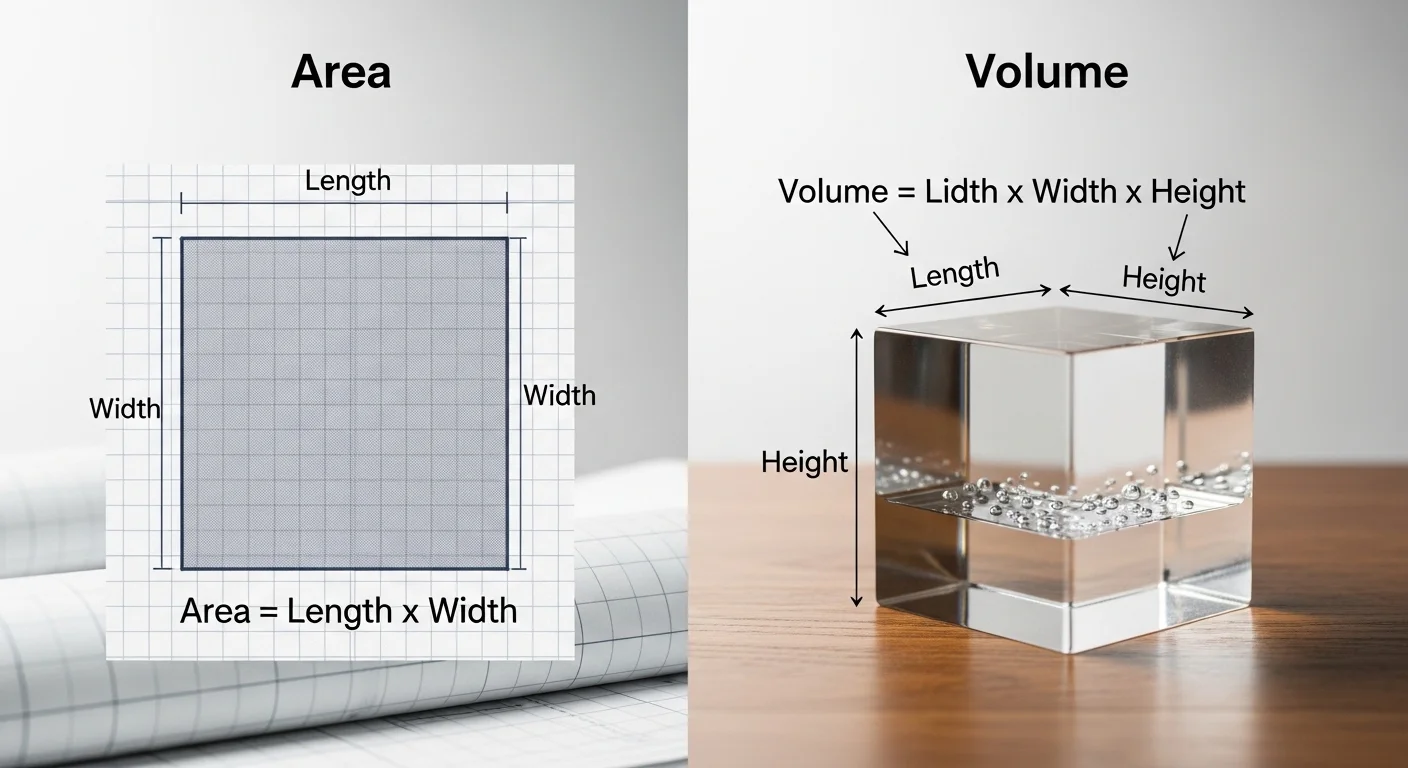
Area measures the size of a two-dimensional surface. Volume measures the three-dimensional space inside an object.
Why is Knowing Their Difference Important?
Knowing the difference between area and volume helps learners solve math problems clearly. It also helps professionals such as architects, engineers, farmers, and designers. Society uses these measurements when building homes, storing liquids, planning cities, and designing products. Without understanding this difference, people may waste materials, space, and money.
Pronunciation
- Area
- US: /ˈer.i.ə/
- UK: /ˈeə.ri.ə/
- US: /ˈer.i.ə/
- Volume
- US: /ˈvɑːl.juːm/
- UK: /ˈvɒl.juːm/
- US: /ˈvɑːl.juːm/
Before we explore details, let us move into the main part of the article to clearly see the difference between area and volume.
10 Differences Between Area and Volume
1. Dimension Measured
- Area measures two dimensions: length and width.
- Volume measures three dimensions: length, width, and height.
Examples:
Area
🔴 Example: The area of a table is calculated by multiplying length and width.
🟣 Example: A farmer measures the area of a field before planting crops.
Sentence: The area of the classroom floor is 40 square meters.
Volume
🔴 Example: The volume of a water tank shows how much water it holds.
🟣 Example: A box’s volume tells how much space is inside it.
Sentence: The tank has a volume of 500 liters.
2. Type of Space
- Area measures flat space.
- Volume measures solid space.
Examples:
Area
🔴 Example: The area of a wall helps us know how much paint we need.
🟣 Example: The area of a park shows the size of land.
Sentence: The park covers a large area.
Volume
🔴 Example: A bottle’s volume shows how much juice it holds.
🟣 Example: The volume of a room tells how much air is inside.
Sentence: The container has a small volume.
3. Units Used
- Area uses square units.
- Volume uses cubic units.
Examples:
Area
🔴 Example: Square meters measure the area of a room.
🟣 Example: Square kilometers measure the area of a city.
Sentence: The floor area is 30 square meters.
Volume
🔴 Example: Cubic meters measure the volume of a building space.
🟣 Example: Liters measure the volume of liquids.
Sentence: The tank stores 200 liters of water.
4. Shape Type
- Area applies to flat shapes.
- Volume applies to solid shapes.
Examples:
Area
🔴 Example: Rectangle area is length × width.
🟣 Example: Circle area uses πr².
Sentence: The area of the square is easy to find.
Volume
🔴 Example: Cube volume is side × side × side.
🟣 Example: Cylinder volume uses πr²h.
Sentence: The cube has a volume of 27 cubic units.
5. Measurement Purpose
- Area helps cover surfaces.
- Volume helps fill containers.
Examples:
Area
🔴 Example: Carpet size depends on the room’s area.
🟣 Example: Paint needed depends on wall area.
Sentence: We measured the area before buying tiles.
Volume
🔴 Example: Water storage depends on tank volume.
🟣 Example: Fuel tanks use volume measurement.
Sentence: The tank volume is enough for the farm.
6. Visual Form
- Area looks flat.
- Volume looks solid.
Examples:
Area
🔴 Example: Paper shows area but not depth.
🟣 Example: A map shows the area of land.
Sentence: The map shows the country’s area.
Volume
🔴 Example: A cube shows volume.
🟣 Example: A ball has measurable volume.
Sentence: The ball has a large volume.
7. Mathematical Formulas
- Area formulas depend on 2D shapes.
- Volume formulas depend on 3D shapes.
Examples:
Area
🔴 Example: Triangle area = ½ × base × height.
🟣 Example: Square area = side × side.
Sentence: Students calculated the triangle area.
Volume
🔴 Example: Sphere volume uses 4/3 πr³.
🟣 Example: Prism volume uses base area × height.
Sentence: The sphere has a large volume.
8. Real-Life Usage
- Area helps in land measurement.
- Volume helps in storage measurement.
Examples:
Area
🔴 Example: Land area helps farmers plan crops.
🟣 Example: Builders measure floor area.
Sentence: The land area is 2 acres.
Volume
🔴 Example: Warehouses measure storage volume.
🟣 Example: Ships measure cargo volume.
Sentence: The cargo volume is huge.
9. Dimension Count
- Area has two directions.
- Volume has three directions.
Examples:
Area
🔴 Example: Length and width of a mat.
🟣 Example: Size of a poster.
Sentence: The poster area is large.
Volume
🔴 Example: Length, width, and height of a box.
🟣 Example: Size of a storage container.
Sentence: The box volume fits many items.
10. Depth Inclusion
- Area does not include depth.
- Volume includes depth.
Examples:
Area
🔴 Example: A sheet of paper has area only.
🟣 Example: A drawing shows area but no depth.
Sentence: The drawing shows the area clearly.
Volume
🔴 Example: A bucket has depth and volume.
🟣 Example: A jar has space inside.
Sentence: The jar’s volume holds water.
Nature and Behaviour of Area and Volume
Area describes the spread of a surface. It stays flat and does not include height or depth. It helps compare surfaces like land, floors, or walls.
Volume describes how much space something contains. It includes depth and height. It is useful for containers, rooms, and objects that hold materials.
Why People Confuse Area and Volume
Many learners mix them because both measure space. The words also appear in the same math lessons. However, the main reason is that both use length measurements. The difference appears when depth is added. Area stays two-dimensional, while volume becomes three-dimensional.
Difference and Similarity Table
| Feature | Area | Volume | Similarity |
| Dimension | 2D | 3D | Both measure space |
| Units | Square units | Cubic units | Both use length units |
| Shape Type | Flat shapes | Solid shapes | Both use formulas |
| Example | Floor space | Water tank space | Both used in math |
| Purpose | Cover surfaces | Fill containers | Both help real life planning |
Which Is Better in What Situation?
Area is better when measuring surfaces. For example, it helps when buying paint, tiles, or carpets. Architects also use area to plan rooms and land spaces. It is best for flat measurements.
Volume is better when measuring capacity. It helps when filling tanks, storing goods, or packing boxes. Engineers and builders use it to design containers and buildings.
Use of Area and Volume in Metaphors and Similes
🟣 “Her ideas covered a wide area of knowledge.”
🟣 “The speaker’s voice filled the room like great volume.”
🟣 “His influence spread across the area like sunlight.”
🟣 “The crowd noise rose in volume like a storm.”
Connotative Meaning
Area
- Neutral meaning: space or region.
Example: The area around the lake is peaceful.
Volume
- Neutral meaning: amount or capacity.
Example: The library has a large volume of books.
Idioms or Proverbs
🟣 “Turn up the volume.”
Example: Please turn up the volume so everyone can hear.
🟣 “A volume of knowledge.”
Example: The teacher shared a volume of knowledge with the class.
Works in Literature
🟣 The Area of Darkness — Travel writing by V. S. Naipaul, 1964
🟣 Selected Poems, Volume One — Poetry collection by Seamus Heaney, 1990
Movies Related to the Words
🟣 Area 51 — 2015, United States (science fiction)
🟣 Loud Volume — 2019, United States (music documentary)
Frequently Asked Questions
1. What is the basic difference between area and volume?
Area measures surface space. Volume measures space inside an object.
2. Which units measure area?
Square units such as square meters or square feet.
3. Which units measure volume?
Cubic units like cubic meters or liters.
4. Can a flat object have volume?
No. Flat objects only have area.
5. Why do students learn both concepts?
Because they help measure surfaces and capacity in daily life.
How are Both Useful for Surroundings?
Area helps people plan land, parks, buildings, and farms. It helps measure surfaces for painting, flooring, and gardening.
Volume helps manage storage and resources. It helps measure water tanks, containers, warehouses, and rooms. Together, they support construction, farming, design, and daily living.
Final Words for Area and Volume
Area and volume are basic but powerful math ideas. They help us understand space around us. When we know the difference, we can measure surfaces and storage correctly.
Conclusion
The difference between area and volume is simple but very important. Area measures flat surfaces, while volume measures the space inside objects. Both concepts help people in daily life, from painting walls to storing water. Students learn them early in math because they build strong measurement skills. Professionals also rely on them for planning, building, and designing. When we understand the difference between area and volume, we can solve practical problems more easily and use resources wisely.

Hi! I am Arshad Ullah presently working as linguist in Punjab Education Department. I have done MA in English Literature while M.Phil in Applied Linguistics. I have taught creative writing to the post graduation classes for 15 years. Presently I am working as content writer, and offering classes for blog writing.