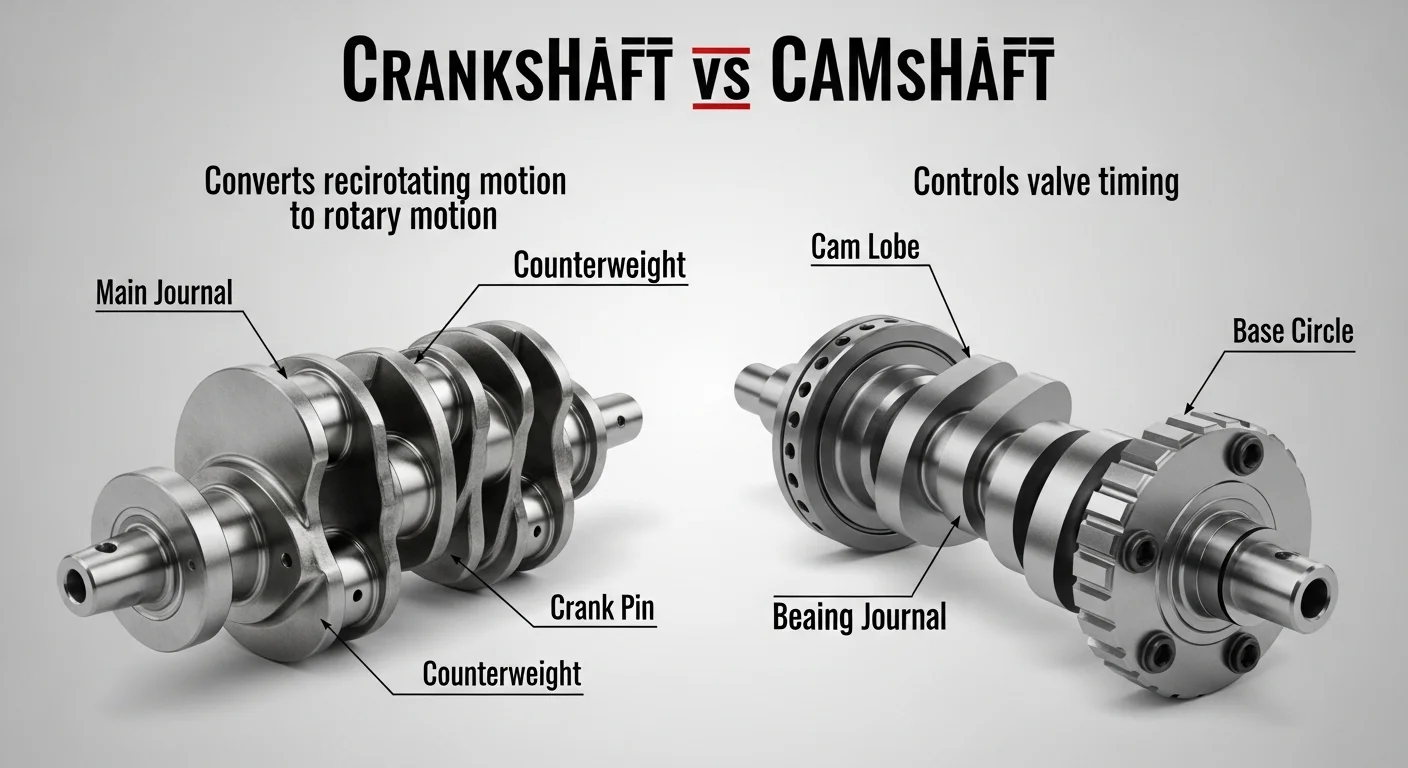
Last year, a young mechanic opened a car engine for the first time. He saw two long metal shafts inside. One moved the pistons. The other controlled the valves. His teacher smiled and said, “To understand engines, you must know the difference between crankshaft and camshaft.”
A crankshaft converts up-and-down motion into rotation. A camshaft controls the opening and closing of engine valves. The difference between crankshaft and camshaft is the heart of engine timing.
Without knowing the difference between crankshaft and camshaft, a learner cannot fully understand how cars run. Even experts must clearly grasp their difference to repair and design engines safely.
Key Difference Between the Both
The crankshaft changes piston motion into rotational power.
The camshaft controls valve timing for air and fuel flow.
One produces motion.
The other controls breathing of the engine.
Why Is Their Difference Necessary to Know for Learners and Experts?
Understanding this difference is vital in mechanical engineering and the automobile industry.
- Mechanics must repair engines correctly.
- Engineers must design efficient engines.
- Students must pass technical exams.
- Society depends on vehicles for transport, trade, and emergency services.
If these parts fail, cars stop. Ambulances stop. Delivery trucks stop. Knowing their difference keeps machines and society moving.
Pronunciation (US & UK)
Crankshaft
- US: /ˈkræŋkˌʃæft/
- UK: /ˈkræŋkʃɑːft/
Camshaft
- US: /ˈkæmˌʃæft/
- UK: /ˈkæmʃɑːft/
Now let us explore the detailed comparison to clearly understand their roles inside an engine.
A List of 10 Differences Between Crankshaft and Camshaft
1. Main Function
Crankshaft converts linear motion into rotation.
Example 1: Pistons move up and down, crankshaft rotates.
Example 2: It sends power to the gearbox.
Camshaft controls valve timing.
Example 1: Opens intake valve.
Example 2: Closes exhaust valve.
2. Location in Engine
Crankshaft is at the bottom of the engine block.
Example 1: Connected to pistons.
Example 2: Linked to flywheel.
Camshaft is at the top of the engine head.
Example 1: Above cylinders.
Example 2: Near valve springs.
3. Movement Type
Crankshaft rotates continuously.
Example 1: Rotates with every piston stroke.
Example 2: Drives wheels through transmission.
Camshaft rotates at half speed (in four-stroke engines).
Example 1: Opens valves once every two rotations.
Example 2: Maintains engine timing.
4. Shape and Design
Crankshaft has offset journals.
Example 1: Bent shape.
Example 2: Counterweights attached.
Camshaft has egg-shaped lobes.
Example 1: Lobe pushes valve open.
Example 2: Smooth area closes valve.
5. Connection
Crankshaft connects to pistons using connecting rods.
Example 1: Moves during combustion.
Example 2: Transfers energy.
Camshaft connects to valves using rocker arms.
Example 1: Pushes valves down.
Example 2: Releases spring tension.
6. Role in Power Generation
Crankshaft produces engine power output.
Example 1: Transfers torque to wheels.
Example 2: Rotates alternator.
Camshaft controls airflow but does not create power directly.
Example 1: Controls fuel entry.
Example 2: Controls exhaust exit.
7. Speed Ratio
Crankshaft rotates faster.
Example 1: Two turns per cycle.
Example 2: High RPM rotation.
Camshaft rotates slower.
Example 1: One turn per cycle.
Example 2: Half crankshaft speed.
8. Maintenance Needs
Crankshaft needs strong lubrication.
Example 1: Oil prevents wear.
Example 2: Bearing inspection required.
Camshaft also needs lubrication.
Example 1: Prevents lobe damage.
Example 2: Protects timing mechanism.
9. Failure Impact
Crankshaft failure stops engine power.
Example 1: Broken shaft causes engine seizure.
Example 2: Car cannot move.
Camshaft failure affects timing.
Example 1: Misfiring engine.
Example 2: Poor fuel efficiency.
10. Material Strength
Crankshaft is very strong and heavy.
Example 1: Made from forged steel.
Example 2: Handles high pressure.
Camshaft is lighter but strong.
Example 1: Hardened steel lobes.
Example 2: Designed for precision.
Nature and Behaviour of Both
The crankshaft behaves like the engine’s backbone. It is strong, stable, and power-focused.
The camshaft behaves like the engine’s brain for timing. It is precise, controlled, and rhythmic.
Why Are People Confused About Their Use?
Both names sound similar. Both are shafts inside engines. Many beginners think they do the same job. The shared word “shaft” creates confusion. But their functions are very different.
Table: Difference and Similarity Between Crankshaft and Camshaft
| Feature | Crankshaft | Camshaft | Similarity |
| Function | Converts motion to rotation | Controls valve timing | Both rotate |
| Location | Engine bottom | Engine top | Inside engine |
| Speed | Faster | Half speed | Connected by timing belt/chain |
| Shape | Offset journals | Lobed shaft | Metal components |
| Role | Power output | Airflow control | Essential for engine work |
Which Is Better in What Situation?
The crankshaft is better when power transfer is the focus. It is the main source of rotational force. Without it, vehicles cannot move. It is essential for heavy-duty engines and performance cars.
The camshaft is better when valve timing and fuel efficiency matter most. Modern engines use advanced camshaft designs to improve performance and reduce pollution. It ensures smooth airflow and balanced combustion.
Both are essential. One cannot replace the other.
How Are the Keywords Used in Metaphors and Similes?
Crankshaft is often compared to “the backbone of a system.”
Example: “He was the crankshaft of the company, driving all progress.”
Camshaft is compared to “a conductor of timing.”
Example: “She managed the team like a camshaft, opening and closing tasks at the right time.”
Connotative Meaning
Crankshaft
- Positive: Strength, power
- Example: “He stood firm like a crankshaft.”
- Example: “He stood firm like a crankshaft.”
- Neutral: Mechanical part
- Negative: Heavy, complex
Camshaft
- Positive: Precision, control
- Example: “Her planning was like a camshaft—perfect timing.”
- Example: “Her planning was like a camshaft—perfect timing.”
- Neutral: Engine component
- Negative: Delicate timing issues
Idioms or Proverbs Related to the Words
There are no direct idioms, but related mechanical expressions exist:
- “Backbone of the system”
- Example: “The crankshaft is the backbone of the engine.”
- Example: “The crankshaft is the backbone of the engine.”
- “In sync”
- Example: “The camshaft and crankshaft must work in sync.”
- Example: “The camshaft and crankshaft must work in sync.”
Works in Literature Mentioning Crankshaft or Camshaft
- Zen and the Art of Motorcycle Maintenance — Philosophical novel, Robert M. Pirsig, 1974
- The Machine Stops — Science fiction, E. M. Forster, 1909
Movies Related to Engines and Mechanical Themes
- Ford v Ferrari — 2019, USA
- Rush — 2013, UK/Germany/USA
- Cars — 2006, USA
Five Frequently Asked Questions
1. Do crankshaft and camshaft touch each other?
No. They are connected by a timing belt or chain.
2. Which rotates faster?
The crankshaft rotates faster.
3. Can an engine run without a camshaft?
No. Valve timing will fail.
4. Why must they be synchronized?
To ensure correct combustion timing.
5. Which is more expensive to repair?
Usually the crankshaft due to its size and labor cost.
How Are Both Useful for Surroundings?
They power cars, buses, trucks, and tractors. They support farming, trade, and emergency services. They help industries run machines. Without them, modern transport would stop.
Final Words for the Both
The crankshaft drives power.
The camshaft controls timing.
Together, they create smooth engine performance.
Conclusion
The difference between crankshaft and camshaft is central to engine science. The crankshaft converts piston motion into rotating power. The camshaft controls valve timing and airflow. Though their names sound similar, their functions are different but connected. Both must work in perfect harmony. Understanding their difference helps learners, mechanics, and engineers design safer and more efficient vehicles. In simple words, one gives power, and the other gives timing. Together, they keep the engine alive.

Hi! I am Arshad Ullah presently working as linguist in Punjab Education Department. I have done MA in English Literature while M.Phil in Applied Linguistics. I have taught creative writing to the post graduation classes for 15 years. Presently I am working as content writer, and offering classes for blog writing.