Think about making a cup of tea at home. You add sugar, tea leaves, and milk. These things mix, but they do not become one new thing forever. Now think about salt. It is made from sodium and chlorine, but you cannot see them separately. This simple story helps us understand the difference between compounds and mixtures.
Key Difference Between the Both
Definition/meaning of Compounds
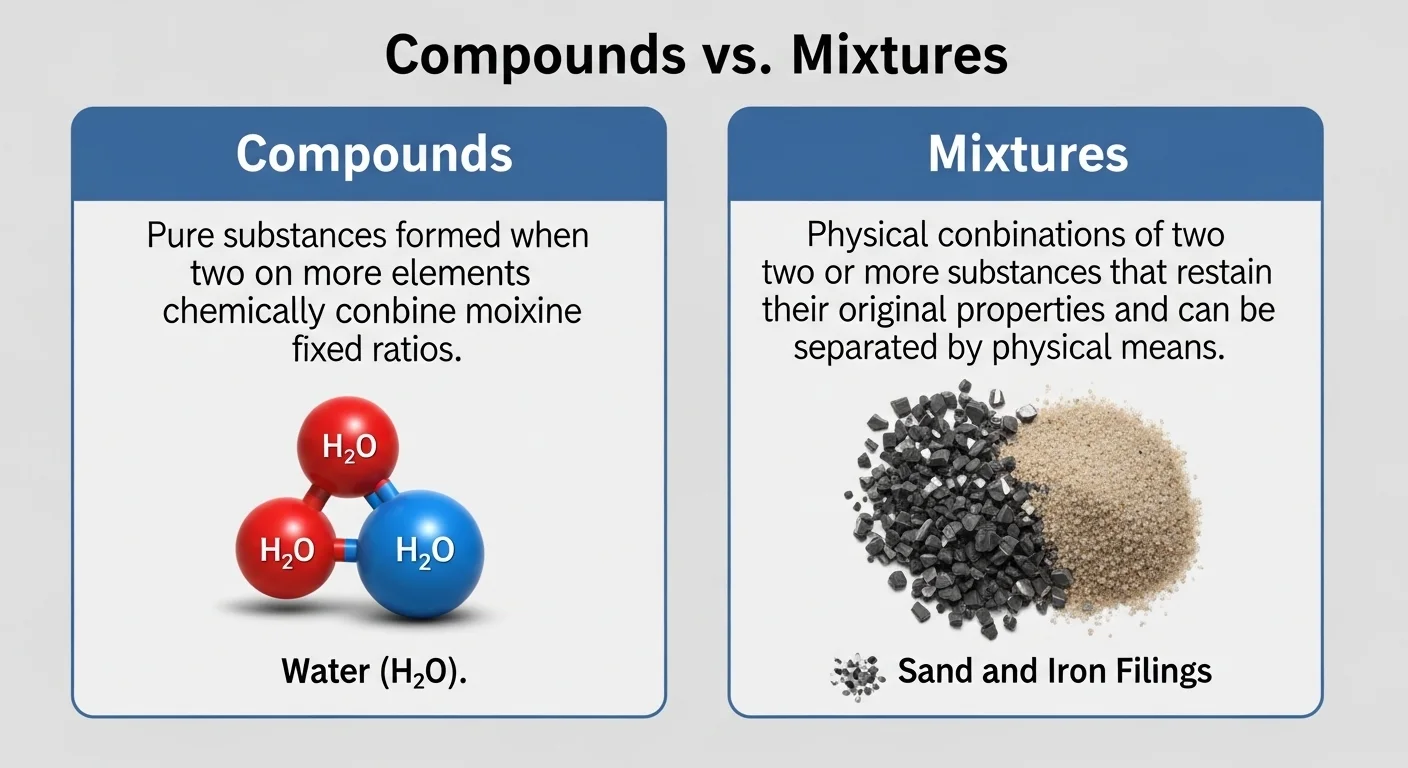
Compounds are pure substances formed by chemical bonds.
Definition/meaning of Mixtures
Mixtures are simple combinations of substances without chemical bonding.
Why Is Their Difference Necessary to Know?
Knowing this difference helps students understand basic science. Experts use it in medicine, food making, and engineering. It helps us choose the right material for the right job. For example, medicines are compounds, while air is a mixture. This knowledge keeps society safe and advanced.
Pronunciation
- Compounds
- US: /ˈkɑːm.paʊndz/
- UK: /ˈkɒm.paʊndz/
- Mixtures
- US: /ˈmɪks.tʃɚz/
- UK: /ˈmɪks.tʃəz/
Now, let’s move forward to see the clear and simple differences.
10 Differences Between Compounds and Mixtures
1. Formation
- Compounds: Formed by chemical reactions.
- 🔴 Example: Water (H₂O)
- 🔴 Example: Carbon dioxide (CO₂)
- Sentence: Water is a compound made by hydrogen and oxygen.
- Mixtures: Formed by mixing substances physically.
- 🟣 Example: Salt in water
- 🟣 Example: Sand and iron
- Sentence: Salt water is a simple mixture.
2. Composition
- Compounds: Fixed ratio of elements.
- 🔴 Example: Water always has 2:1 ratio
- 🔴 Example: NaCl always same ratio
- Sentence: Compounds have fixed composition.
- Mixtures: Variable ratio.
- 🟣 Example: More sugar in tea
- 🟣 Example: Less salt in soup
- Sentence: Mixtures can change their ratio.
3. Properties
- Compounds: New properties.
- 🔴 Example: Sodium + chlorine → salt
- 🔴 Example: Hydrogen + oxygen → water
- Sentence: Compounds show new behavior.
- Mixtures: Keep original properties.
- 🟣 Example: Sand and salt stay same
- 🟣 Example: Fruit salad items stay same
- Sentence: Mixtures keep original traits.
4. Separation
- Compounds: Need chemical methods.
- 🔴 Example: Electrolysis of water
- 🔴 Example: Breaking salt chemically
- Sentence: Compounds are hard to separate.
- Mixtures: Easy physical methods.
- 🟣 Example: Filtration
- 🟣 Example: Evaporation
- Sentence: Mixtures are easy to separate.
5. Uniformity
- Compounds: Always uniform.
- 🔴 Example: Pure water
- 🔴 Example: Pure sugar
- Sentence: Compounds look same everywhere.
- Mixtures: Can be uniform or not.
- 🟣 Example: Air (uniform)
- 🟣 Example: Salad (non-uniform)
- Sentence: Mixtures may look different.
6. Energy Change
- Compounds: Energy is used or released.
- 🔴 Example: Burning hydrogen
- 🔴 Example: Chemical reactions
- Sentence: Compounds need energy change.
- Mixtures: No energy change.
- 🟣 Example: Mixing sand and water
- 🟣 Example: Mixing sugar in tea
- Sentence: Mixtures do not need energy.
7. Identity
- Compounds: Lose original identity.
- 🔴 Example: Hydrogen not seen in water
- 🔴 Example: Sodium not seen in salt
- Sentence: Compounds form new identity.
- Mixtures: Keep identity.
- 🟣 Example: Nuts in mix
- 🟣 Example: Fruits in bowl
- Sentence: Mixtures keep original identity.
8. Melting and Boiling Points
- Compounds: Fixed points.
- 🔴 Example: Water boils at 100°C
- 🔴 Example: Ice melts at 0°C
- Sentence: Compounds have fixed points.
- Mixtures: No fixed points.
- 🟣 Example: Oil mixture
- 🟣 Example: Alloy metals
- Sentence: Mixtures change temperature points.
9. Chemical Formula
- Compounds: Have formula.
- 🔴 Example: H₂O
- 🔴 Example: CO₂
- Sentence: Compounds have formulas.
- Mixtures: No formula.
- 🟣 Example: Air
- 🟣 Example: Soil
- Sentence: Mixtures have no formula.
10. Types
- Compounds: Only one type.
- 🔴 Example: Organic
- 🔴 Example: Inorganic
- Sentence: Compounds are pure types.
- Mixtures: Many types.
- 🟣 Example: Homogeneous
- 🟣 Example: Heterogeneous
- Sentence: Mixtures have many forms.
Nature and Behaviour
Compounds are stable and fixed. They behave in a defined way.
Mixtures are flexible. They change easily and behave based on their parts.
Why People Get Confused About Their Use
People think both are the same because both involve more than one substance. Also, mixtures can look uniform like compounds. This makes it hard to tell the difference without deeper knowledge.
Table: Difference and Similarity
| Feature | Compounds | Mixtures |
| Formation | Chemical | Physical |
| Ratio | Fixed | Variable |
| Separation | Chemical | Physical |
| Properties | New | Original |
| Formula | Yes | No |
| Similarity | Both contain more than one substance | Both contain more than one substance |
Which Is Better in What Situation?
Compounds are better when we need purity and fixed results. For example, medicines must be compounds. They must work the same every time. This makes them safe and reliable.
Mixtures are better for daily use. Food, air, and drinks are mixtures. They are easy to make and adjust. This makes them flexible for everyday life.
How Are the Keywords Used in Metaphors and Similes?
🟣 Life is a mixture of joy and sorrow.
🟣 Love is a strong compound that binds hearts.
🟣 A team is like a mixture of talents.
Connotative Meaning
- Compounds: Neutral, sometimes positive (strong bond)
- Example: Their friendship is a compound of trust.
- Mixtures: Neutral, sometimes positive or negative
- Example: His ideas are a mixture of good and bad.
Idioms and Proverbs
🟣 “A mixed bag” – something with many types
Example: The results were a mixed bag.
🟣 “Compound interest grows fast”
Example: Hard work gives compound rewards.
Works in Literature
🟣 “The Periodic Table” – Primo Levi (Memoir, 1975)
🟣 “Uncle Tungsten” – Oliver Sacks (Memoir, 2001)
Movies Related to Keywords
🟣 “Chemical Hearts” (2020, USA)
🟣 “Flubber” (1997, USA)
FAQs
1. What is the main difference?
Compounds are chemically combined, mixtures are physically combined.
2. Can mixtures become compounds?
Yes, through chemical reactions.
3. Is air a compound?
No, it is a mixture.
4. Why are compounds pure?
Because they have fixed composition.
5. Are all mixtures visible?
No, some look uniform like air.
How Are Both Useful for Surroundings?
Compounds help in making medicines, fuels, and materials. They improve health and technology.
Mixtures help in daily life like food, air, and soil. They support life and environment.
Final Words for the Both
Compounds bring stability and precision.
Mixtures bring flexibility and variety.
Conclusion
The difference between compounds and mixtures is simple but very useful. Compounds are fixed and strong, while mixtures are flexible and easy to change. Both play a big role in science and daily life. From the air we breathe to the food we eat, we see mixtures everywhere. At the same time, compounds help us in medicine and industry. Understanding this topic helps learners and experts make better decisions. In short, both are important, but they work in different ways to support life and progress.

Hi! I am Arshad Ullah presently working as linguist in Punjab Education Department. I have done MA in English Literature while M.Phil in Applied Linguistics. I have taught creative writing to the post graduation classes for 15 years. Presently I am working as content writer, and offering classes for blog writing.