A few years ago, a health coach shared a simple story in a wellness workshop. She showed two green powders. One was made from tiny algae, and the other was a plant pigment. Many people thought they were the same. But they were not. One was chlorella, a living micro-algae used as a food supplement. The other was chlorophyll, the green pigment that helps plants make energy from sunlight.
This small moment shows why the difference between chlorella and chlorophyll matters. Many people buy green supplements without knowing what they contain. Some think chlorella and chlorophyll work in the same way. In truth, they have different roles in nature and in nutrition.
When we clearly see the difference between chlorella and chlorophyll, we can choose the right supplement and also understand plant science better.
Key Difference Between the Both
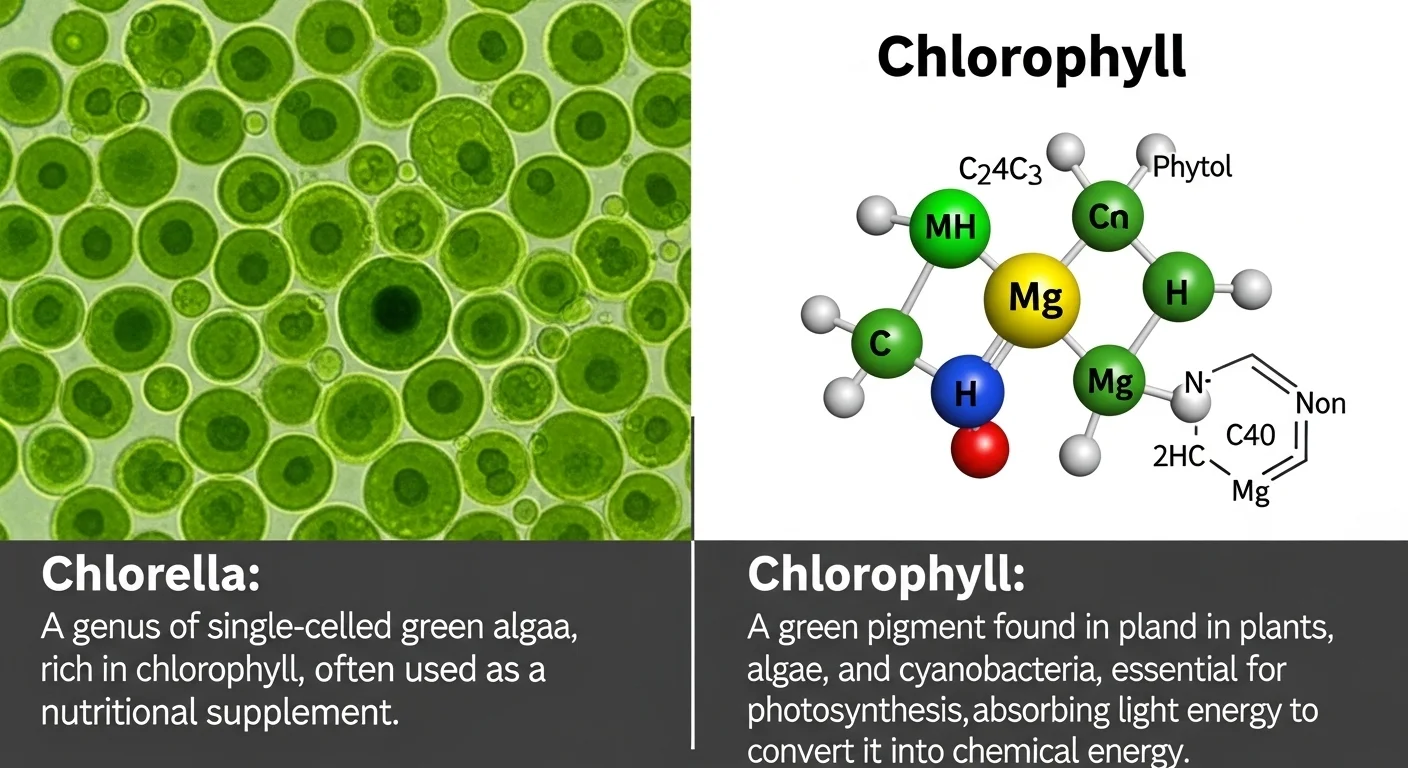
The main difference between chlorella and chlorophyll is simple. Chlorella is a single-cell green algae. It is a whole living organism. Chlorophyll is only a green pigment found inside plants and algae. It helps capture sunlight for energy.
Why Their Difference Is Important for Learners and Experts
Knowing the difference between chlorella and chlorophyll is important in science, nutrition, and environmental studies. Students learn how plants make food through photosynthesis. Health experts explain why some supplements contain whole algae while others contain only plant pigment. Society also benefits because this knowledge helps people make safe nutrition choices and understand nature better.
Pronunciation
Chlorella
- US: kluh-REL-uh
- UK: kluh-REL-uh
Chlorophyll
- US: KLOR-uh-fil
- UK: KLOR-uh-fil
Before exploring deeper science, let us look closely at the difference between chlorella and chlorophyll step by step.
10 Differences Between Chlorella and Chlorophyll
1. Nature
- Chlorella is a living organism. It is a type of micro-algae.
🔴 Example (Chlorella): Chlorella grows in freshwater ponds.
🟣 Example sentence: “The farmer grows chlorella in tanks for food supplements.”
- Chlorophyll is a chemical pigment found in plants.
🔴 Example (Chlorophyll): Leaves contain chlorophyll.
🟣 Example sentence: “The leaf looks green because of chlorophyll.”
2. Structure
- Chlorella has a full cell structure with nucleus and nutrients.
🔴 Example: Chlorella cells contain protein and vitamins.
🟣 Sentence: “Scientists study chlorella under a microscope.”
- Chlorophyll is only a molecule inside plant cells.
🔴 Example: Chlorophyll sits in chloroplasts.
🟣 Sentence: “The plant uses chlorophyll to absorb light.”
3. Function
- Chlorella acts as food for humans and animals.
🔴 Example: Some people take chlorella tablets.
🟣 Sentence: “She drinks chlorella powder in a smoothie.”
- Chlorophyll helps plants perform photosynthesis.
🔴 Example: Chlorophyll absorbs sunlight.
🟣 Sentence: “Without chlorophyll, plants cannot make food.”
4. Source
- Chlorella comes from freshwater algae farms.
🔴 Example: It grows in controlled tanks.
🟣 Sentence: “The company harvests chlorella every week.”
- Chlorophyll exists naturally in plants and algae.
🔴 Example: Spinach has high chlorophyll.
🟣 Sentence: “Green vegetables are rich in chlorophyll.”
5. Nutritional Value
- Chlorella contains protein, vitamins, and minerals.
🔴 Example: It has vitamin B and iron.
🟣 Sentence: “Athletes sometimes add chlorella to their diet.”
- Chlorophyll mainly provides plant pigment benefits.
🔴 Example: It may help detox support in some supplements.
🟣 Sentence: “The drink contains liquid chlorophyll.”
6. Form in Supplements
- Chlorella appears as tablets, capsules, or powder.
🔴 Example: Green chlorella powder.
🟣 Sentence: “He buys chlorella capsules online.”
- Chlorophyll appears as liquid drops or extracts.
🔴 Example: Chlorophyll water drinks.
🟣 Sentence: “She adds chlorophyll drops to water.”
7. Biological Role
- Chlorella is an organism that performs photosynthesis.
🔴 Example: It grows using sunlight.
🟣 Sentence: “Chlorella produces oxygen like plants.”
- Chlorophyll is the pigment used during photosynthesis.
🔴 Example: It captures light energy.
🟣 Sentence: “Chlorophyll turns sunlight into plant energy.”
8. Scientific Category
- Chlorella belongs to microalgae species.
🔴 Example: Chlorella vulgaris is a known species.
🟣 Sentence: “Biologists classify chlorella as algae.”
- Chlorophyll belongs to plant pigments.
🔴 Example: Chlorophyll a and b.
🟣 Sentence: “Plants contain different types of chlorophyll.”
9. Visibility
- Chlorella can be seen as green powder or algae culture.
🔴 Example: Chlorella tanks appear dark green.
🟣 Sentence: “The lab grows chlorella in glass tubes.”
- Chlorophyll is not visible alone but gives leaves color.
🔴 Example: Green leaf pigment.
🟣 Sentence: “Autumn leaves fade when chlorophyll breaks down.”
10. Usage in Industry
- Chlorella is used in nutrition and biotechnology.
🔴 Example: Used in protein research.
🟣 Sentence: “Companies grow chlorella for health products.”
- Chlorophyll is used in food coloring and science study.
🔴 Example: Natural green dye.
🟣 Sentence: “Food makers use chlorophyll for green color.”
Nature and Behaviour of Both
Chlorella behaves like a tiny plant organism. It grows fast in water with sunlight, carbon dioxide, and nutrients.
Chlorophyll behaves like a pigment molecule. It absorbs light energy and helps convert it into chemical energy for plants.
Why are People Confused in their Use?
Many people confuse them because both are green and related to plants. Also, health products often use the word “chlor” in both names. This makes them sound similar even though one is an organism and the other is a pigment.
Table of Difference and Similarity
| Feature | Chlorella | Chlorophyll | Similarity |
| Type | Micro-algae | Plant pigment | Both related to plants |
| Structure | Living cell | Molecule | Both are green |
| Role | Nutritional organism | Photosynthesis pigment | Both linked to plant energy |
| Use | Supplements | Food color and plant science | Both used in health products |
| Source | Freshwater algae | Plants and algae | Natural origin |
Which Is Better in What Situation?
Chlorella is better when someone wants a full nutritional supplement. It provides protein, vitamins, and minerals. People who want a plant-based nutrient source may choose chlorella powder or tablets.
Chlorophyll is better when the focus is plant pigment benefits or food coloring. It is often used in drinks or research about photosynthesis. It is also used in natural coloring for food products.
How do the Words Appear in Metaphors and Similes?
🟣 “Her energy was like chlorella, small but full of power.”
🟣 “The garden glowed like chlorophyll under the summer sun.”
🟣 “His idea spread like chlorella growing in fresh water.”
🟣 “The field stayed green like chlorophyll in spring.”
Connotative Meaning
Chlorella
- Positive: health, nutrition, growth
Example: “The brand markets chlorella as a symbol of natural strength.”
Chlorophyll
- Neutral to positive: nature, greenery, freshness
Example: “The drink promises the freshness of chlorophyll.”
Idioms or Proverbs Related to the Words
🟣 “Green like chlorophyll” – meaning very fresh or lively.
Example: “The park looked green like chlorophyll after rain.”
🟣 “Grow like algae” – similar idea to chlorella growth.
Example: “The startup grew like chlorella in sunlight.”
Works in Literature
🟣 “The Hidden Half of Nature” – science nonfiction by David R. Montgomery and Anne Biklé (2015) discusses microbes and plant science.
🟣 “The Emerald Planet” – science book by David Beerling (2007) exploring plant evolution and chlorophyll roles.
Movies Related to Plant Science Themes
🟣 “The Martian” (2015, USA) – shows plant growth and photosynthesis in space.
🟣 “Fantastic Fungi” (2019, USA) – explores microscopic life and ecosystems related to plant science.
Frequently Asked Questions
1. Are chlorella and chlorophyll the same?
No. Chlorella is algae, while chlorophyll is a pigment.
2. Does chlorella contain chlorophyll?
Yes. Chlorella contains chlorophyll because it performs photosynthesis.
3. Which is better as a supplement?
Chlorella is usually better because it contains many nutrients.
4. Why are both green?
Both appear green because of chlorophyll pigment.
5. Can chlorophyll exist without chlorella?
Yes. Many plants contain chlorophyll without being chlorella.
How do Both Help the Environment?
Both support the natural world. Chlorella absorbs carbon dioxide and releases oxygen in water ecosystems. This helps balance aquatic life. Chlorophyll allows plants and algae to perform photosynthesis, which produces oxygen and supports the food chain. Together they play an important role in keeping Earth’s ecosystems healthy and balanced.
Final Words for Both
Chlorella is a tiny but powerful algae with nutritional value.
Chlorophyll is the green pigment that makes plant life possible.
Both are different, yet both support life on Earth.
Conclusion
The difference between chlorella and chlorophyll is clear once we look at their roles. Chlorella is a living micro-algae used as a nutrient source. Chlorophyll is the pigment that gives plants their green color and helps them capture sunlight. Although their names sound similar, their nature and purpose are different. Understanding this difference helps students learn plant science and helps consumers choose supplements wisely. In simple words, chlorella is the organism, while chlorophyll is the pigment inside many plants and algae. Together they show how small green elements play a huge role in nature and human life.

Hi! I am Arshad Ullah presently working as linguist in Punjab Education Department. I have done MA in English Literature while M.Phil in Applied Linguistics. I have taught creative writing to the post graduation classes for 15 years. Presently I am working as content writer, and offering classes for blog writing.